What is AI Knowledge Management and Why Does It Matter?
AI Knowledge Management enables businesses to manage information smarter and faster. It drives efficiency, better decisions and stronger customer experiences.
AI Knowledge Management enables businesses to manage information smarter and faster. It drives efficiency, better decisions and stronger customer experiences.
Did you know that AI will be able to perform almost half of all knowledge management tasks?
The rapid advancement of technology has evolved the way businesses manage their knowledge base. But many organizations are still struggling to effectively leverage AI in their knowledge management strategies.
41% of knowledge management experts say that incorporating AI is a top priority for their teams in 2026.
Let us explore the importance of AI in knowledge management and provide you with practical tips on how to enhance your knowledge management processes using AI technology. Stay tuned to discover how AI can revolutionize the way you manage knowledge in your organization.
AI knowledge management is a system that uses artificial intelligence technology to improve the way organizations collect, store, and distribute information. Traditional knowledge management systems rely on manual input and organization of data, which can be time-consuming . AI knowledge management uses machine learning algorithms to automate these processes and make data retrieval more efficient.
AI knowledge management goes beyond simply storing information. It actively learns from patterns, user interactions, and organizational workflows to deliver contextual insights. By leveraging natural language processing (NLP), semantic search, and predictive analytics, these systems can provide employees and customers with precise, relevant information at the right time.
Key features:
Knowledge management captures, stores and shares information to boost productivity as well as innovation. With AI, it has evolved to deliver even greater benefits to businesses.
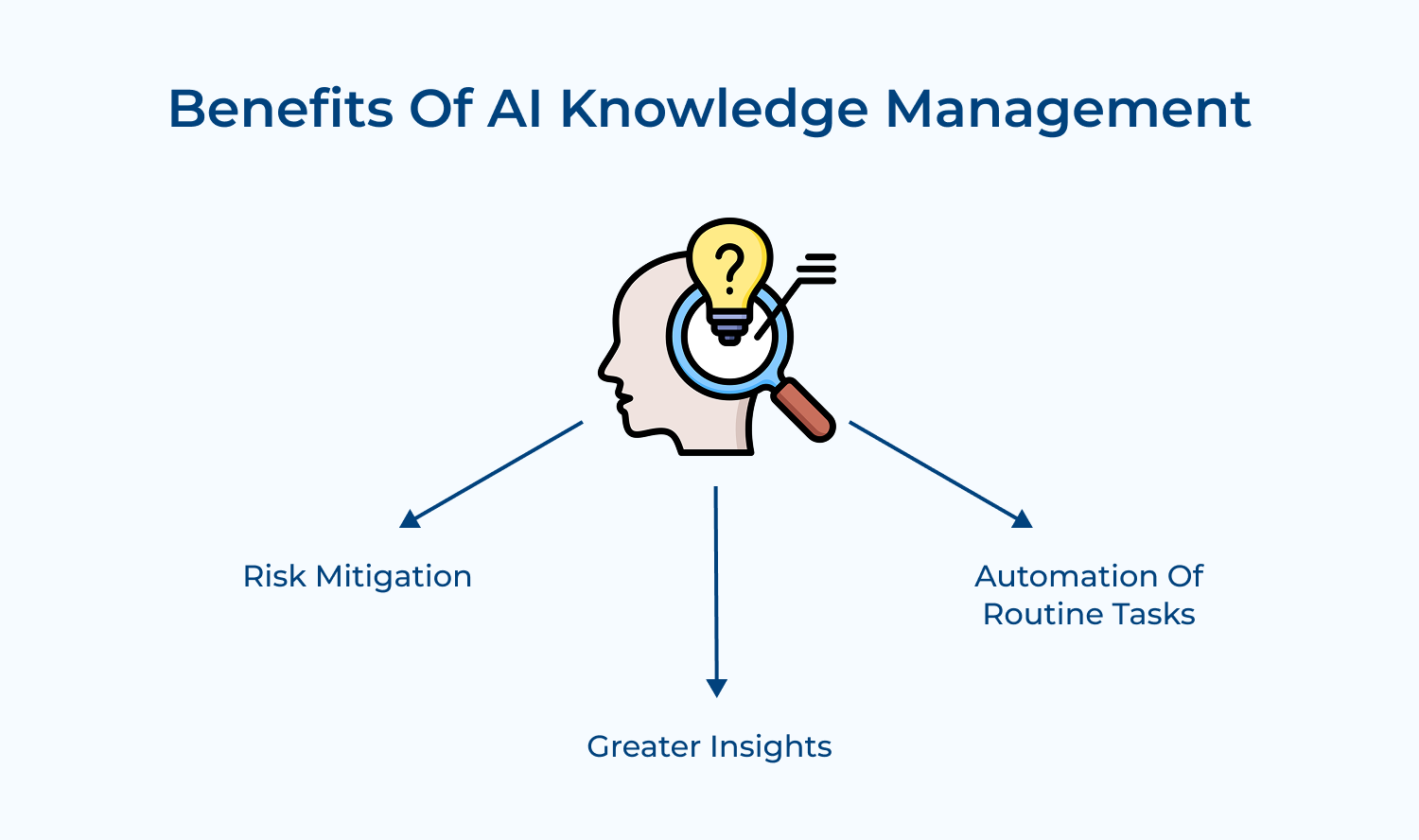
AI is transforming knowledge management by streamlining processes, enabling data-driven decisions and boosting organizational efficiency.
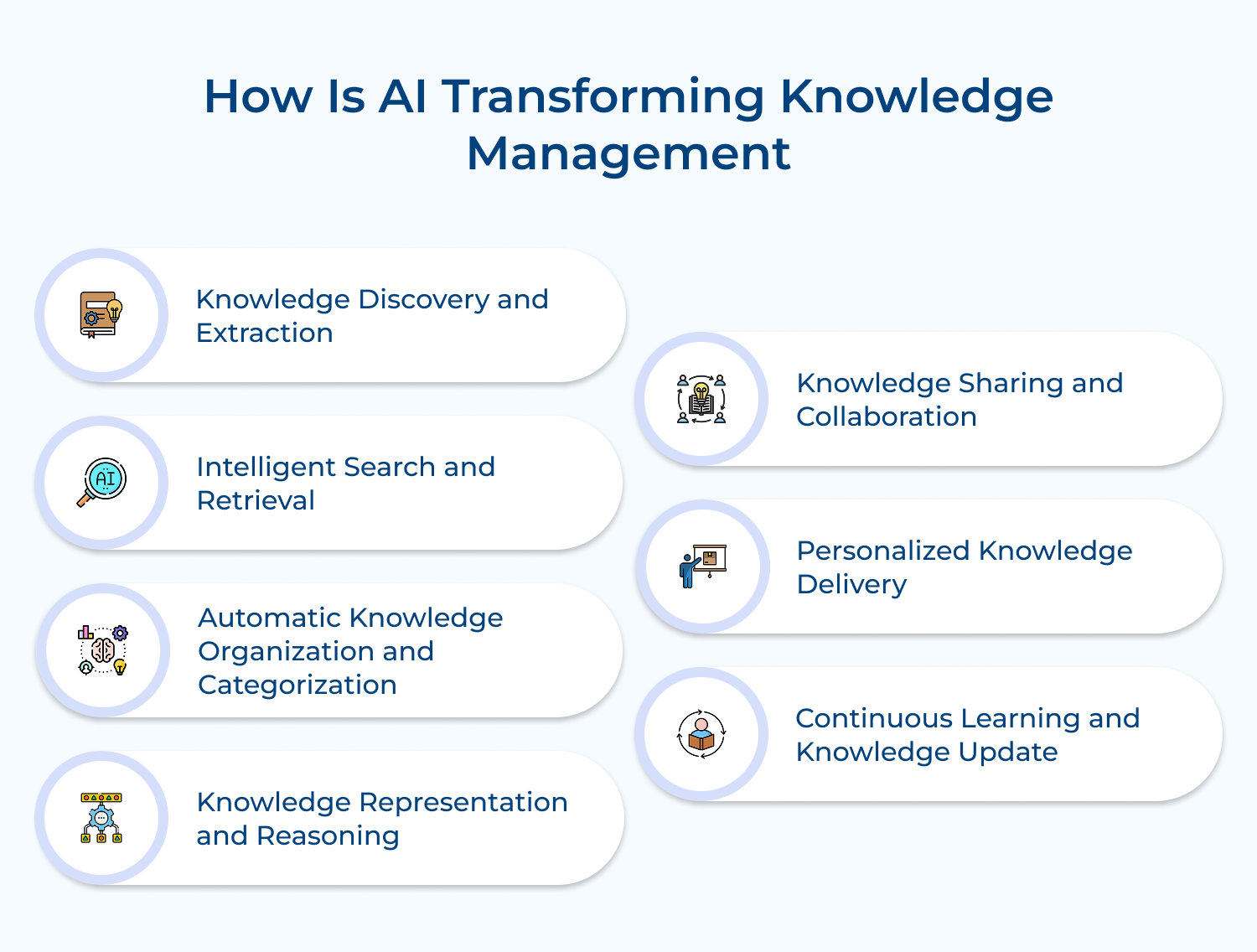
AI algorithms can analyze vast amounts of unstructured data to extract valuable insights and knowledge. Such capability enables organizations to uncover hidden patterns that would be difficult or impossible for humans to detect manually.
Implementing AI-powered chatbots or virtual assistants can also assist in extracting knowledge by answering employee inquiries and providing relevant information in real-time.
AI-powered search engines and virtual assistants can understand natural language queries. It provides contextual information from various sources. It enhances knowledge accessibility and allows users to quickly find the information they need & decision-making processes.
AI-driven search tools can also automatically categorize search results as well as suggest related content, making it easier for users to navigate and explore knowledge within the organization’s repository. These systems can incorporate semantic search capabilities to improve accuracy and precision.
AI techniques like machine learning & deep learning can automatically categorize vast amounts of information based on content, context, and metadata. It helps in structuring knowledge repositories, making it easier to navigate and retrieve relevant information.
Implementing AI-powered content tagging systems can assign metadata to knowledge assets, enabling users to quickly filter and retrieve specific information based on predefined categories or tags.
AI technologies, such as expert systems & knowledge graphs, can represent and model complex knowledge domains and provide decision support. Such capability is valuable in fields like healthcare, finance and legal domains, where decision-making relies heavily on domain-specific knowledge.
AI can help improve the way knowledge is organized and searched for within a knowledge management system by using semantic search capabilities. It means that the system can better understand the context and meaning of user queries, making it easier to find relevant information.
AI-powered collaboration tools can facilitate knowledge sharing within organizations by recommending relevant experts, documents, or resources based on the context of a user’s work. It fosters better collaboration and knowledge reuse across teams/departments.
AI chatbots can be implemented to provide real-time responses to user inquiries and facilitate knowledge sharing within an organization. Chatbots can also be integrated with collaboration tools to streamline communication between team members.
AI algorithms can analyze user behavior, preferences and context to deliver personalized knowledge recommendations. It ensures that users receive the most pertinent information tailored to their needs, improving efficiency and productivity.
AI chatbots can provide personalized assistance and support to individuals as they interact with knowledge management systems. Chatbots can offer guidance, answer questions, and provide customized recommendations to help users navigate as well as to utilize knowledge resources effectively.
AI systems can continuously learn from new data and update existing knowledge models. It allows organizations to stay up-to-date with the latest information and evolving knowledge domains.
AI can analyze user knowledge gaps and learning progress to suggest additional resources or learning opportunities to bridge those gaps. It can help facilitate continuous learning and professional development for employees within an organization.
AI has transformed knowledge management with software that helps organizations efficiently organize, access and utilize their knowledge for better outcomes.
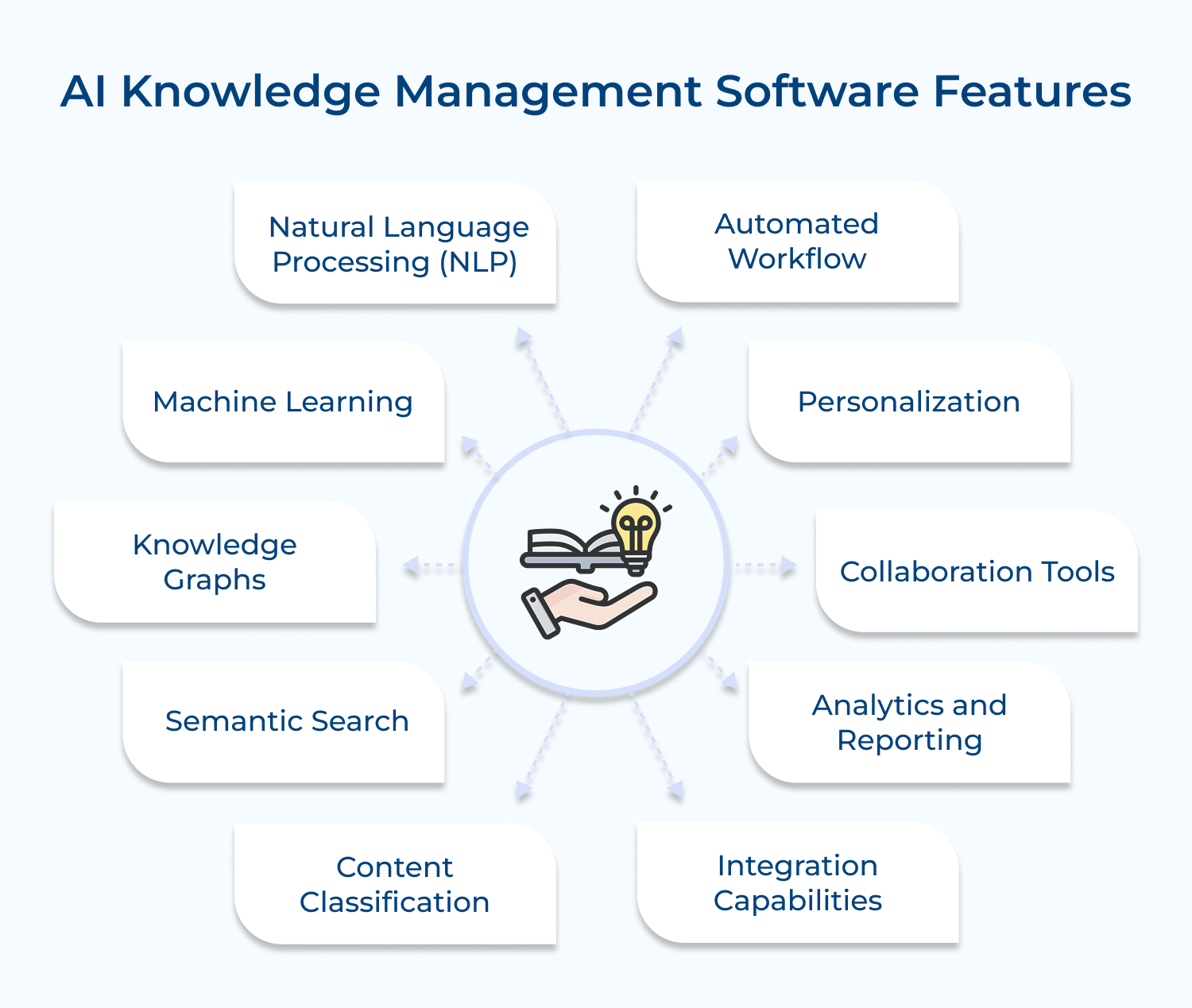
1. Natural Language Processing (NLP)
NLP allows the software to understand and process human language, enabling users to interact with the system in a more natural way. This feature is essential for effective search functions and user-friendly interfaces.
2. Machine Learning
Machine learning (ML) algorithms enable the software to continuously learn and improve over time. By analyzing data and user behavior, the software can provide more personalized as well as relevant knowledge recommendations.
3. Knowledge Graphs
Knowledge graphs are visual representations of relationships between different pieces of information. This feature allows users to explore and navigate complex knowledge networks more easily.
4. Semantic Search
Semantic search goes beyond traditional keyword-based search by understanding the context and meaning of search queries. This feature helps users find more accurate and relevant information.
5. Content Classification
Content classification algorithms can automatically categorize and tag knowledge documents based on their content. This feature makes it easier to organize and retrieve information.
6. Automated Workflow
Automated workflows help streamline knowledge management processes by automating repetitive tasks and routing information to the right people at the right time. This feature can improve productivity and reduce manual errors.
7. Personalization
Personalization features allow users to customize their knowledge management experience based on their preferences and needs. It can include personalized recommendations, dashboards and notifications.
8. Collaboration Tools
Collaboration tools facilitate teamwork and communication within the organization. Features such as shared workspaces, real-time editing and version control enable teams to collaborate more effectively on knowledge projects.
9. Analytics and Reporting
Analytics and reporting features provide insights into how knowledge is being accessed, used, and shared within the organization. This data can help identify trends, measure performance, and make data-driven decisions.
10. Integration Capabilities
Integration capabilities allow the software to connect with knowledge management tools and systems within the organization, such as CRM, ERP & project management software. This feature ensures seamless data flow and collaboration across different departments.
The integration of artificial intelligence into knowledge management systems is revolutionizing the way organizations capture, store and share information. By harnessing the power of AI, businesses can streamline processes, improve decision-making and increase overall productivity.
As technology continues to advance, it is crucial for organizations to adapt and embrace these changes in order to stay competitive in a fast-paced digital world. Evolving knowledge management with artificial intelligence is not just a trend, but a necessity for companies looking to thrive in the ever-changing landscape of information management.

How do AI and KM Complement Each Other?
AI and KM complement each other by enhancing the way organizations capture, process and utilize knowledge. AI can automate various knowledge management processes, such as organizing information, identifying trends and patterns in data and providing personalized recommendations.
KM helps in creating, sharing and managing knowledge within an organization. Together, AI and KM can improve decision-making, increase efficiency and drive innovation.
What challenges in traditional knowledge management systems does AI overcome?
Traditional knowledge management systems often face challenges such as information overload, lack of collaboration, and difficulty in locating relevant information. AI can help overcome these challenges by using technologies like natural language processing, machine learning, and predictive analytics to filter & organize vast amounts of data, and enhance collaboration through intelligent recommendation systems. Then provide quick access to relevant information through smart search capabilities.
How AI-powered knowledge management systems transform organizations?
AI-powered knowledge management systems have the potential to transform organizations in several ways. They can improve knowledge sharing & collaboration among employees, automate routine tasks, enhance decision-making by providing insights based on data analysis, and facilitate continuous learning. By harnessing the power of AI in KM, organizations can become more agile, competitive, and responsive to change.
How AI is Used in Knowledge Management?
AI is used in knowledge management in various ways, such as:
What’s the connection between AI and knowledge management?
The connection between AI and knowledge management lies in their shared goal of harnessing information and expertise to drive organizational success. AI enhances knowledge management by automating repetitive tasks, uncovering hidden insights in data and enabling effective knowledge sharing. By leveraging AI technologies in knowledge management, organizations can unlock the full potential of their intellectual capital and stay ahead in the rapidly evolving digital landscape.
 https://omni24.io/wp-content/uploads/2026/08/Omnichannel-Chatbots.png
1256
2400
Tushar Joshi
https://omni24.io/wp-content/uploads/2023/04/Omni-Logo-1.svg
Tushar Joshi2026-08-13 04:43:302026-08-24 09:02:01How Omnichannel Chatbots Improve Your Customer Experience
https://omni24.io/wp-content/uploads/2026/08/Omnichannel-Chatbots.png
1256
2400
Tushar Joshi
https://omni24.io/wp-content/uploads/2023/04/Omni-Logo-1.svg
Tushar Joshi2026-08-13 04:43:302026-08-24 09:02:01How Omnichannel Chatbots Improve Your Customer Experience https://omni24.io/wp-content/uploads/2026/08/Ecommerce-Chatbots-1.png
1256
2400
Tushar Joshi
https://omni24.io/wp-content/uploads/2023/04/Omni-Logo-1.svg
Tushar Joshi2026-08-12 03:57:552026-08-24 09:03:22Ecommerce Chatbots: What are They and Their Use Cases
https://omni24.io/wp-content/uploads/2026/08/Ecommerce-Chatbots-1.png
1256
2400
Tushar Joshi
https://omni24.io/wp-content/uploads/2023/04/Omni-Logo-1.svg
Tushar Joshi2026-08-12 03:57:552026-08-24 09:03:22Ecommerce Chatbots: What are They and Their Use Cases https://omni24.io/wp-content/uploads/2026/08/Omnichannel-Ecommerce.png
1256
2400
Tushar Joshi
https://omni24.io/wp-content/uploads/2023/04/Omni-Logo-1.svg
Tushar Joshi2026-08-11 04:50:362026-08-24 09:00:45How to Create an Omnichannel Ecommerce Strategy: 7 Best Ways
https://omni24.io/wp-content/uploads/2026/08/Omnichannel-Ecommerce.png
1256
2400
Tushar Joshi
https://omni24.io/wp-content/uploads/2023/04/Omni-Logo-1.svg
Tushar Joshi2026-08-11 04:50:362026-08-24 09:00:45How to Create an Omnichannel Ecommerce Strategy: 7 Best Ways
Whether it’s about acquire, engage or support – Omni24 covers all your customer engagement needs in one complete platform.

Copyright ©2026 Veemo All rights reserved.
CA, Los Angeles, Hall Ave, 19011