How to Increase Conversion Rate: 7 Key Strategies
Improving conversion rates maximizes traffic value and revenue without extra costs, enabling efficient business growth through loyal customers.
Improving conversion rates maximizes traffic value and revenue without extra costs, enabling efficient business growth through loyal customers.
Many businesses struggle with low conversion rates, leading to missed sales opportunities and stagnant growth. Potential customers often abandon their shopping carts or leave websites without making a purchase, creating frustration for e-commerce retailers.
AI-driven recommendations can boost conversion rates by up to 30% and automation helps achieve a 4X uplift when combined with chat support.
Increasing conversion rates is essential for maximizing revenue and improving overall business performance. Implementing effective strategies can transform hesitant visitors into loyal customers.
Discover how to increase conversion rates and drive sustainable growth for your ecommerce business.
The conversion rate is a key performance metric that measures the percentage of users who take a desired action on a website or app, such as making a purchase, signing up for a newsletter, or filling out a contact form. It is calculated by dividing the number of conversions by the total number of visitors, then multiplying by 100 to express it as a percentage.
A higher conversion rate indicates that a larger proportion of visitors are engaging with the brand and taking actions that benefit the business. Monitoring this metric allows companies to refine their marketing strategies, enhance user experiences, and achieve better results.
Key objectives:
Understanding how to calculate conversion rate is essential for measuring the effectiveness of your marketing efforts. Here are the steps involved.
1. Define the Conversion Goal
Determine what constitutes a conversion for your business. This could be a sale, sign-up, download or any specific action you want users to take.
2. Collect Data
Gather data on the number of conversions and the total number of visitors during a specific time period.
3. Use the Formula
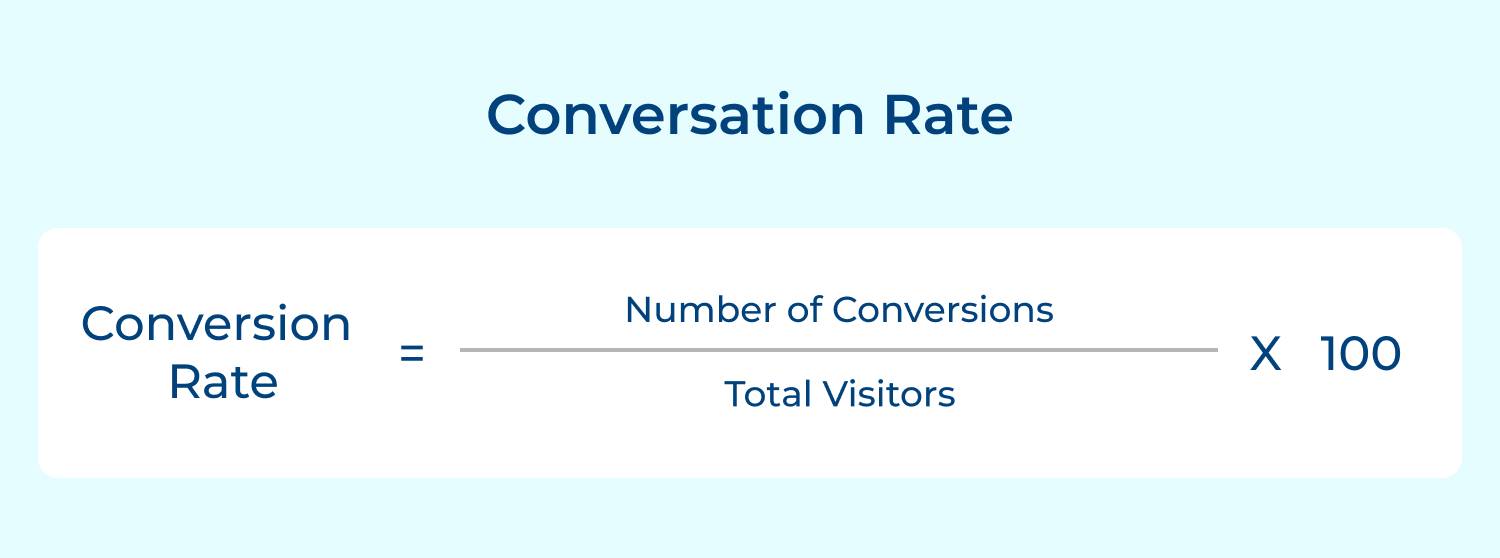
The formula to calculate conversion rate is:
Conversion Rate = Number of Conversions/Total Visitors* 100
4. Example Calculation
If your website had 500 visitors in a month and 50 of them completed a purchase:
Conversion Rate =50 /500* 100 = 10%
5. Analyze and Optimize
Once you have your conversion rate, use this information to analyze your marketing strategies and website performance, making adjustments to improve future conversion rates. Calculating your conversion rate regularly can help track performance and guide decision-making for optimization efforts.
Implementing effective strategies can significantly boost conversion rates and improve customer engagement. Here are key tactics to consider:
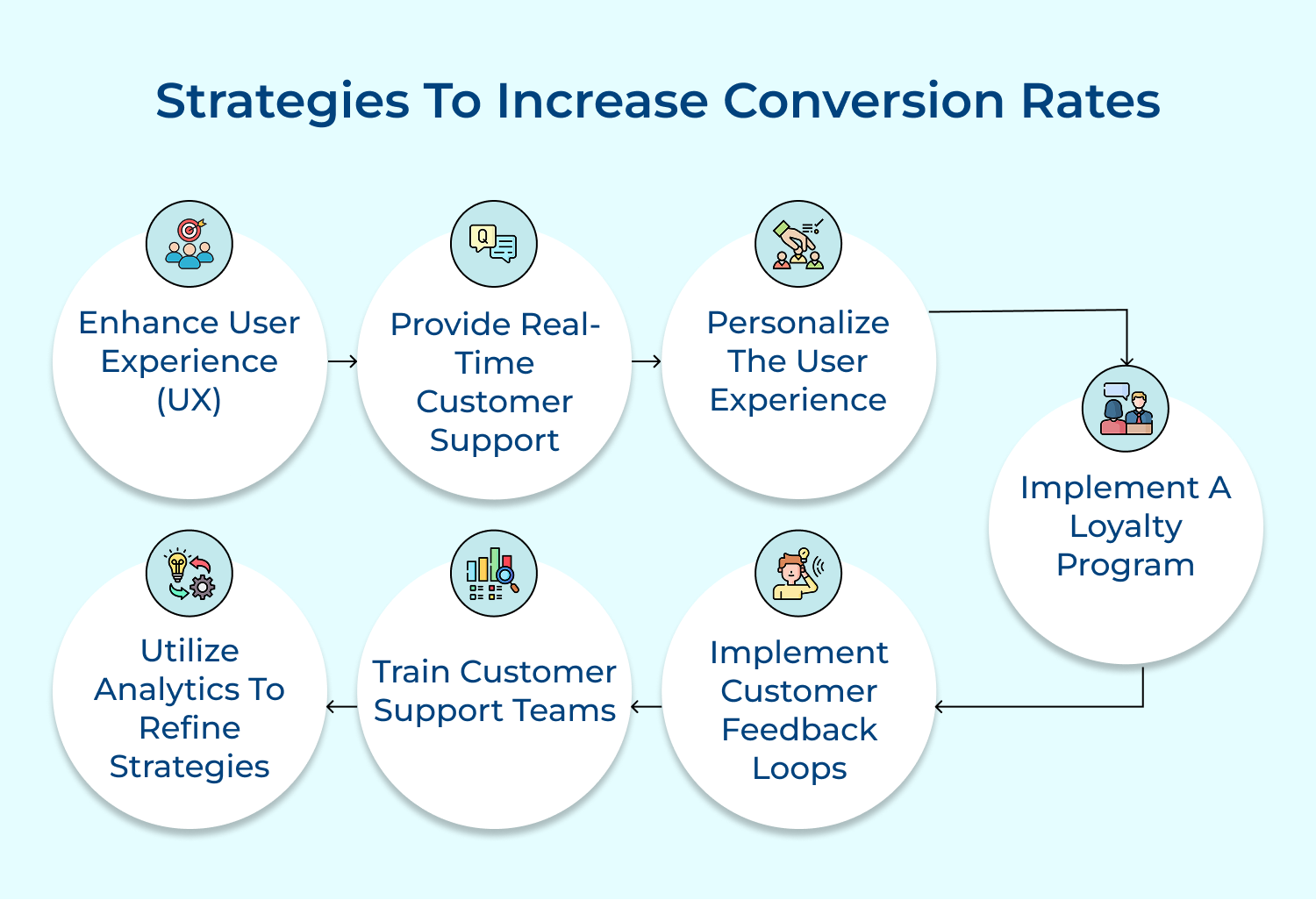
A smooth, intuitive user experience is crucial for keeping visitors engaged and guiding them towards conversion. Poor UX can lead to frustration, abandonment and lost sales. Enhancing UX reduces friction in the customer journey, making it easier and more enjoyable for users .
Improve site navigation, optimize page load speeds and ensure mobile responsiveness. Simplify the checkout process, use compelling CTAs and implement intuitive search functionality. Create logical user flows, use whitespace effectively and ensure consistency in design across all pages.
Actionable tips:
Real-time support addresses customer queries immediately, reducing hesitation and increasing confidence in purchasing decisions. It helps overcome objections, clarifies product information and provides reassurance during the buying process.
Implement live chat functionality on your website, offering instant assistance to visitors. Use chatbots for handling common queries and human agents for complex issues. Provide support across multiple channels including social media. Offer co-browsing capabilities for personalized assistance. Ensure support is readily available during peak shopping hours.
Actionable tips:
Personalization creates a more relevant and engaging experience for each user, increasing the likelihood of conversion. It helps customers find products they’re interested in more quickly, makes marketing messages more effective and creates a sense of individual attention.
Implement personalized product recommendations based on browsing history and past purchases. Use dynamic content on your website that changes based on user behavior or demographics. Send personalized email campaigns with targeted offers. Use retargeting ads to show users products they’ve previously viewed.
Actionable tips:
Loyalty programs encourage repeat purchases, increase customer lifetime value and can drive word-of-mouth referrals. They provide an incentive for customers to choose your brand over competitors and can increase average order value.
Offer points for purchases that can be redeemed for discounts or exclusive products. Provide tiered membership levels with increasing benefits. Offer early access to sales or new products for loyal customers. Use gamification elements to make the program engaging.
Actionable tips:
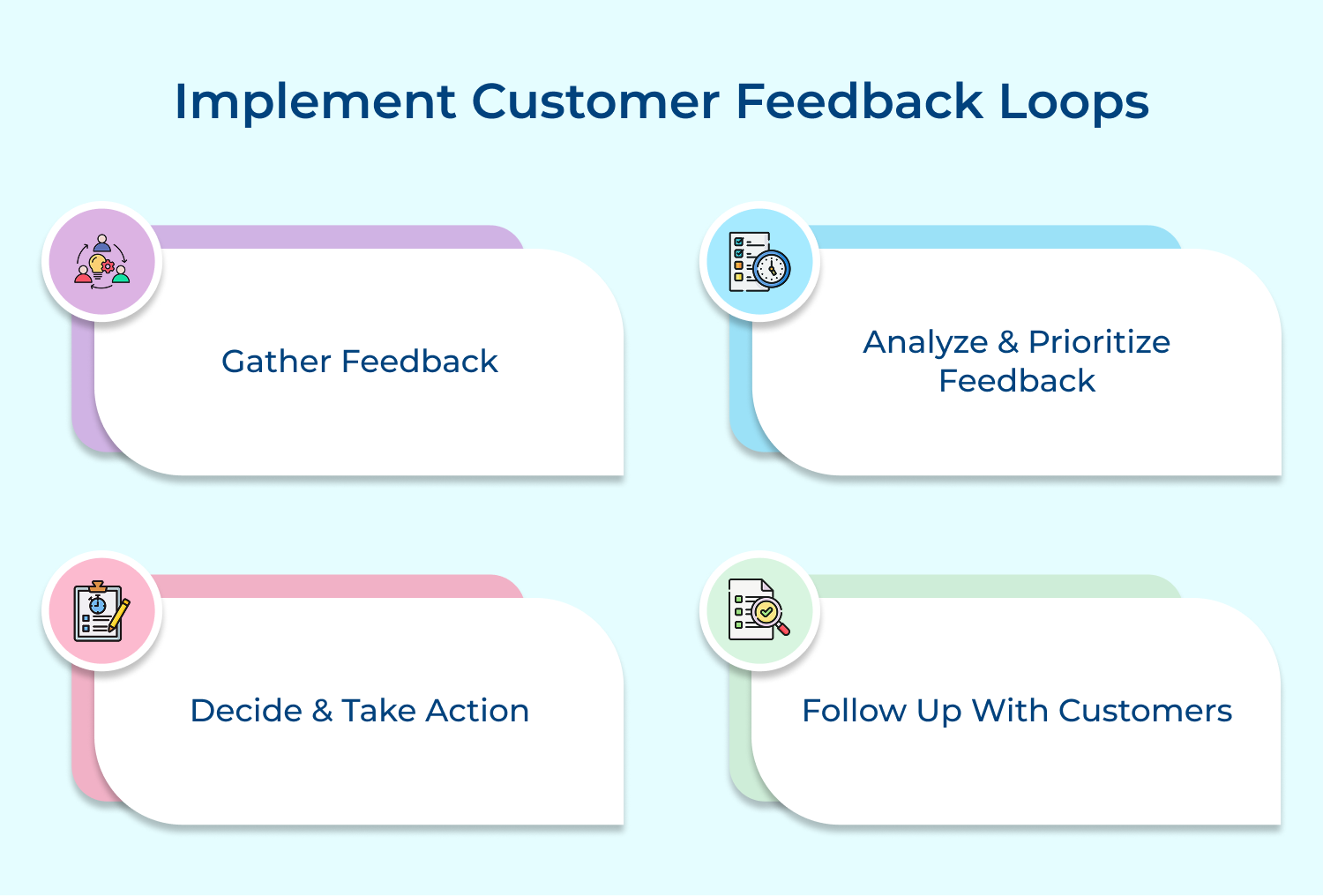
Customer feedback loops provide invaluable insights into what’s working and what needs improvement in your business. They help identify pain points in the customer journey, uncover new opportunities and show customers that their opinions are valued.
Use post-purchase surveys to gather feedback on the buying experience. Implement on-site feedback tools for real-time input. Conduct regular customer satisfaction surveys. Use social media listening tools to monitor brand mentions and sentiment. Analyze customer support interactions for common issues.
Actionable tips:
Well-trained support teams can significantly impact conversion rates by providing excellent customer experiences. They can effectively address concerns, provide product information and guide customers through the purchase process.
Provide comprehensive product and policy training to support staff. Teach effective communication and problem-solving skills. Train teams on using customer data for personalized interactions. Implement role-playing exercises to practice handling different scenarios. Use quality assurance monitoring and feedback for continuous improvement.
Actionable tips:
Analytics provide data-driven insights into customer behavior, allowing you to make informed decisions about optimization strategies. They help identify bottlenecks in the conversion funnel, understand which marketing efforts are most effective, and reveal opportunities for improvement.
Implement web analytics tools to track user behavior and conversion paths. Use A/B testing platforms to experiment with different elements and measure their impact. Set up funnel analysis to identify drop-off points. Utilize heat maps and session recordings for detailed user behavior insights.
Actionable tips:
Conversion rate is a critical metric that impacts business success and profitability. Here are the reasons why it deserves your attention.
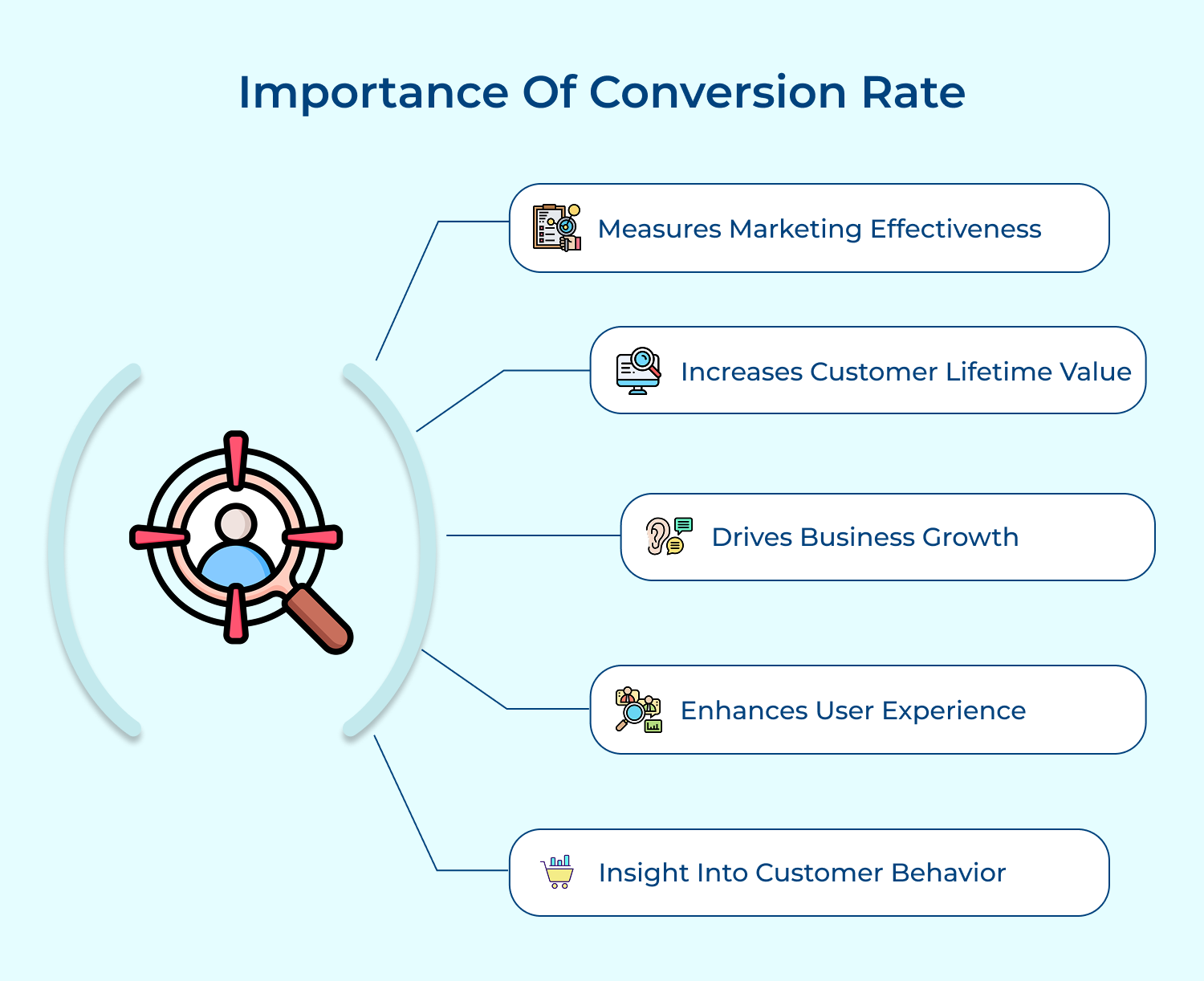
Measures Marketing Effectiveness
Conversion rate is a crucial metric that shows how well campaigns and strategies resonate with the target audience, allowing businesses to assess which tactics are driving desired actions. This insight enables marketers to refine their approaches, allocate resources more efficiently and maximize return on investment.
Increases Customer Lifetime Value
A high conversion rate often correlates with improved customer lifetime value. When visitors convert, they become customers, opening opportunities for ongoing engagement and repeat business. Focusing on conversion optimization helps companies attract quality leads more likely to become loyal, long-term customers, increasing the average revenue generated per customer over time.
Drives Business Growth
Conversion rate directly impacts a company’s bottom line. Improving this metric means more visitors are taking valuable actions, whether it’s making purchases, signing up for services, or engaging with the brand. This increase in conversions translates to higher revenue, expanded market share and accelerated business growth.
Enhances User Experience
Optimizing for conversions often involves improving website design, simplifying navigation and streamlining processes. These enhancements create a more user-friendly experience, making it easier for visitors to find information and complete desired actions. A better user experience not only boosts conversions but also increases customer satisfaction.
Insight into Customer Behavior
Analyzing conversion rates provides valuable insights into customer preferences, pain points and decision-making processes. Understanding what drives conversions and what creates barriers allows businesses to tailor their offering to better meet customer needs.
Identifying the factors that contribute to low conversion rates is vital for improvement. Here are the most common reasons businesses face.
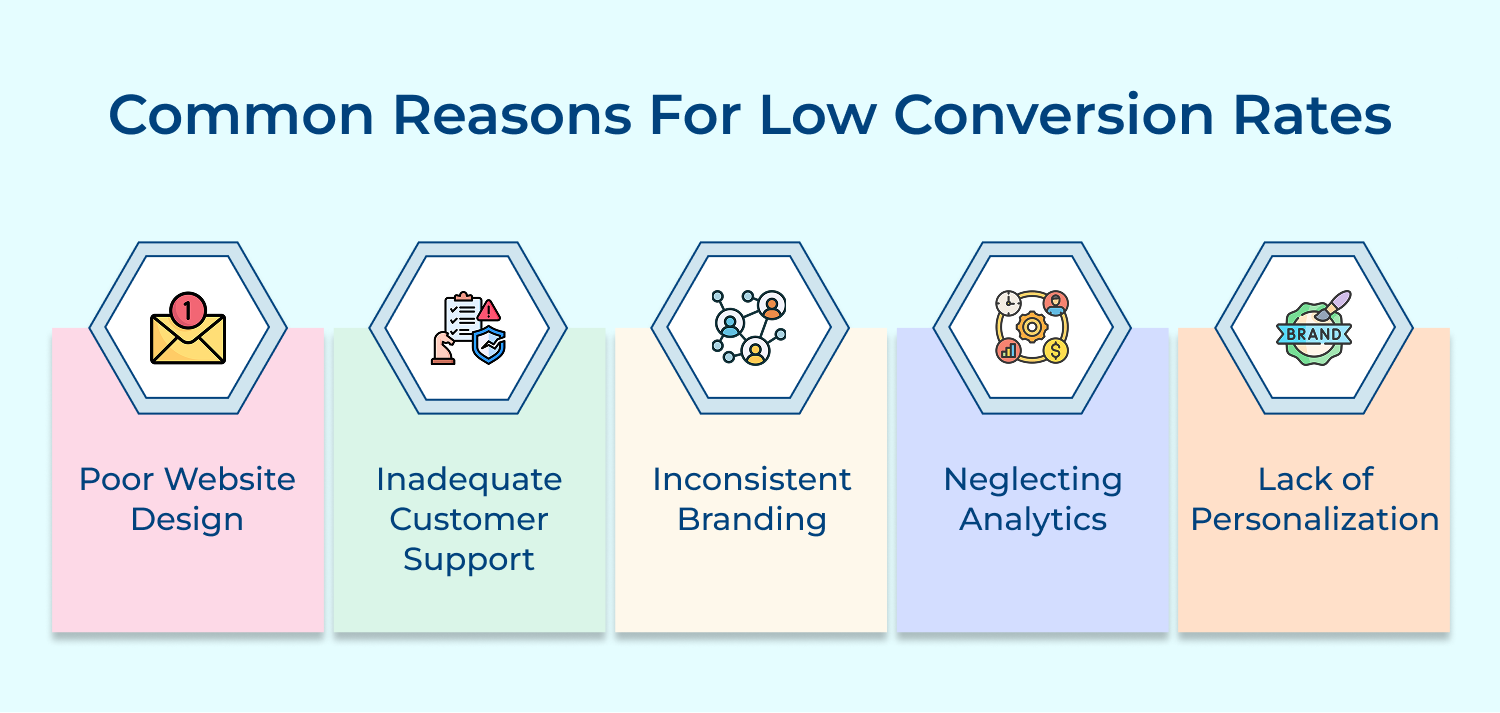
Poor Website Design
A poorly designed website can frustrate users and drive them away. Cluttered layouts, confusing navigation, slow loading times and non-responsive design on mobile devices all contribute to a poor user experience. These issues can make it difficult for visitors to find what they need, leading to high bounce rates and low conversions.
Inadequate Customer Support
Insufficient or low-quality customer support can significantly impact conversion rates. When customers can’t get timely answers to their questions or assistance with issues, they’re likely to abandon their purchase. Lack of multiple support channels, slow response times and unhelpful or untrained support staff can all contribute to customer frustration.
Inconsistent Branding
Inconsistent branding across different channels and touchpoints can confuse customers. When messaging, visual elements, or tone vary significantly between a company’s website, social media and advertising, it can create a disjointed experience. This inconsistency can make customers question the reliability and professionalism of the business, leading to hesitation in making purchases.
Neglecting Analytics
Failing to utilize analytics effectively can result in missed opportunities for optimization. Without proper tracking and analysis of user behavior, businesses can’t identify bottlenecks in their conversion funnel or understand which marketing efforts are most effective. This lack of insight leads to uninformed decision-making and ineffective strategies for improving conversion rates.
Lack of Personalization
In today’s market, customers expect personalized experiences. Failing to tailor content, product recommendations, or marketing messages to individual preferences can result in lower engagement and conversion rates. Generic, one-size-fits-all approaches often fail to resonate with customers, making them less likely to complete a purchase or take desired actions.
Learning from successful businesses can provide valuable insights for improving your own conversion rates. Here are notable examples and their strategies.
1. Walmart.com
Walmart.com significantly increased its conversion rate by focusing on mobile optimization. They redesigned their mobile site to be more user-friendly, implemented a streamlined checkout process and improved page load speeds. They also introduced a “Buy Now” button for faster purchases and enhanced their product recommendation algorithm. These changes led to a 20% increase in mobile conversions.
2. Booking.com
Booking.com is renowned for its relentless A/B testing approach. They continuously test every aspect of their website, from button colors to copy variations. They implemented personalized search results based on user behavior, added urgency indicators like “Only 2 rooms left!” and optimized their mobile experience. These strategies helped them achieve an industry-leading conversion rate of 10%.
3. Amazon
Amazon’s success in conversion rate optimization is largely due to its personalization efforts. They use sophisticated algorithms to provide personalized product recommendations, implement one-click ordering for registered users and leverage user data to create targeted email campaigns. They also use social proof extensively, displaying customer reviews prominently. These strategies contribute to their estimated 13% conversion rate.
4. Expedia
Expedia increased its annual revenue by $12 million by simply removing one field from their checkout form. They realized that the “Company” field was causing confusion and abandonment. By removing this unnecessary field, they streamlined the checkout process and significantly boosted their conversion rate. This case demonstrates the power of simplifying the user experience.
Increasing conversion rates requires a multifaceted approach that focuses on enhancing user experience, providing exceptional customer support and implementing personalized marketing strategies.
Businesses should prioritize simplifying the checkout process, optimizing website design and utilizing analytics to understand user behavior. By addressing potential barriers and continuously refining strategies, companies can foster engagement, ultimately leading to higher conversion rates. This not only boosts revenue but also strengthens customer loyalty, creating long-term value.
Consistent efforts in improving conversion rates empower businesses to remain competitive, adapt to market changes and maximize their growth potential in an increasingly digital landscape.

Why is increasing conversion rate important for a business?
Increasing conversion rate is crucial because it directly impacts a business’s profitability and efficiency. A higher conversion rate means you’re getting more value from your existing traffic, reducing customer acquisition costs. It indicates that your marketing efforts, user experience and product offerings are resonating with your audience. Improved conversion rates lead to increased revenue and better ROI.
What are the long-term methods to boost your conversion rate?
Long-term methods to boost conversion rates include ongoing user experience optimization, continuous A/B testing and data-driven decision making. Invest in building a strong brand and fostering customer trust. Implement a robust customer feedback system and act on insights. Develop a culture of constant improvement in your product or service offerings. Focus on personalization and creating tailored experiences for different customer segments. Regularly train your team on customer service and sales techniques.
What factors affect conversion rate?
Numerous factors affect conversion rates, including website design and the usability of your value proposition. The quality of your traffic, pricing strategy, and competitive positioning also play crucial roles. Other factors include the effectiveness of your call-to-action buttons, the strength of your copy, and product descriptions. External factors like seasonality and economic conditions can also impact conversion rates.
What is the top change I can make to increase conversion rates?
The top change to increase conversion rates often involves optimizing your call-to-action (CTA). This includes improving the visibility, clarity, and compelling nature of your CTAs. Ensure they stand out visually, use action-oriented language, and clearly communicate the value proposition. Test different placements, colors, and copy for your CTAs. Remember, while this is often impactful, the “top” change can vary depending on your specific business and current website setup. Always test changes to confirm their effectiveness.
 https://omni24.io/wp-content/uploads/2026/07/Customer-Data-Platform.png
1256
2400
Tushar Joshi
https://omni24.io/wp-content/uploads/2023/04/Omni-Logo-1.svg
Tushar Joshi2026-07-08 03:58:592026-07-08 03:58:59How a Customer Data Platform Unlocks Unified Customer Insights
https://omni24.io/wp-content/uploads/2026/07/Customer-Data-Platform.png
1256
2400
Tushar Joshi
https://omni24.io/wp-content/uploads/2023/04/Omni-Logo-1.svg
Tushar Joshi2026-07-08 03:58:592026-07-08 03:58:59How a Customer Data Platform Unlocks Unified Customer Insights https://omni24.io/wp-content/uploads/2026/07/Unified-Customer-View.png
1256
2400
Tushar Joshi
https://omni24.io/wp-content/uploads/2023/04/Omni-Logo-1.svg
Tushar Joshi2026-07-07 03:37:342026-07-07 03:37:34How a Unified Customer View Transforms Customer Experience
https://omni24.io/wp-content/uploads/2026/07/Unified-Customer-View.png
1256
2400
Tushar Joshi
https://omni24.io/wp-content/uploads/2023/04/Omni-Logo-1.svg
Tushar Joshi2026-07-07 03:37:342026-07-07 03:37:34How a Unified Customer View Transforms Customer Experience https://omni24.io/wp-content/uploads/2026/06/Omnichannel-CRM.png
1256
2400
Tushar Joshi
https://omni24.io/wp-content/uploads/2023/04/Omni-Logo-1.svg
Tushar Joshi2026-07-06 03:49:012026-07-06 04:00:22How to Implement Omnichannel CRM Strategy: 7 Key Steps
https://omni24.io/wp-content/uploads/2026/06/Omnichannel-CRM.png
1256
2400
Tushar Joshi
https://omni24.io/wp-content/uploads/2023/04/Omni-Logo-1.svg
Tushar Joshi2026-07-06 03:49:012026-07-06 04:00:22How to Implement Omnichannel CRM Strategy: 7 Key Steps
Whether it’s about acquire, engage or support – Omni24 covers all your customer engagement needs in one complete platform.

Copyright ©2026 Veemo All rights reserved.
CA, Los Angeles, Hall Ave, 19011