10 Ecommerce KPIs and Metrics to Track Performance & Growth
Discover the top ecommerce KPIs and metrics as well as how to use them to boost sales / customer satisfaction.

Discover the top ecommerce KPIs and metrics as well as how to use them to boost sales / customer satisfaction.
Ecommerce businesses often struggle with measuring success and identifying areas of improvement. Without clear KPIs and metrics, it’s easy to miss opportunities or waste resources.
Ecommerce KPIs and metrics provide the roadmap for better decision-making. Hence, helping businesses track performance, optimize strategies as well as boost profitability. Conversion rates, for example, across ecommerce sites typically fall between ~2.5 % and 3 %, varying by industry and device type.
Here, we’ll explore essential ecommerce KPIs and metrics that can drive growth, improve customer experience, while maximizing revenue. Let’s dive into how these key indicators can transform your ecommerce strategy.
Ecommerce KPIs (Key Performance Indicators) are measurable values that help businesses track their performance in key areas like sales, marketing and customer experience. KPIs are specific, quantifiable metrics that align with business objectives, while general metrics offer insights into different operational aspects. These indicators help business owners and teams understand how well their strategies are working as well as where improvements are needed.
Tracking these numbers helps businesses identify trends, measure growth and optimize processes for better efficiency. For example, monitoring the conversion rate helps you determine how effectively your website turns visitors into customers, while tracking customer retention rates reveals how well you’re keeping your existing customers engaged.
Key objectives :
E-commerce KPIs help businesses measure what truly matters, turning raw data into clear performance insights. Here’s how they add value to your business in the long run.
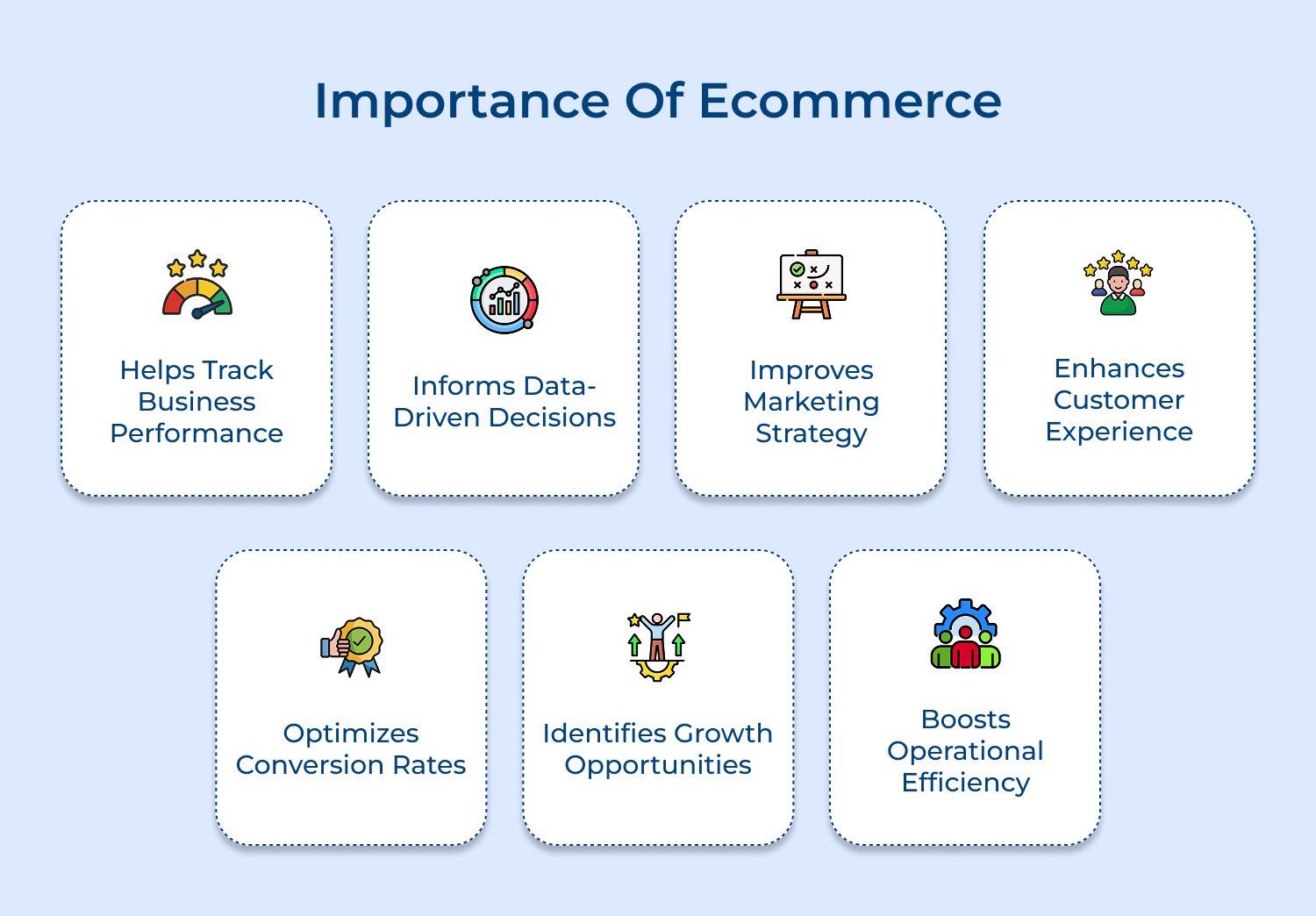
Ecommerce KPIs allow businesses to monitor overall performance by measuring specific metrics such as revenue, conversion rates and customer acquisition costs. This helps ensure that all business activities align with desired outcomes, driving growth and success.
KPIs provide valuable data that helps business owners make informed decisions. Instead of relying on assumptions, businesses can analyze real-time metrics to understand customer behavior, marketing effectiveness and operational efficiency, leading to smarter decision-making.
Ecommerce KPIs such as ROI and conversion rates are essential for optimizing marketing strategies. By tracking the effectiveness of campaigns, businesses can refine their approaches, allocate resources better as well as maximize marketing returns on investment.
KPIs related to customer satisfaction, such as Net Promoter Score (NPS) or customer retention rate, help businesses understand how well they’re meeting customer needs. Insights from these metrics enable improvements to enhance the overall customer experience.
Tracking KPIs like cart abandonment rate and conversion rate directly impacts revenue generation. Identifying barriers in the customer journey helps businesses make adjustments to streamline the checkout process. Hence, reducing friction and increasing conversions.
Ecommerce KPIs help uncover growth opportunities by highlighting trends and patterns. For example, tracking product performance and customer behavior can reveal new market segments, popular products, or untapped areas for expansion. Therefore, enabling smarter business strategies.
Tracking operational KPIs such as order fulfillment time and shipping costs helps businesses identify inefficiencies in their processes. These insights allow companies to streamline operations, reduce costs and enhance overall productivity, leading to improved profitability.
Tracking the right ecommerce metrics helps you understand performance, spot bottlenecks and uncover growth opportunities. Here are 10 crucial metrics you should consider:
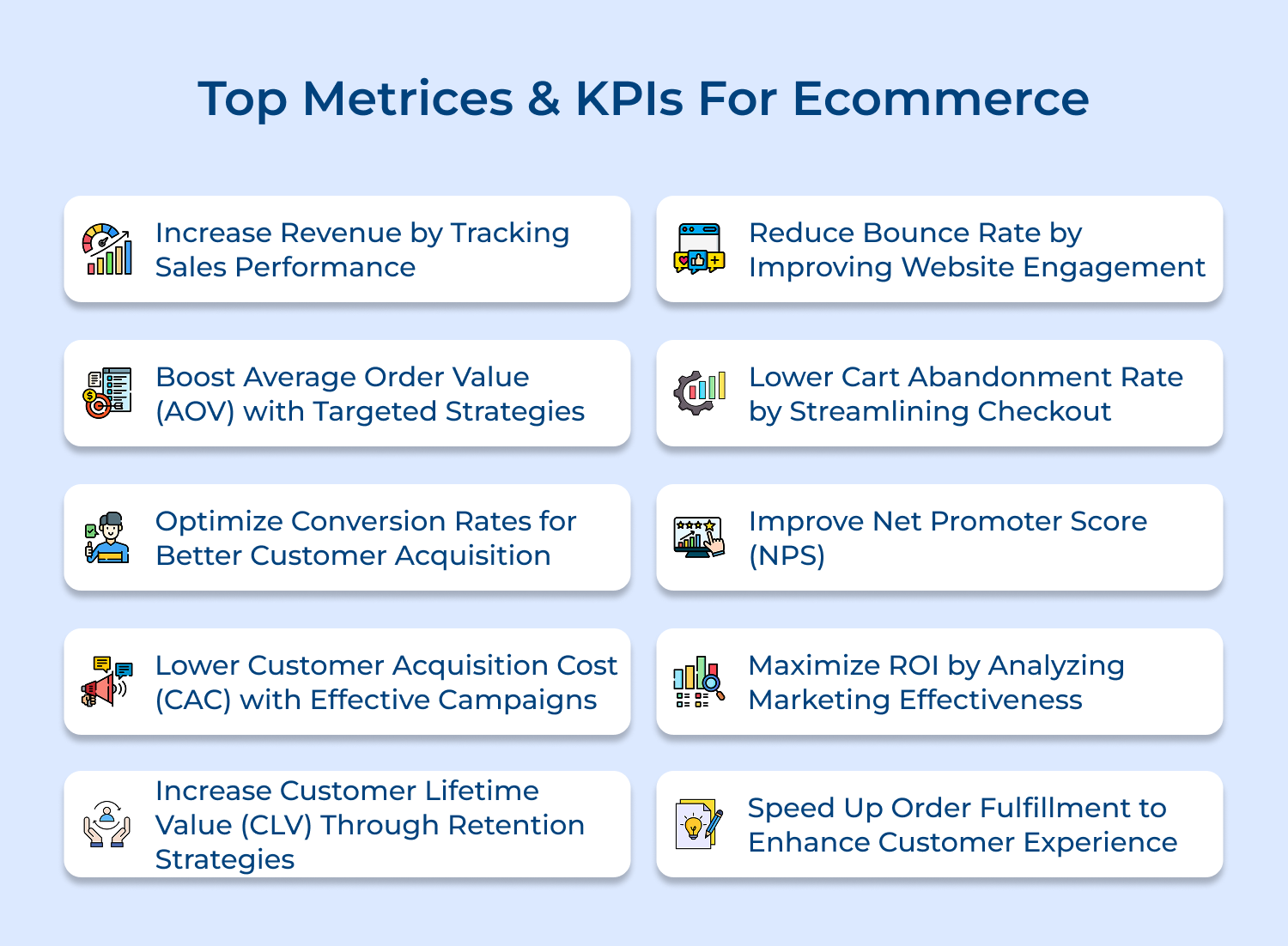
Revenue refers to the total income generated by your ecommerce business through the sale of goods or services. It’s measured over a specific period, such as daily, weekly or annually.
Revenue is the primary indicator of your business’s financial health. It reflects how well your products or services are performing as well as how effectively marketing and sales strategies are driving sales.
Track revenue regularly to identify peak sales periods and adjust strategies accordingly. Use it alongside other KPIs like AOV and conversion rate to determine how efficiently your marketing efforts are converting into actual sales.
Actionable tips:
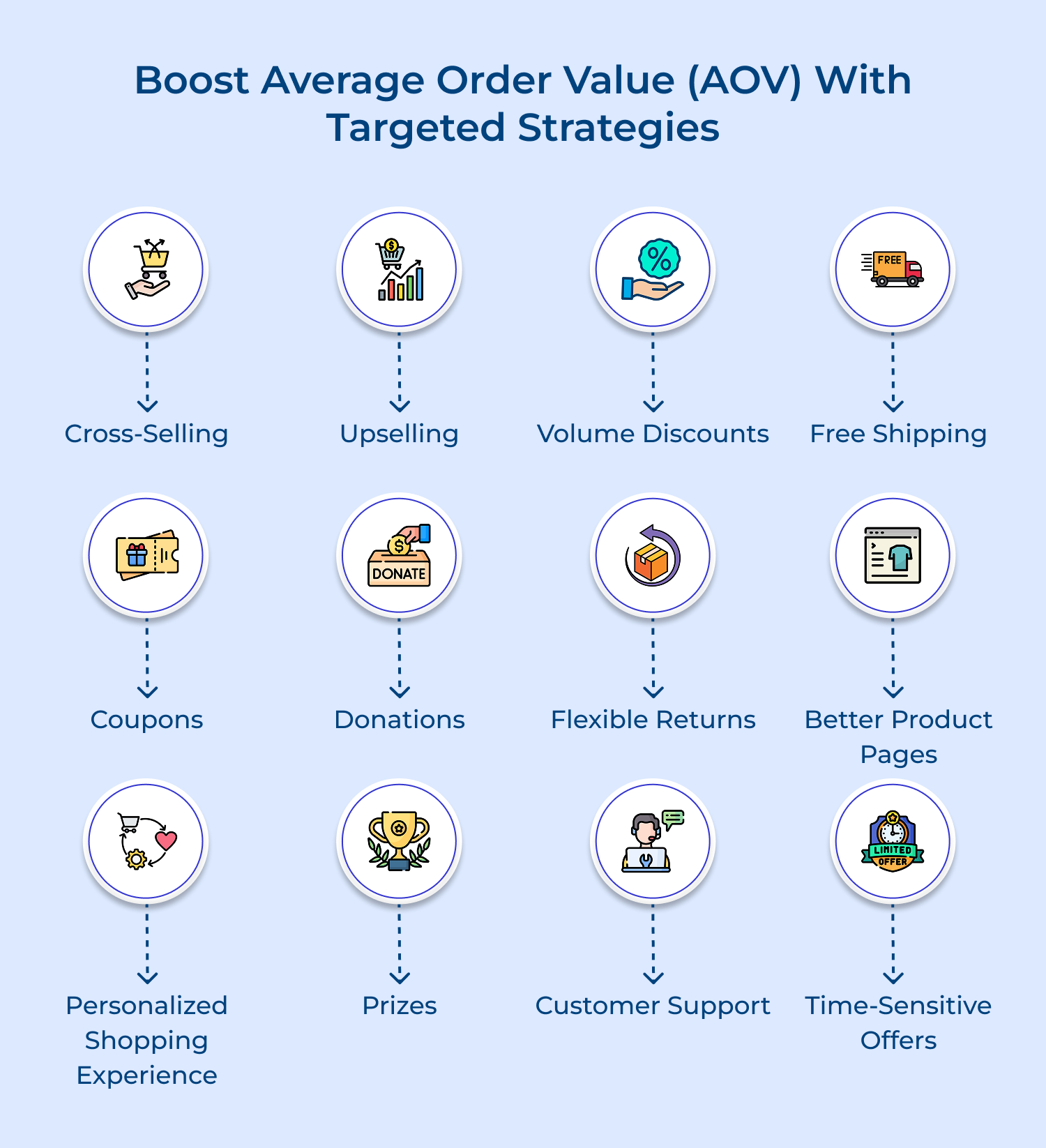
Average Order Value (AOV) shows how much customers spend each time they place an order. It’s calculated by dividing total revenue by the number of orders in a given period.
The metric helps you understand buying patterns, spot upselling or bundling opportunities and improve pricing strategies. Increasing AOV is one of the easiest ways to boost profitability without spending more on customer acquisition.
Actionable tips:
Conversion rate measures the percentage of visitors who take a desired action, like completing a purchase. It’s calculated by dividing total conversions by total visitors and multiplying by 100.
The metric shows how effectively your site turns traffic into customers. A low conversion rate often points to friction like poor UX or a complex checkout, while improving it helps increase sales without driving more traffic.
Actionable tips:
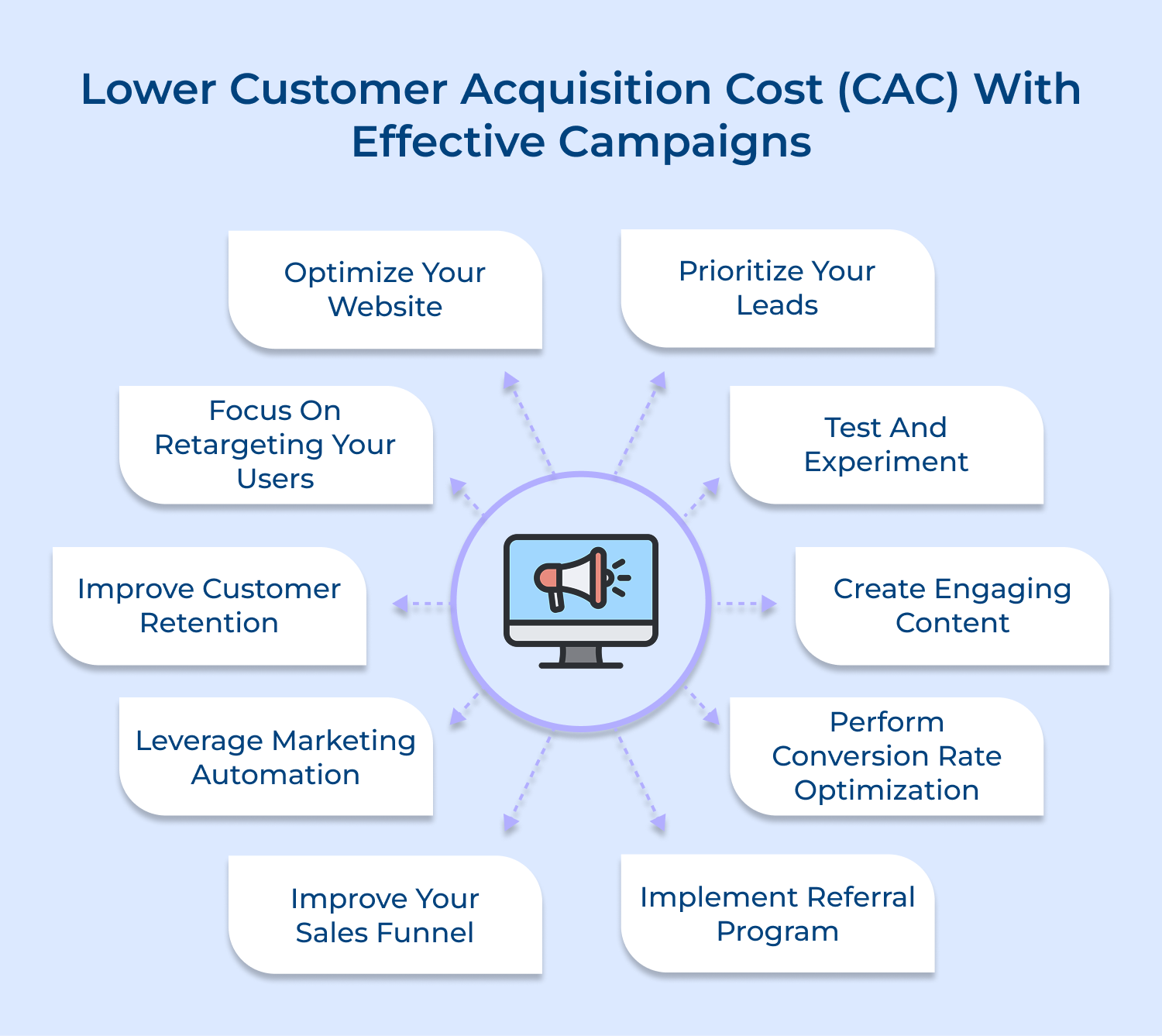
Customer Acquisition Cost (CAC) shows how much you spend to gain a new customer, including marketing and advertising costs. It’s calculated by dividing total acquisition spend by the number of new customers.
CAC helps you evaluate marketing efficiency and profitability—if it’s too high, margins suffer. Tracking CAC makes it easier to spot costly channels, refine targeting and invest in strategies that acquire customers more efficiently.
Actionable tips:
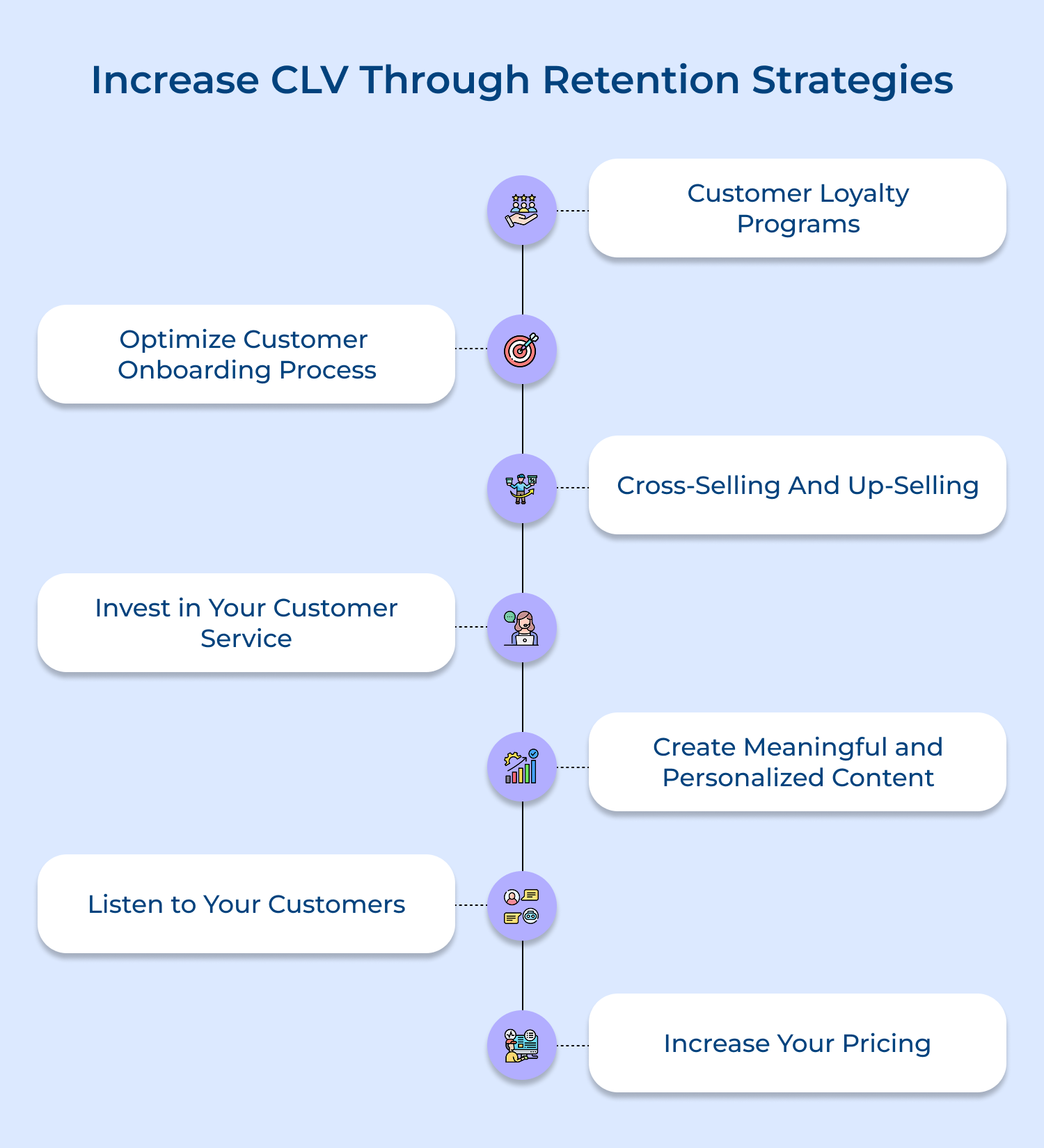
Customer Lifetime Value (CLV) represents the total revenue a business can expect from a customer over the entire relationship. It factors in repeat purchases, loyalty and retention.
CLV helps you understand how valuable each customer truly is and how much you can spend to acquire them. A higher CLV supports sustainable growth and guides smarter retention and marketing strategies focused on high-value customers.
Actionable tips:
Bounce rate is the percentage of visitors who leave a website after viewing only one page. A high bounce rate indicates that visitors are not engaging with the site or finding it relevant.
A high bounce rate suggests that your website may not be effectively capturing the attention of visitors, which can hurt conversions. Reducing bounce rate helps improve engagement and the likelihood of conversion.
Use bounce rate to assess your landing pages and ensure that content is engaging as well as aligned with user expectations. A high bounce rate may indicate a need to adjust the messaging or design of your site.
Actionable tips:
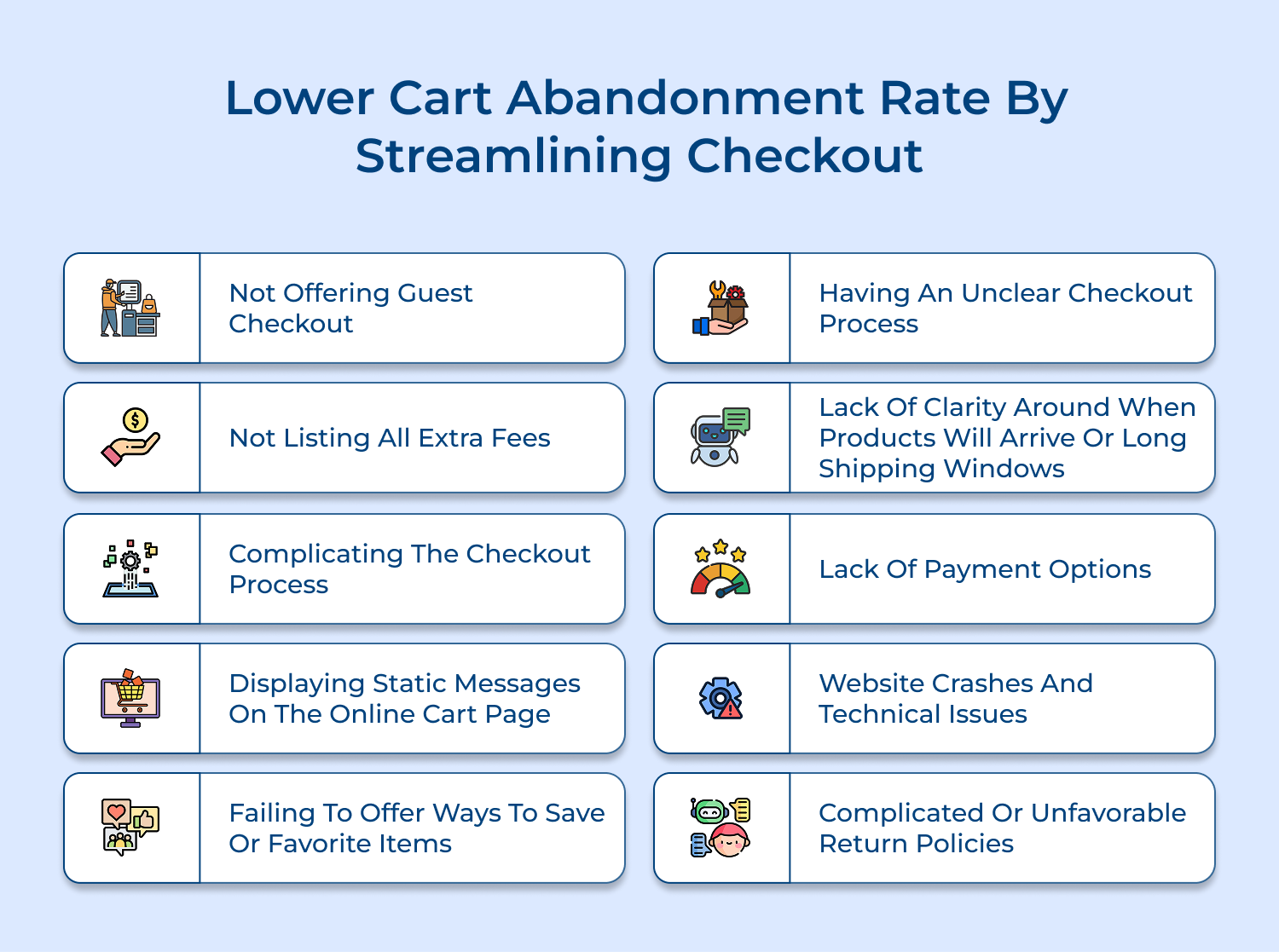
Cart abandonment rate shows the percentage of shoppers who add items to their cart but leave without completing the purchase.
A high rate often signals checkout issues like unexpected costs or a complicated process. Tracking this metric helps you spot where customers drop off and fix friction points—such as simplifying forms or offering incentives—to recover lost sales.
Actionable tips:
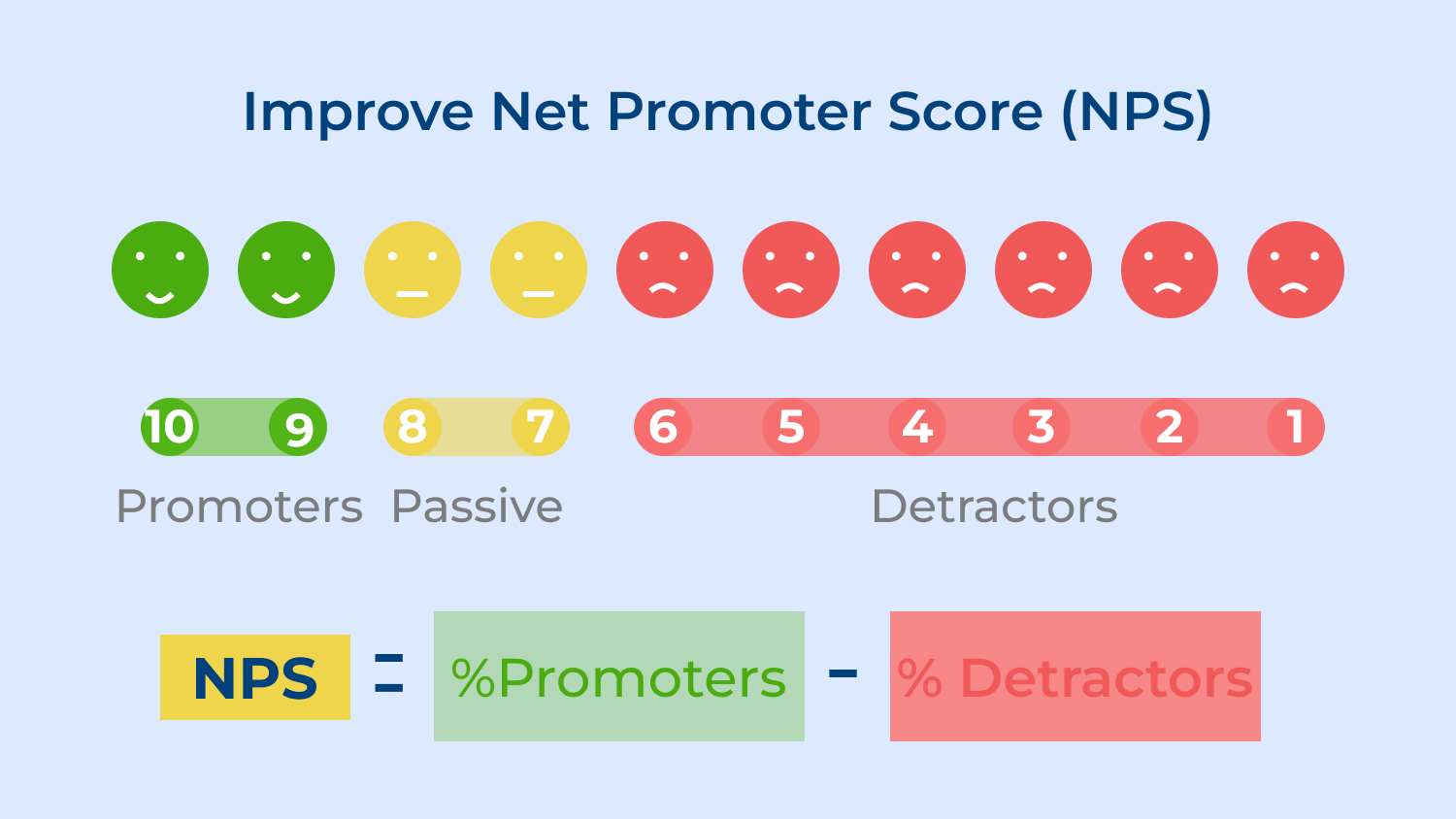
NPS is a metric that measures customer satisfaction and loyalty by asking customers how likely they are to recommend your business to others on a scale of 0-10.
NPS helps gauge customer loyalty and provides insight into how your brand is perceived. A high NPS score indicates strong customer satisfaction and potential for organic growth through referrals.
Regularly track NPS to monitor customer sentiment and identify areas for improvement. Use feedback from detractors to address weaknesses and from promoters to strengthen loyalty programs.
Actionable tips:
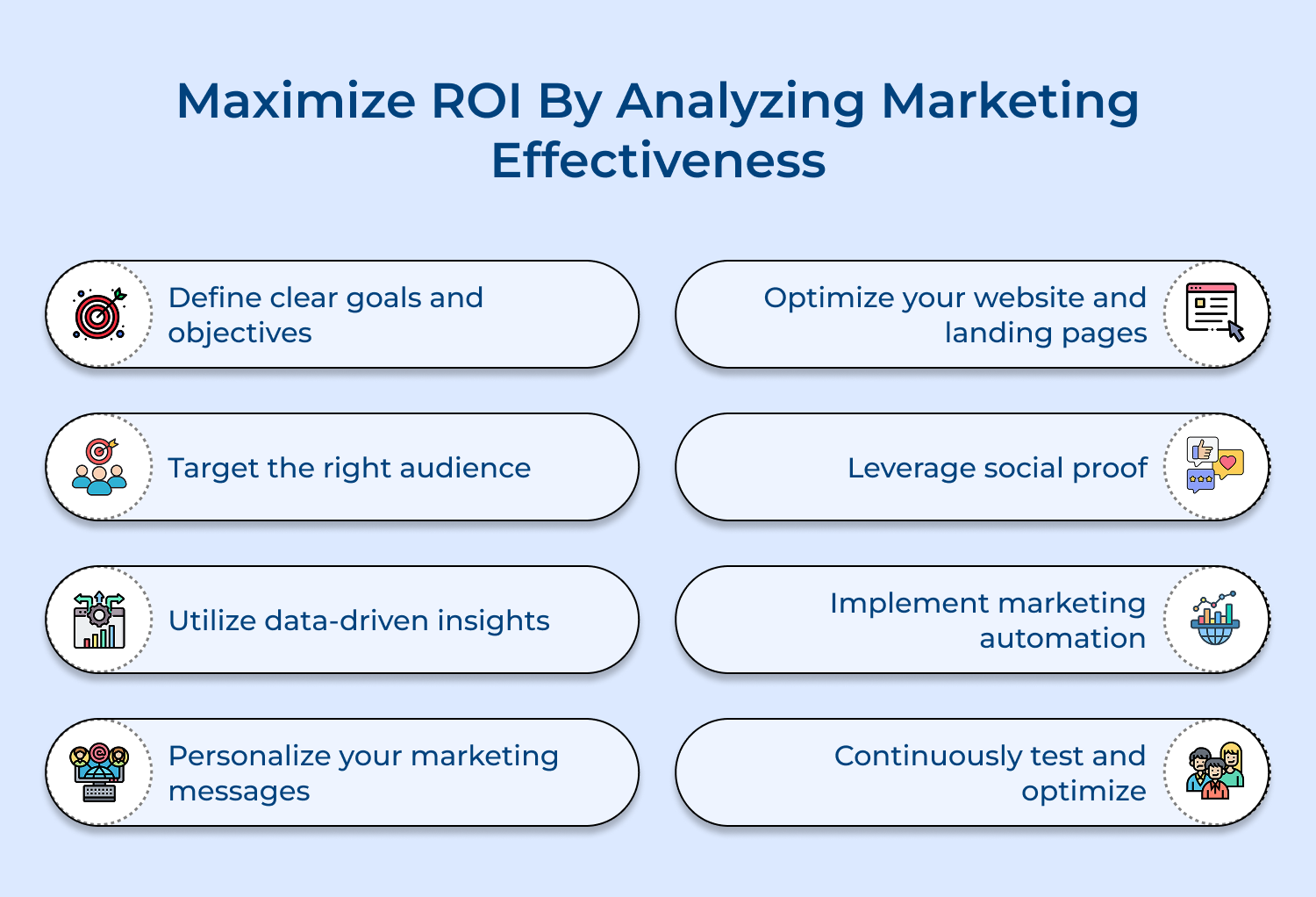
Return on Investment (ROI) measures how profitable an investment is by comparing the return to its cost. It’s calculated by dividing net profit by the investment amount.
ROI helps you understand which campaigns or initiatives are delivering value and which aren’t. Tracking ROI makes it easier to shift budgets toward high-performing channels and cut spend on efforts that don’t pay off.
Actionable tips:
Order fulfillment time is the average time taken to process, pack and ship an order to the customer.
Faster fulfillment times improve customer satisfaction and lead to higher repeat purchase rates. It also helps reduce costs by streamlining supply chain operations.
Track fulfillment time to identify bottlenecks in the order process. By reducing delays and optimizing logistics, you can enhance the customer experience as well as improve retention.
Actionable tips:
Tracking ecommerce KPIs is only useful if you know how to act on them. We’ve curated just the right steps to make sure you use them efficiently.
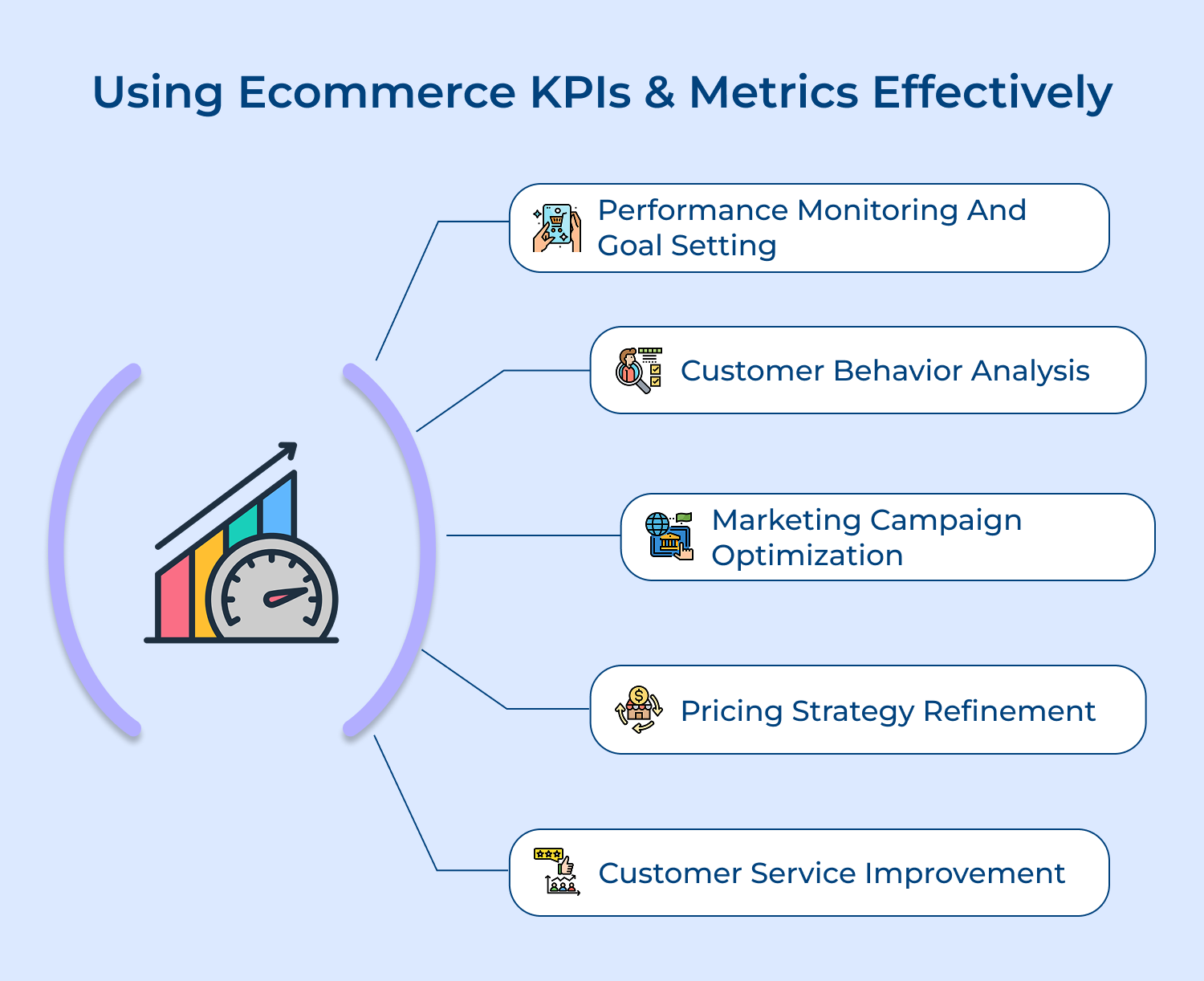
Performance Monitoring and Goal Setting
Track your store’s performance against set targets and industry benchmarks to identify growth opportunities as well as areas needing improvement. Regular monitoring helps establish realistic goals and ensures your business stays on track with objectives.
Customer Behavior Analysis
Use KPIs to understand how customers interact with your store, from browsing patterns to purchase decisions. This insight helps optimize the user experience, improve product recommendations and create more effective marketing strategies.
Marketing Campaign Optimization
Evaluate the effectiveness of different marketing channels and campaigns by analyzing metrics like ROAS, conversion rates, as well as customer acquisition costs. It helps allocate marketing budgets more efficiently and improve campaign targeting.
Pricing Strategy Refinement
Review metrics like average order value, profit margins, and conversion rates to adjust your pricing approach. These insights help you find the right price points, measure how well promotions perform and increase revenue without losing competitiveness.
Customer Service Improvement
Monitor customer satisfaction scores, return rates and support resolution times to improve service quality. The data helps pinpoint friction in the customer journey and make focused improvements that strengthen loyalty and retention.
Tracking ecommerce KPIs isn’t always straightforward, especially as data sources and tools grow. Many businesses face challenges that prevent them from turning metrics into actionable insights.
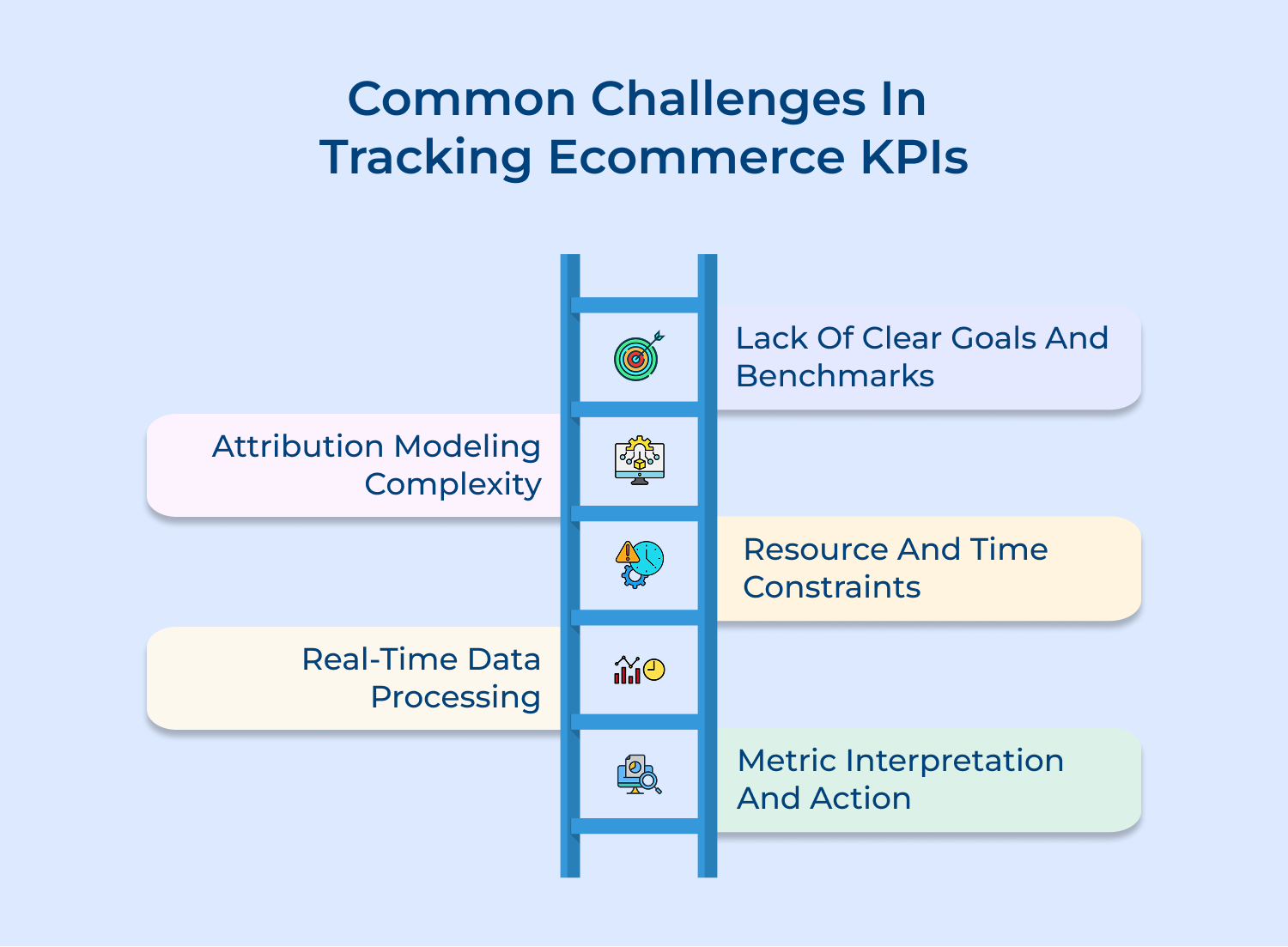
Lack of Clear Goals and Benchmarks
Challenge: Without defined targets and industry benchmarks, it’s difficult to determine if KPI performance is actually good or needs improvement.
Solution:
Attribution Modeling Complexity
Challenge: Determining which marketing channels deserve credit for conversions, especially with customers engaging across multiple touchpoints.
Solution:
Resource and Time Constraints
Challenge: Limited time and expertise to properly analyze data while deriving actionable insights from KPIs.
Solution:
Real-Time Data Processing
Challenge: Delayed access to critical metrics hampering quick decision-making and response to market changes.
Solution:
Metric Interpretation and Action
Challenge: Difficulty in translating KPI data into actionable business decisions.
Solution:
Optimizing ecommerce KPIs requires more than just tracking numbers—it’s about using insights to drive action. Here are the best practices to follow:
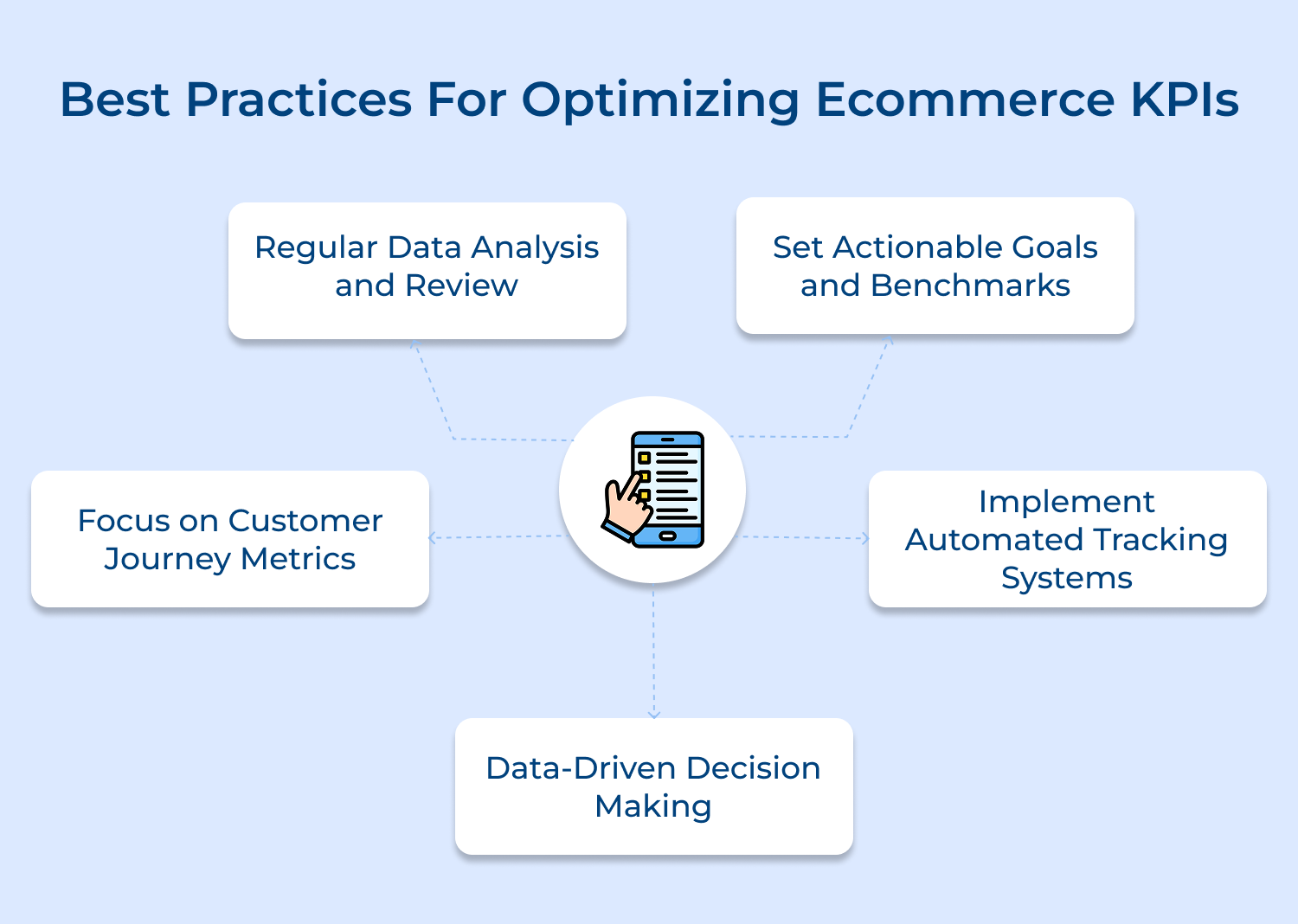
Regular Data Analysis and Review
Establish a consistent schedule for analyzing KPI data and reviewing performance trends. Conduct weekly operational reviews and monthly strategic assessments to identify patterns, opportunities as well as areas needing immediate attention.
Set Actionable Goals and Benchmarks
Define clear, measurable targets for each KPI based on historical data and industry standards. Break down long-term objectives into shorter milestone targets and regularly adjust goals based on market conditions as well as business growth.
Focus on Customer Journey Metrics
Track metrics across the entire customer journey, from awareness to post-purchase. Monitor touchpoints like initial engagement, cart abandonment, conversion rates and post-purchase satisfaction to optimize the complete customer experience.
Implement Automated Tracking Systems
Use automated tools and dashboards to collect while visualizing data in real-time. Set up alerts for significant metric changes and automate routine reporting tasks to ensure consistent monitoring without excessive manual effort.
Data-Driven Decision Making
Base business decisions on KPI insights rather than assumptions. Test changes through A/B testing, measure their impact on relevant metrics and iterate based on results to continuously improve performance.
Unlocking ecommerce growth requires focusing on the key KPIs that directly impact performance. Measuring metrics ensures better resource allocation, customer engagement and profitability. Regular evaluation keeps strategies on track as well as the business ahead.
Accurate tracking allows businesses to anticipate trends, refine strategies proactively and enhance marketing efforts for a higher ROI. Equipped with data, companies can confidently make decisions that lead to long-term, sustainable growth and improved market positioning.

How often should I review my ecommerce KPIs?
Monitor basic metrics (sales, traffic, conversion rates) daily, conduct weekly reviews of marketing performance and customer behavior, while performing monthly deep-dives into broader trends as well as strategic metrics. Quarterly reviews should focus on long-term KPIs like customer lifetime value and retention rates.
What’s a good conversion rate for e-commerce?
Average e-commerce conversion rates typically range from 1% to 4%, but “good” rates vary significantly by industry, product type and price point. Focus on improving your own historical conversion rate rather than just comparing to industry averages.
How can I improve my customer lifetime value (CLV)?
Increase CLV by implementing loyalty programs, personalizing customer experiences, offering targeted upsells and cross-sells. Provide excellent customer service and maintain consistent communication through email marketing as well as engagement campaigns.
What’s the best way to reduce cart abandonment?
Address common abandonment causes by offering transparent shipping costs, multiple payment options, guest checkout, clear return policies, mobile-optimized checkout and security badges. Implement abandoned cart recovery emails with personalized incentives to recapture lost sales.
How do I calculate ROI for my marketing campaigns?
Calculate marketing ROI by subtracting total marketing costs from revenue generated, then dividing by marketing costs and multiplying by 100. Include all campaign-related expenses and use proper attribution tracking to accurately measure revenue impact.
What’s more important: acquiring new customers or retaining existing ones?
Both matter, but retention often provides better ROI since acquiring new customers typically costs 5-25 times more than retaining existing ones. Focus on balancing both metrics while prioritizing retention strategies that encourage repeat purchases.
 https://omni24.io/wp-content/uploads/2026/08/AI-Customer-Service-Agents.png
1256
2400
Webvision Solution
https://omni24.io/wp-content/uploads/2023/04/Omni-Logo-1.svg
Webvision Solution2026-09-21 04:48:512026-09-21 04:48:51How to Build an AI Customer Service Agents: 8 Key Steps
https://omni24.io/wp-content/uploads/2026/08/AI-Customer-Service-Agents.png
1256
2400
Webvision Solution
https://omni24.io/wp-content/uploads/2023/04/Omni-Logo-1.svg
Webvision Solution2026-09-21 04:48:512026-09-21 04:48:51How to Build an AI Customer Service Agents: 8 Key Steps https://omni24.io/wp-content/uploads/2026/08/Omnichannel-Conversational-AI.png
1256
2400
Tushar Joshi
https://omni24.io/wp-content/uploads/2023/04/Omni-Logo-1.svg
Tushar Joshi2026-09-16 03:51:072026-09-16 03:51:07How to Build Omnichannel Conversational AI Strategy
https://omni24.io/wp-content/uploads/2026/08/Omnichannel-Conversational-AI.png
1256
2400
Tushar Joshi
https://omni24.io/wp-content/uploads/2023/04/Omni-Logo-1.svg
Tushar Joshi2026-09-16 03:51:072026-09-16 03:51:07How to Build Omnichannel Conversational AI Strategy https://omni24.io/wp-content/uploads/2026/08/Customer-Service-Teams.png
1256
2400
Tushar Joshi
https://omni24.io/wp-content/uploads/2023/04/Omni-Logo-1.svg
Tushar Joshi2026-09-15 04:01:522026-09-15 04:02:16How to Build Customer Service Teams: 6 Key Steps
https://omni24.io/wp-content/uploads/2026/08/Customer-Service-Teams.png
1256
2400
Tushar Joshi
https://omni24.io/wp-content/uploads/2023/04/Omni-Logo-1.svg
Tushar Joshi2026-09-15 04:01:522026-09-15 04:02:16How to Build Customer Service Teams: 6 Key Steps
Whether it’s about acquire, engage or support – Omni24 covers all your customer engagement needs in one complete platform.

Copyright ©2026 Veemo All rights reserved.
CA, Los Angeles, Hall Ave, 19011