9 Proven Steps to Deliver an Effective Live Chat Strategy
Using digital channels like live chat enables real-time customer connections, boosting business ROI and strengthening long-term customer relationships overall.
Using digital channels like live chat enables real-time customer connections, boosting business ROI and strengthening long-term customer relationships overall.
Customers no longer want to deal with the hassles of waiting on hold for customer service. They prefer the convenience of having their queries addressed real time. Live chat has become a necessity in the modern digital space for any business wanting to create a truly successful customer experience (CX).
41% of consumers prefer live chat support, and it has the highest consumer satisfaction rate. Live chat allows clients instant access to support reps who can quickly address their issues.
Hence, it is clear why any successful CX program must include a live chat strategy. By implementing a live chat strategy, you can improve overall customer service communication
Let us discuss what live chat is needed, its best practices, and actionable steps that businesses can take to deliver an effective live chat strategy.
A live chat strategy is defined as a plan that enables a company to proactively engage customers, address their questions or concerns instantly, and use the conversation to drive sales.
A successful web chat strategy will include planning how customer questions are answered, staff training on customer service best practices, tracking customer metrics such as satisfaction, abandonment rates, and even analytical tools like AI-driven software solutions to help agents streamline customer conversations.
Key objective:
A live chat strategy helps companies provide better customer service while potentially increasing sales or conversion rates. Live chat gives companies the chance to personalize interactions with their customers by showing they are truly listening to their needs and responding in kind.
Addressing customer inquiries quickly via live chat, companies can reduce support costs. Gathering data from chats can also assist customers by generating recommendations based on past conversations. A comprehensive live chat strategy is an invaluable asset for businesses looking to build loyal relationships with their customers.
Unlike reactive support like email or phone, the proactive live chat support enables you to see the activity of the user on the website. Implementing live chat as part of the overall customer communication strategy can help businesses across key business functions.
Deploying live chat brings in multiple benefits towards the business. A strategic live chat strategy can help create tremendous value for both customers and businesses alike.
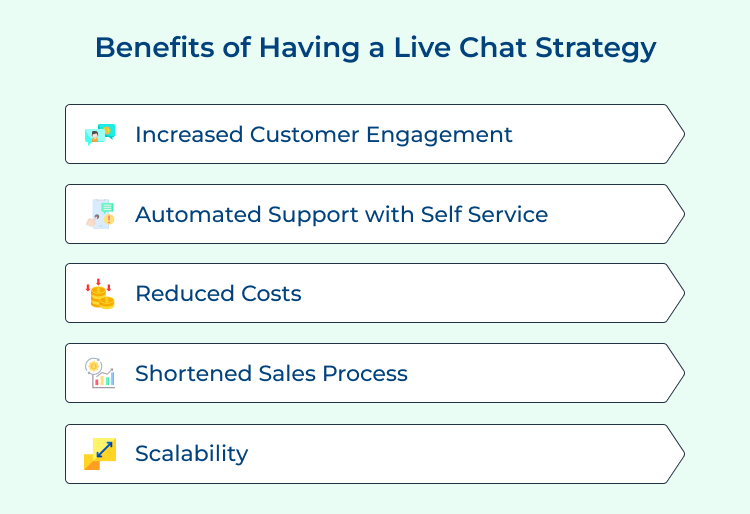
Successful live chat implementation requires clearly defined objectives and a well-structured plan. Focusing on these key areas ensures the strategy delivers maximum impact.
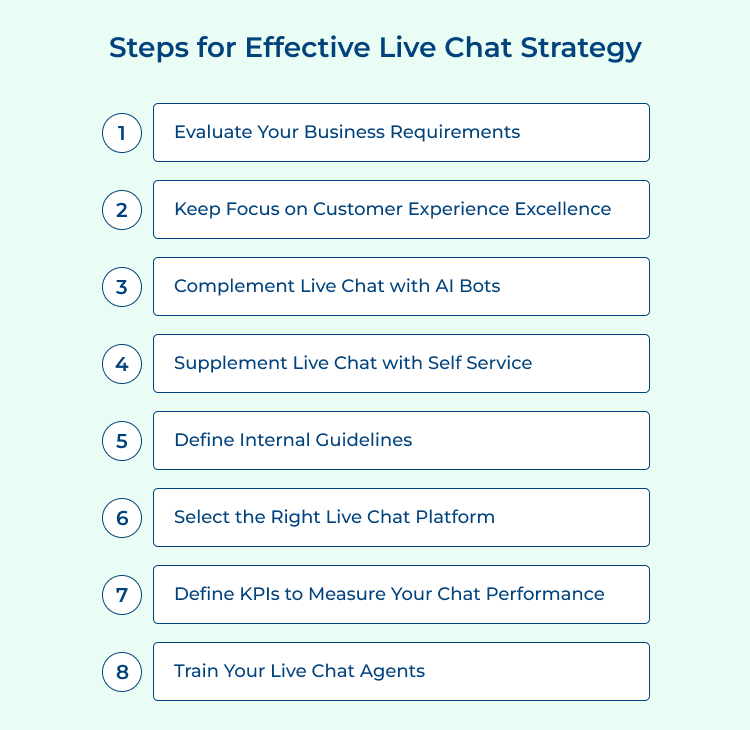
When it comes to developing a live chat strategy, firstly evaluate your business needs and determine how a live chat system can benefit the business. It will help ensure that the resources invested in a live chat system are actually being used to improve customer service and engagement.
Consider analyzing various customer service requests, considering customer buying behavior, determining the peak hours for interactions and evaluating how many agents you need at any given time.
Pro tips:
Your live chat strategy should always be about providing an excellent customer experience. This should remain your priority when developing content or selecting new chat software and other tools.
So things like delivering personalized conversations, ensuring secure access to sensitive data, using automated triggers/ bots & analytics to meet customer needs quickly, etc., should all be part of the plan.
Implementing live chat strategies that would allow customers to leave feedback or request reviews could help further bolster the user experience.
Pro tips:
AI bots are quickly emerging as an effective complement to live chat for customer service. If programmed correctly, they can take on many of the mundane tasks, such as directing customers to relevant web pages or forms and providing basic customer service inquiries.
Chatbots can provide personalized customer service by remembering and responding to customers’ histories or behaviors. It is important to ensure that customer inquiries are captured properly and that customers receive responses in a timely manner.
Pro tips:
Brands can improve their customer service by introducing self-service options for customers who prefer more interactive and personalized solutions than a simple bot interaction.
Companies can implement self-service options through menu bars, FAQs, knowledge databases, interactive guides, and more, depending on the type of business.
These options allow customers to access answers without having to speak with an agent and give agents valuable insights into user behavior or intent so they can efficiently serve customers who require more help or greater assistance in assessing their needs.
Overall, adding various self-service options that are easily accessible will create a more efficient live chat experience for all parties involved.
Pro tips:
Before starting any live chat service, it is important to establish internal guidelines for use. It should include protocol on how to handle customer inquiries, when to transfer chats to other team members or departments, what types of communication are allowed in the chat system, and who is responsible for issuing responses and updates.
Having an established set of internal procedures, customer satisfaction and employee performance can be improved throughout the duration of the live chat service.
Pro tips:
After deciding upon your internal guidelines, selecting the most appropriate platform for your objectives is essential for success.
Ensure that the chosen platform offers features like customizable message templates, reporting capabilities, API integrations with existing systems, email notifications, encrypted sessions security, and mobile compatibility, amongst others, as per your requirements.
Pro tips:
Establishing evaluation metrics from key performance indicators allows you to track progress on longer-term goals that relate to customer satisfaction ratings, sales figures, and employee efficiency levels, so you can measure return-on-investment (ROI).
Auxiliary benefits such as positive branding due to better engagement rate,s will show themselves later down the line.
Looking at these factors together helps you assess effectiveness over time instead of just immediate reactivity and response rate successes in order to have a more comprehensive view of which strategies are working well long-term.
Pro tips:
Ensure your customers have a speedy and satisfactory resolution to their queries; it is crucial to have well-trained live chat agents.
Conducting regular customer service training that focuses on providing excellent customer service and that familiarizes agents with company products will help ensure they can provide the best possible advice or resolutions to inquiries or problems.
Pro tips:
Planning an effective live chat strategy helps businesses to achieve objectives, but you should also consider other key factors such as omnichannel, team management and internal training to get optimum results.
Leveraging AI-enabled bots, live chat can become the most powerful channel to deliver sales and support assistance, and also automate your routine tasks. So it’s the best of both worlds, better performance and lower costs.

How can businesses provide proactive support through their live chat strategy?
Businesses that had implemented live chat strategy can offer proactive support by the following ways:
How can businesses measure the effectiveness of their live chat strategy?
Businesses can measure the effectiveness of their live chat strategy with a set of key performance indicators (KPIs). It is vital to measure the effectiveness as it helps businesses to understand if they are able to meet customer expectations and measure customer satisfaction scores. The metrics and KPIs also help to measure agent performance in terms of how they are handling customer conversations.
How can a well-defined live chat strategy enhance customer engagement?
The good quality product & customer support determine the success of your business. One of the best ways to deliver an excellent customer experience is to provide real time assistance by automating help 24×7 with a well-defined live chat strategy. If visitors can easily connect with you with product/service-related queries, they will be more confident and a source of satisfying customer support and valuable knowledge.
What are some best practices for implementing a successful live chat strategy?
There are many best practices that help businesses in successfully implementing live chat strategy. Some of them are as follows:
 https://omni24.io/wp-content/uploads/2026/09/Social-commerce-scaled.png
1340
2560
Webvision Solution
https://omni24.io/wp-content/uploads/2023/04/Omni-Logo-1.svg
Webvision Solution2026-10-23 12:18:272026-10-23 12:18:27What is Social Commerce and Why Does It Matter?
https://omni24.io/wp-content/uploads/2026/09/Social-commerce-scaled.png
1340
2560
Webvision Solution
https://omni24.io/wp-content/uploads/2023/04/Omni-Logo-1.svg
Webvision Solution2026-10-23 12:18:272026-10-23 12:18:27What is Social Commerce and Why Does It Matter? https://omni24.io/wp-content/uploads/2026/08/AI-Customer-Service-Agents.png
1256
2400
Webvision Solution
https://omni24.io/wp-content/uploads/2023/04/Omni-Logo-1.svg
Webvision Solution2026-09-21 04:48:512026-09-21 04:48:51How to Build an AI Customer Service Agents: 8 Key Steps
https://omni24.io/wp-content/uploads/2026/08/AI-Customer-Service-Agents.png
1256
2400
Webvision Solution
https://omni24.io/wp-content/uploads/2023/04/Omni-Logo-1.svg
Webvision Solution2026-09-21 04:48:512026-09-21 04:48:51How to Build an AI Customer Service Agents: 8 Key Steps https://omni24.io/wp-content/uploads/2026/08/Omnichannel-Conversational-AI.png
1256
2400
Tushar Joshi
https://omni24.io/wp-content/uploads/2023/04/Omni-Logo-1.svg
Tushar Joshi2026-09-16 03:51:072026-09-16 03:51:07How to Build Omnichannel Conversational AI Strategy
https://omni24.io/wp-content/uploads/2026/08/Omnichannel-Conversational-AI.png
1256
2400
Tushar Joshi
https://omni24.io/wp-content/uploads/2023/04/Omni-Logo-1.svg
Tushar Joshi2026-09-16 03:51:072026-09-16 03:51:07How to Build Omnichannel Conversational AI Strategy
Whether it’s about acquire, engage or support – Omni24 covers all your customer engagement needs in one complete platform.

Copyright ©2026 Veemo All rights reserved.
CA, Los Angeles, Hall Ave, 19011