Why Most Chatbot Fails and How to Prevent Them?

Chatbot Fails can be hilarious or frustrating—discover memorable misfires and key lessons for businesses to improve customer experiences.
Chatbot fails

Chatbots have become ubiquitous in customer service, but their shortcomings are increasingly apparent.

Microsoft’s Tay, XiaoBing, Tencent’s BabyQ and KLM’s Twitter bot were all withdrawn after high-profile failures such as hate speech, unpatriotic comments etc.

Despite advances in AI, many users still encounter frustrating experiences with these digital assistants. From misinterpreting queries to providing irrelevant responses, chatbot failures can lead to customer dissatisfaction and lost business opportunities.

Explore common chatbot pitfalls and their impact on user experience. Delve into real-world examples of chatbot fails, analyze the underlying causes, and discuss the ripple effects on brand perception.

What is Chatbot Failure?

Chatbot failure occurs when an AI-powered conversational interface fails to meet user expectations or achieve its intended purpose. It can result in poor user experience, miscommunication, or inability to complete tasks effectively.

A common reason behind chatbot failure is the lack of contextual understanding and adaptability. When a chatbot cannot accurately interpret user intent or provide relevant and timely responses, users often feel frustrated and lose trust in the system.

Key objectives:

  1. Improve natural language understanding Enhance the chatbot’s ability to interpret user inputs accurately
  2. Expand knowledge base or context awareness Broaden the chatbot’s information repository and situational comprehension
  3. Enhance error handling and recovery Develop better mechanisms to identify manage misunderstandings
  4. Optimize conversation flow and user engagement Refine dialogue structures to maintain engaging interactions

Why Do Chatbots Fail ?

Chatbots have become increasingly popular as a customer service and engagement tool, but they often fail to meet user expectations.
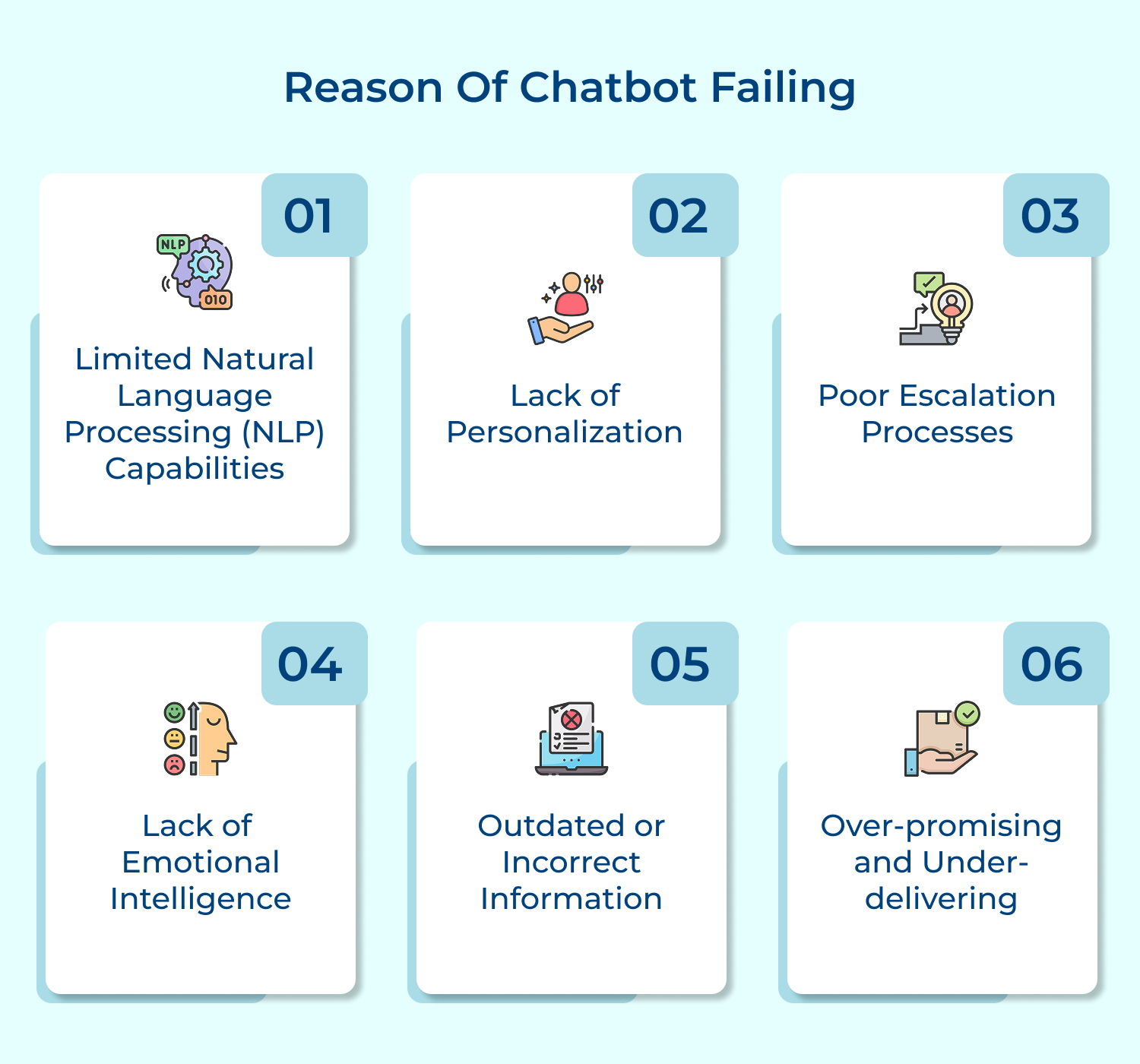
Reason of chatbot failing
  • Limited Natural Language Processing (NLP) Capabilities
    Many chatbots struggle with understanding context, nuance and complex language. Their NLP algorithms may be too basic to interpret user intent accurately, especially when dealing with colloquialisms, sarcasm, or industry-specific jargon. The limitation can lead to frustrating interactions where the chatbot misinterprets user queries or provides irrelevant responses.
  • Lack of Personalization
    Generic responses often characterize chatbot interactions. Without access to user history or preferences, chatbots fail to provide personalized experiences. Such one-size-fits-all approach can make users feel like they’re talking to a machine rather than receiving tailored assistance, leading to dissatisfaction and a preference for human interaction.
  • Poor Escalation Processes
    When a chatbot can’t resolve an issue, it should seamlessly transfer the conversation to a human agent. But, many chatbots lack effective escalation protocols. They might not recognize when they’re out of their depth or fail to properly hand over context to human agents, resulting in frustrated users who have to repeat their problems.
  • Lack of Emotional Intelligence
    Chatbots typically cannot detect or respond appropriately to user emotions. They may miss cues indicating frustration, urgency, or distress in a user’s messages. This lack of emotional intelligence can lead to tone-deaf responses that exacerbate user frustration rather than alleviating it.
  • Outdated or Incorrect Information
    Chatbots rely on the information they’re programmed with or have access to. If this information isn’t regularly updated, chatbots may provide outdated or incorrect answers. It is problematic in fast-changing environments like e-commerce, where product information, pricing and availability frequently change.
  • Over-promising and Under-delivering
    Many businesses market their chatbots as highly capable AI assistants, setting high user expectations. When these chatbots fail to live up to the hype – struggling with basic tasks or providing obviously automated responses – users feel let down. This mismatch between expectation and reality can damage brand perception or customer trust.

Top 6 Common Chatbot Fails and How to Prevent Them

Chatbots have become an essential tool for businesses looking to streamline their customer service operations and improve user experience. Like any technology, chatbots are not immune to issues that can hinder their effectiveness.
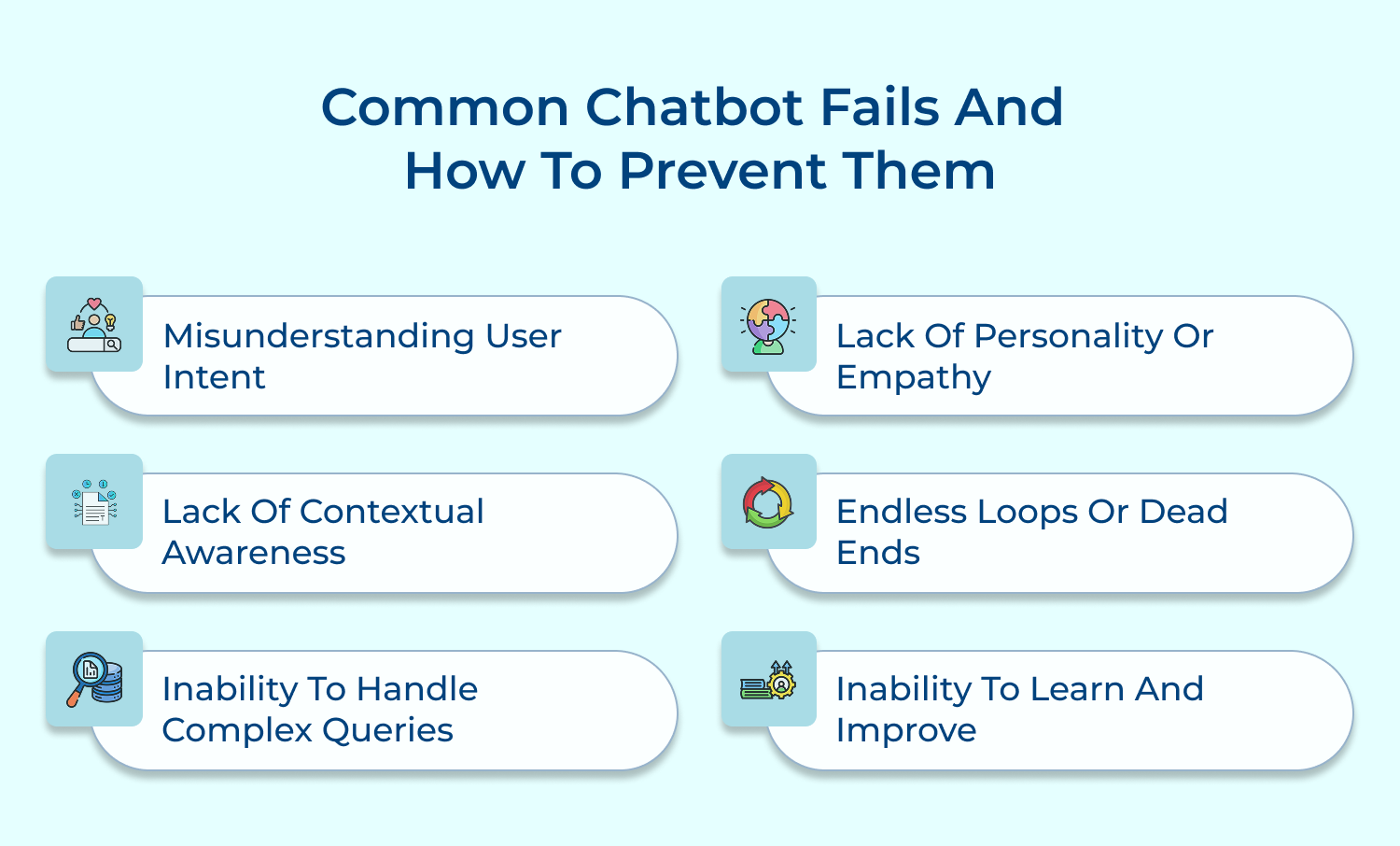
Common chatbot fails and how to prevent them

1. Misunderstanding User Intent

Chatbots sometimes misinterpret user queries, leading to irrelevant or incorrect responses. This can occur due to limited natural language processing capabilities or insufficient training data.

Prevention: Improve the chatbot’s natural language understanding through extensive training with diverse datasets. Implement intent recognition algorithms and continuously update the chatbot’s knowledge base based on user interactions.

How to implement :

  • Utilize advanced NLP libraries and machine learning models
  • Regularly analyze user queries to identify and address common misinterpretations
  • Implement a feedback loop for continuous improvement

2. Lack of Contextual Awareness

Chatbots may fail to maintain context throughout a conversation, resulting in disjointed or repetitive responses that frustrate users.

Prevention: Develop the chatbot’s ability to track conversation history and maintain context. Implement state management techniques and design conversation flows that account for various user paths.

Tips to Implement:

  • Use dialogue management systems to track conversation state
  • Implement memory mechanisms to recall previous user inputs
  • Design conversation trees with multiple branches and fallback options

3. Inability to Handle Complex Queries

When faced with multi-faceted or nuanced questions, chatbots may provide oversimplified or incomplete answers.

Prevention: Design the chatbot to recognize complex queries and either break them down into manageable parts or escalate to human support when necessary. Develop a robust knowledge base to handle a wide range of topics.

Pro tips:

  • Create a query complexity assessment algorithm
  • Implement a human handoff protocol for queries beyond the chatbot’s capabilities
  • Continuously expand the chatbot’s knowledge base based on user interactions

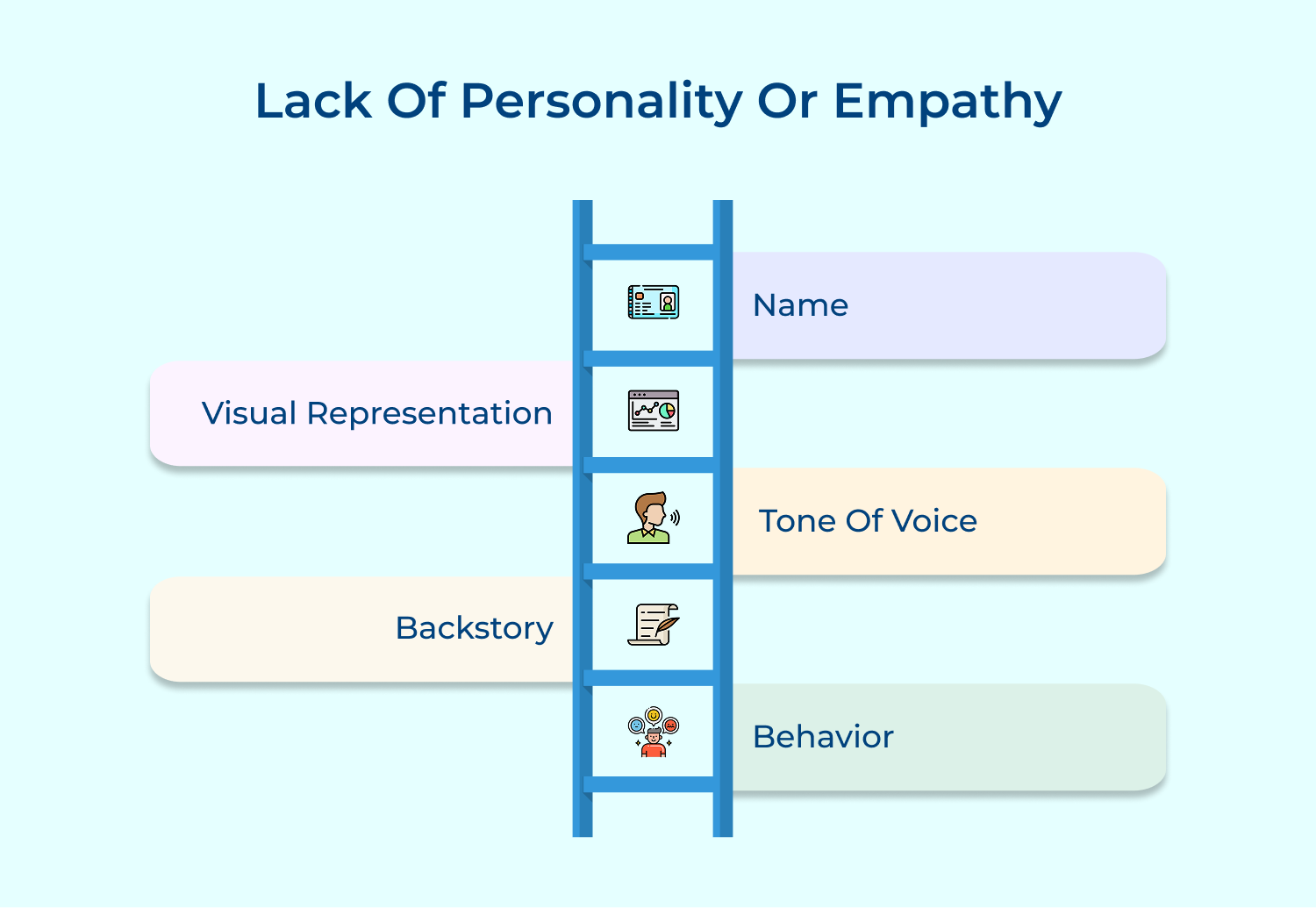
4. Lack of Personality or Empathy

Chatbots that communicate in a robotic or impersonal manner can alienate users and fail to build rapport.

Prevention: Develop a consistent personality for the chatbot that aligns with your brand voice. Incorporate empathy into responses, especially when dealing with customer service issues or sensitive topics.
Lack of personality or empathy

Ways to Implement it:

  • Define clear personality traits and communication style guidelines
  • Incorporate sentiment analysis to detect user emotions and respond appropriately
  • Use natural language generation techniques to create more human-like responses

5. Endless Loops or Dead Ends

Users can become trapped in conversation loops or reach dead ends where the chatbot cannot provide further assistance.

Prevention: Design conversation flows with clear exit points and fallback options. Implement mechanisms to detect when a user is stuck and offer alternative solutions or human support.

How to Implement it:

  • Create a conversation flow map with multiple pathways and escape routes
  • Implement a maximum iteration counter to prevent infinite loops
  • Provide clear options for users to reset the conversation or seek alternative help

6. Inability to Learn and Improve

Static chatbots that don’t evolve based on user interactions quickly become outdated and ineffective.

Prevention: Implement machine learning algorithms that allow the chatbot to learn from each interaction. Regularly analyze user feedback and chat logs to identify areas for improvement.

Tips to Implement it:

  • Integrate reinforcement learning techniques to optimize chatbot responses
  • Establish a regular review process for chatbot performance metrics
  • Implement A/B testing for new features or conversation flows

Strategies to Prevent Chatbot Failure

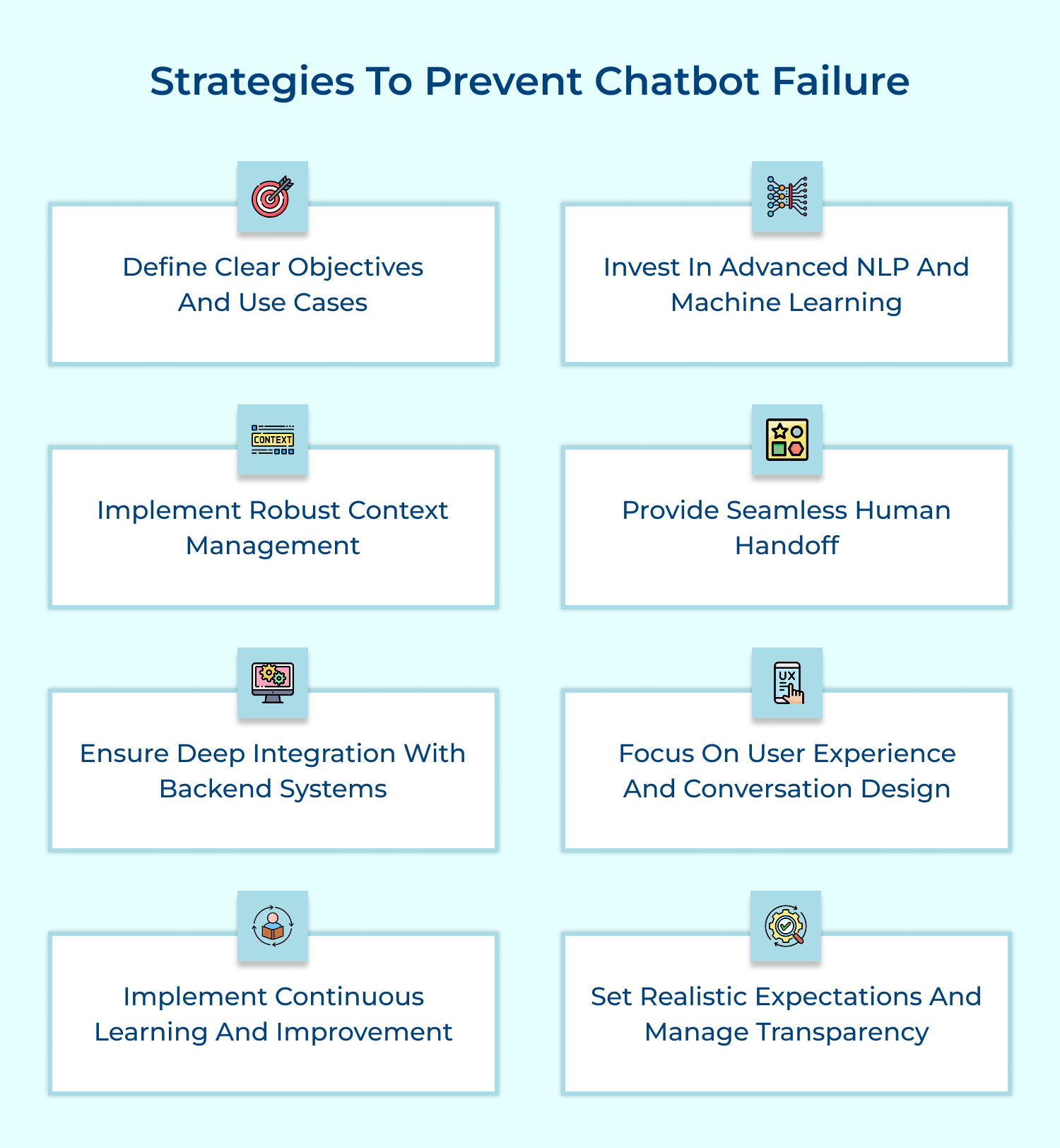
Chatbots have become an integral tool for businesses looking to improve customer service, automate processes and increase efficiency. But, chatbot failure is a common issue that many businesses face.
Strategies to prevent chatbot failure
  • Define Clear Objectives and Use Cases
    Start by clearly defining the purpose of your chatbot and the specific problems it’s meant to solve. Identify key use cases and prioritize them based on user needs. This focused approach helps in designing a chatbot that excels in its intended role rather than trying to be a jack-of-all-trades. By setting clear objectives, you can measure success more effectively and continually refine the chatbot’s capabilities.
  • Invest in Advanced NLP and Machine Learning
    To overcome limitations in understanding and interpreting user input, invest in advanced Natural Language Processing (NLP) plus machine learning technologies. These technologies enable your chatbot to better understand context, handle variations in language and improve its responses over time. Regularly update and retrain your language models with new data to keep the chatbot understanding relevant.
  • Implement Robust Context Management
    Design your chatbot with strong context management capabilities. This involves maintaining conversation history, understanding user intent across multiple interactions and remembering key information without repetitive questioning. Implementing a solid context management system allows for more natural, flowing conversations and enables the chatbot to provide more personalized responses.
  • Provide Seamless Human Handoff
    Recognize that there will always be scenarios where human intervention is necessary. Design your chatbot to identify when it’s struggling or when a query is too complex and implement a smooth handoff process to human agents. This transition should be seamless with the chatbot providing all relevant conversation context to the human agent. Clearly communicate to users when they’re being transferred to a human, maintaining transparency throughout the process.
  • Ensure Deep Integration with Backend Systems
    For a chatbot to be truly effective, it needs access to relevant data and systems. Invest in robust integrations with your CRM, knowledge bases, product catalogs and other critical backend systems. This integration allows the chatbot to provide up-to-date information, perform actions on behalf of users and offer personalized assistance.
  • Focus on User Experience and Conversation Design
    Pay close attention to the user experience and conversation design. Create natural, engaging dialogues that guide users effectively towards their goals. Use clear, concise language and break complex processes into manageable steps. Incorporate elements of personality that align with your brand voice and design conversations that can handle small talk and show empathy when appropriate. Regularly refine conversation flows based on user feedback and interaction data.
  • Implement Continuous Learning and Improvement
    Set up systems for continuous learning and improvement. Regularly analyze chatbot interactions to identify areas where it’s struggling or failing to meet user needs. Use this data to refine responses, add new capabilities and improve existing ones. Consider implementing machine learning algorithms that can automatically learn from interactions and improve performance over time.
  • Set Realistic Expectations and Manage Transparency
    Be transparent about your chatbot’s capabilities and limitations. Clearly communicate to users that they’re interacting with an AI and set realistic expectations about what the chatbot can and cannot do. Provide easy options for users to access alternative support channels when needed. By managing expectations, you can reduce user frustration and build trust in your chatbot solution.

Key Benefits of Avoiding Chabot Fails

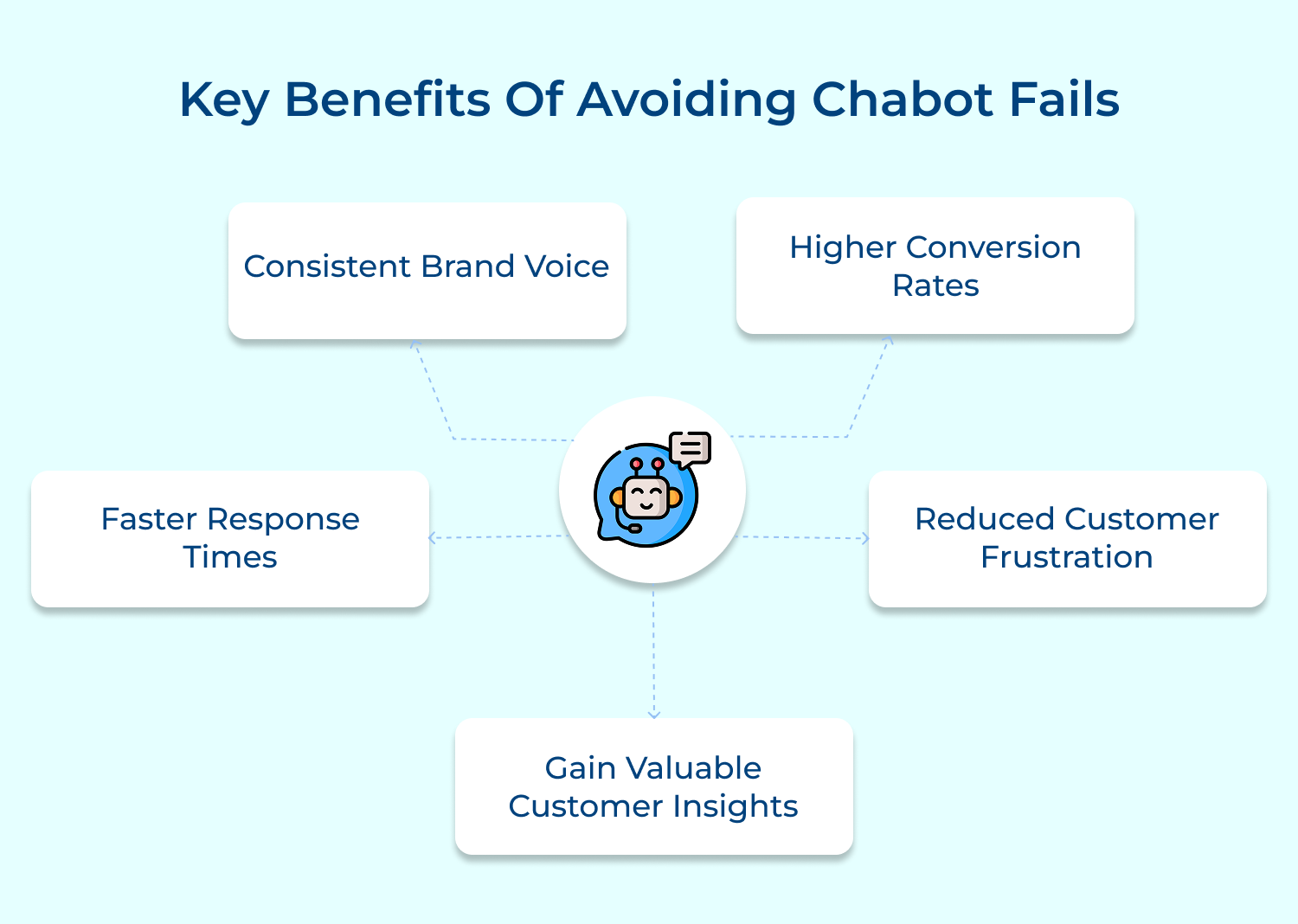
Avoiding chatbot failures yields numerous benefits for businesses, enhancing customer experience and operational efficiency.
Key benefits of avoiding chabot fails
  • Consistent Brand Voice
    When chatbots perform well, they maintain a consistent brand voice across all interactions. This consistency reinforces brand identity and values, creating a cohesive customer experience. Well-functioning chatbots can embody the company’s personality, whether it’s professional, friendly or quirky, ensuring that every interaction aligns with the brand’s image and messaging strategy.
  • Higher Conversion Rates
    Successful chatbots can significantly boost conversion rates. By providing accurate information, guiding users through sales funnels and offering personalized recommendations, chatbots can effectively nudge potential customers towards making purchases or taking desired actions. They can also re-engage hesitant customers, address concerns promptly and reduce cart abandonment rates.
  • Faster Response Times
    One of the primary advantages of well-implemented chatbots is their ability to provide instant responses. This immediacy satisfies the modern customer’s expectation for quick service, enhancing overall satisfaction. Faster response times can lead to more efficient problem resolution, reducing the time customers spend seeking assistance and improving their overall experience with the brand.
  • Reduced Customer Frustration
    Avoiding common pitfalls, chatbots can significantly reduce customer frustration. Accurate responses, seamless conversations and appropriate escalation to human agents when necessary all contribute to a smoother customer journey. This reduction in frustration can lead to improved customer loyalty, positive word-of-mouth and a stronger brand reputation.
  • Gain Valuable Customer Insights
    Well-functioning chatbots serve as excellent data collection points. They can gather insights on customer preferences, common issues, frequently asked questions and emerging trends. This wealth of data can inform product development, marketing strategies and customer service improvements. By analyzing chatbot interactions, businesses can proactively address customer needs and stay ahead of market demands.

Types of Chatbot Failures

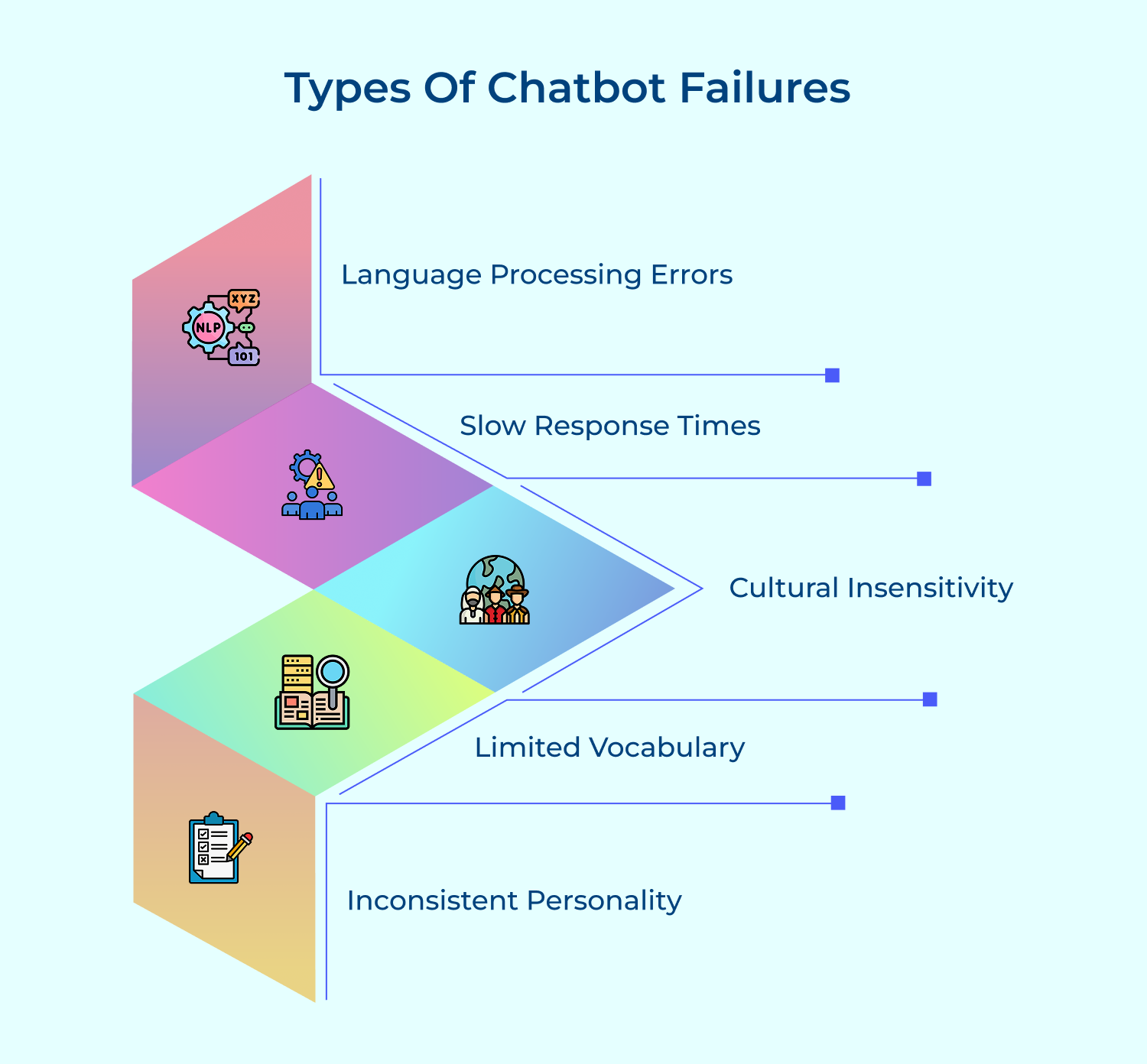
Chatbots can interact with users and answer their questions or assist them. But, despite their growing popularity, chatbots are not without their flaws.
Types of chatbot failures 

1. Language Processing Errors

Language processing errors occur when chatbots misinterpret user input, leading to irrelevant or incorrect responses. These errors can stem from limitations in natural language understanding, inability to grasp context or confusion with ambiguous phrases and colloquialisms.

Pro tips to avoid:

  1. Invest in advanced NLP technologies and regularly update language models.
  2. Implement context management systems to better understand user intent.
  3. Continuously train the chatbot with diverse language samples and real conversation data.

2. Slow Response Times

Slow response times refer to delays between user input and chatbot replies. This can frustrate users accustomed to instant digital interactions, potentially leading to abandonment of the conversation and negative perception of the service.

Pro tips to avoid:

  1. Optimize backend processes and ensure efficient integration with databases.
  2. Implement caching mechanisms for frequently requested information.
  3. Monitor and upgrade server capacity to handle peak loads effectively.

3. Cultural Insensitivity

Cultural insensitivity in chatbots manifests as responses that are inappropriate or offensive to certain cultural groups. This can result from biases in training data, lack of cultural awareness in programming, or failure to account for regional differences in language and customs.

Pro tips to avoid:

  1. Diversify the team developing the chatbot to include various cultural perspectives.
  2. Conduct thorough cultural sensitivity reviews of chatbot responses and scenarios.
  3. Implement region-specific customizations to account for local norms and expressions.

4. Limited Vocabulary

A limited vocabulary restricts a chatbot’s ability to understand and respond to a wide range of user inputs. This can lead to repetitive responses, inability to handle nuanced queries and a general feeling of interacting with a simplistic system.

Pro tips to avoid:

  1. Expand the chatbot’s knowledge base with industry-specific terms and common phrases.
  2. Implement machine learning algorithms to continuously expand vocabulary based on user interactions.
  3. Regularly update the chatbot’s language database with current terminology and expressions.

5. Inconsistent Personality

Inconsistent personality refers to a chatbot’s failure to maintain a coherent character or tone throughout interactions. This can confuse users and diminish the authenticity of the conversation, potentially reducing trust.

Pro tips to avoid:

  1. Develop a clear personality profile for the chatbot aligned with brand values.
  2. Create a comprehensive set of guidelines for tone, language and behavior.
  3. Regularly audit chatbot conversations to ensure consistency and make necessary adjustments.

Make Chatbot Fails as an Opportunity to Learn and Grow

Chatbots have the potential to revolutionize customer service and business processes, but their success is not guaranteed. Factors such as poor design, lack of context, and technical limitations can all contribute to chatbot failure.

It is important for businesses to carefully implement their chatbot strategies, ensuring they provide value to users and are continuously monitored or improved. By learning from past failures and taking proactive steps to address potential issues, businesses can increase the chances of chatbot success at the same time enhance the customer experience.

Neeti Singh brings clarity and creativity to her role as a content writer at Omni24. She specializes in turning technical subjects into accessible, compelling content, crafting blogs and guides that keep readers informed and confident in the dynamic world of software solutions.
Neeti Singh

FAQs about Chatbot Failure

A chatbot failure can be caused by various factors such as poor design, lack of proper training data, inadequate testing and failure to understand user needs. If a chatbot is not properly programmed or trained, it may give incorrect or irrelevant responses to user queries, leading to frustration and dissatisfaction.

It is important to overcome chatbot failure because a poorly functioning chatbot can have negative consequences for your business. Customers may become frustrated with the chatbot and choose to interact with a human representative instead, leading to longer wait times. A chatbot that consistently provides incorrect information can damage your brand reputation and credibility.

A chatbot failure can have a significant impact on your business in terms of customer satisfaction, brand image and overall revenue. If customers have a negative experience with your chatbot, they may be less likely to engage with your business in the future. This can result in lost sales opportunities and lower customer retention rates. If customers share their negative experiences with others, it can harm your brand reputation and deter potential customers.

When choosing a chatbot for your business, it is important to consider your specific needs and goals. There are various types of chatbots available, ranging from rule-based chatbots to AI-powered chatbots. Rule-based chatbots are more limited in their capabilities and can only respond to specific prompts, while AI-powered chatbots use natural language processing to understand to a wider range of queries.

blog sidebar image

Quickstart Guides

Popular

Latest Blogs