AI vs Human Customer Service: Which One Works Best?
Compare AI and human customer service, understand strengths, limitations, as well as best practices to design efficient support systems.
Compare AI and human customer service, understand strengths, limitations, as well as best practices to design efficient support systems.
Businesses these days often struggle to balance fast AI-powered support with the human touch customers value. Recent data shows while AI tools can offer 24/7 service and handle routine queries quickly, about 93% of customers still prefer human support for complex or sensitive issues.
By recognizing unique strengths and limitations of each approach, businesses can make strategic decisions about where technology creates value as well as where human connection remains irreplaceable.
In this guide, we explore eight crucial distinctions that illuminate how AI and human elements work together harmoniously. These insights will empower you to design a customer service ecosystem that feels both efficient and genuinely attentive.
AI-powered customer service uses artificial intelligence technologies to handle customer inquiries and support needs with minimal human intervention. It combines machine learning algorithms, natural language processing and automation to understand customer questions, provide relevant answers while resolving issues quickly. These systems learn from past interactions to improve their responses over time while offering 24/7 availability.
AI customer service starts by analyzing incoming customer messages through natural language processing. This technology helps the system understand the customer’s intent and sentiment regardless of how they phrase their question. The AI then searches its knowledge base for relevant information to formulate an appropriate response.
After identifying the right solution, the system delivers the answer through the customer’s preferred channel like chat, email, or voice. Throughout this process, the AI collects data about the interaction to learn from it. The system gets smarter with each conversation, recognizing patterns and improving its ability to handle similar questions in the future.
Key features:
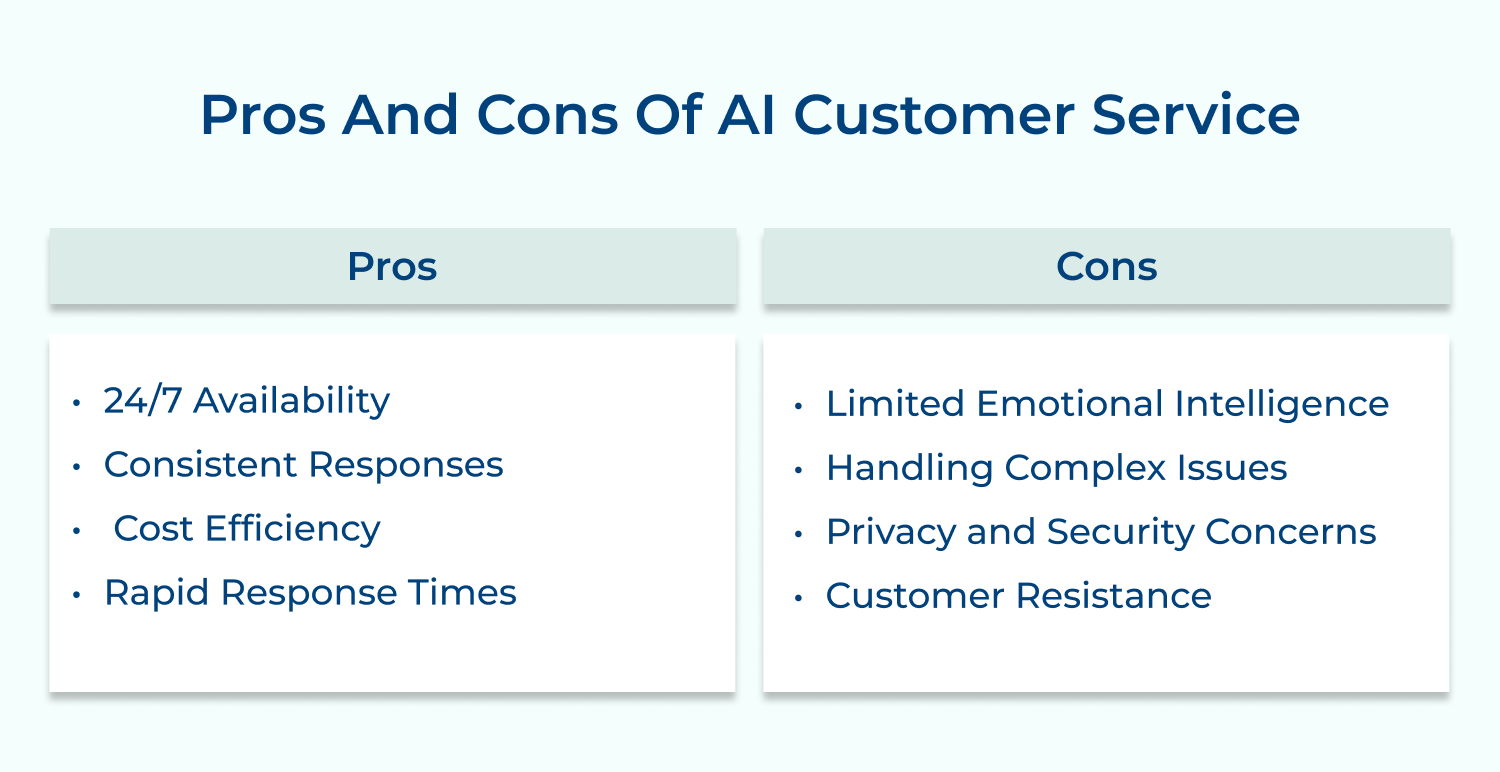
AI-powered customer service offers significant benefits but also comes with important limitations. Let’s explore both sides of this technology.
24/7 Availability
AI customer service agents can operate around the clock without breaks or shifts. This constant availability means customers can get help at any hour regardless of time zones or holidays. Companies can maintain service quality even during off-hours without increasing staffing costs.
Consistent Responses
AI systems deliver the same level of service quality to every customer interaction. Unlike human agents who might have varying knowledge levels or be affected by mood fluctuations, AI maintains consistency in tone, information accuracy, and problem-solving approaches across all customer touchpoints.
Cost Efficiency
Implementing AI customer service significantly reduces operational expenses over time. While the initial setup requires investment, businesses save on training, salaries, benefits, and facilities for large support teams. One AI system can handle thousands of simultaneous conversations at a fraction of human staffing costs.
Rapid Response Times
AI systems process and respond to inquiries almost instantly. This elimination of wait times addresses one of the biggest customer frustrations in traditional support channels. The technology can simultaneously handle multiple queries without performance degradation, maintaining speed even during high-volume periods.
From a CX perspective, AI customer service creates a more accessible, efficient support ecosystem that meets modern expectations. Today’s customers value immediate responses and self-service options. AI delivers these benefits while freeing human agents to handle complex issues requiring empathy and creative problem-solving.
Despite its advantages, AI customer service has several notable drawbacks that companies must consider before implementation.
Limited Emotional Intelligence
AI struggles to truly understand and respond to complex human emotions. While sentiment analysis has improved, AI cannot genuinely empathize with frustrated customers or read between the lines in emotional situations. This limitation can make interactions feel mechanical when customers need compassion.
Handling Complex Issues
Current AI systems often fail when confronted with unique or multifaceted problems. They work best with common questions and straightforward processes but may get confused by unusual scenarios or requests that fall outside their training parameters. Complex troubleshooting still requires human expertise.
Privacy and Security Concerns
AI customer service systems require access to substantial customer data to function effectively. This raises questions about data storage, privacy protection and vulnerability to breaches. Customers may feel uncomfortable sharing sensitive information with an automated system rather than a human representative.
Customer Resistance
Many customers still prefer human interaction for service issues. Some demographics find AI interfaces frustrating or difficult to navigate. When customers perceive they’re being directed away from human agents to cut costs, it can damage brand perception and loyalty regardless of the AI’s effectiveness.
Human-based customer service involves real people interacting with customers to address their questions, concerns and issues through various communication channels. These trained representatives use their interpersonal skills, product knowledge, and problem-solving abilities to provide personalized assistance.
Human customer service begins when a customer reaches out through phone, email, chat, or in person with a question or problem. The service representative first listens carefully to understand both the stated issue and any underlying concerns. They then access company knowledge bases and systems to find relevant information as well as potential solutions tailored to the specific situation.
After identifying possible solutions, the representative explains options to the customer in clear, understandable language. Throughout this process, they adjust their communication style based on customer reactions and feedback. They document the interaction for future reference and follow up when necessary to ensure complete resolution, building trust through their attentiveness as well as care.
Roles of a Human Reps:
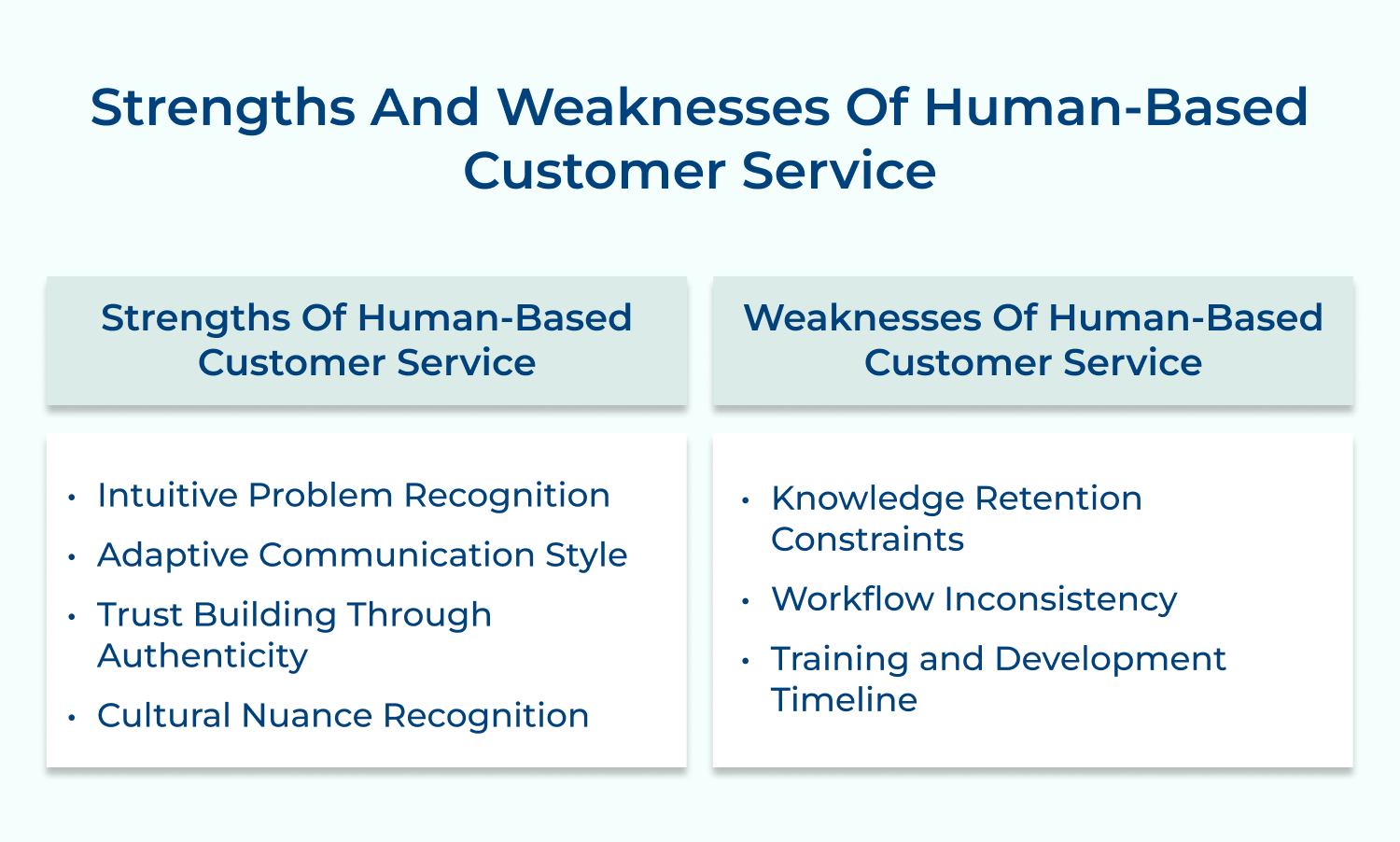
Let’s delve into both sides of the coin. Shedding light on why human customer service, despite its drawbacks, still holds a significant place in the customer experience.
Intuitive Problem Recognition
Human agents can detect underlying issues that customers struggle to articulate clearly. They recognize subtle cues in tone, phrasing or hesitation that reveal the true problem. Their intuition often leads to solving root causes rather than just addressing surface symptoms mentioned in the initial contact.
Adaptive Communication Style
Human representatives naturally adjust their language, tone and approach based on who they’re speaking with. They simplify technical concepts for beginners, use industry terminology with experts, or adapt to cultural differences. This flexibility creates comfortable conversations tailored to each customer’s communication preferences.
Trust Building Through Authenticity
Human interactions convey genuine concern through spontaneous conversation, appropriate humor and sincere apologies. These authentic moments create emotional connections that customers remember. The natural imperfection of human communication paradoxically strengthens relationships through shared humanity.
Cultural Nuance Recognition
Human representatives understand implicit cultural expectations and social norms. They recognize when directness is appropriate or when indirect communication is preferred. They adapt to cultural concepts of time, formality and respect that vary globally. This cultural intelligence prevents misunderstandings in diverse customer bases.
Despite their strengths, human customer service representatives face inherent limitations that affect service quality and consistency.
Knowledge Retention Constraints
Human agents struggle to memorize extensive product details, policy exceptions, and procedural nuances. Information retrieval takes time as they search reference materials. Knowledge gaps appear when handling less common issues, leading to research delays or occasional misinformation despite best efforts.
Workflow Inconsistency
Each human representative develops personal habits and shortcuts that create service variations. Some excel at technical troubleshooting but rush through explanations, while others provide thorough education but take longer. These individual differences make service quality unpredictable across different interactions.
Training and Development Timeline
New human representatives require extensive onboarding before reaching proficiency. Knowledge transfer happens gradually through training, mentorship and direct experience. This lengthy development process creates temporary service vulnerabilities during staff transitions or business growth periods that affect customer experience.
Understanding the fundamental differences between AI and human customer service helps businesses make informed decisions. Let’s explore these key distinctions in depth.
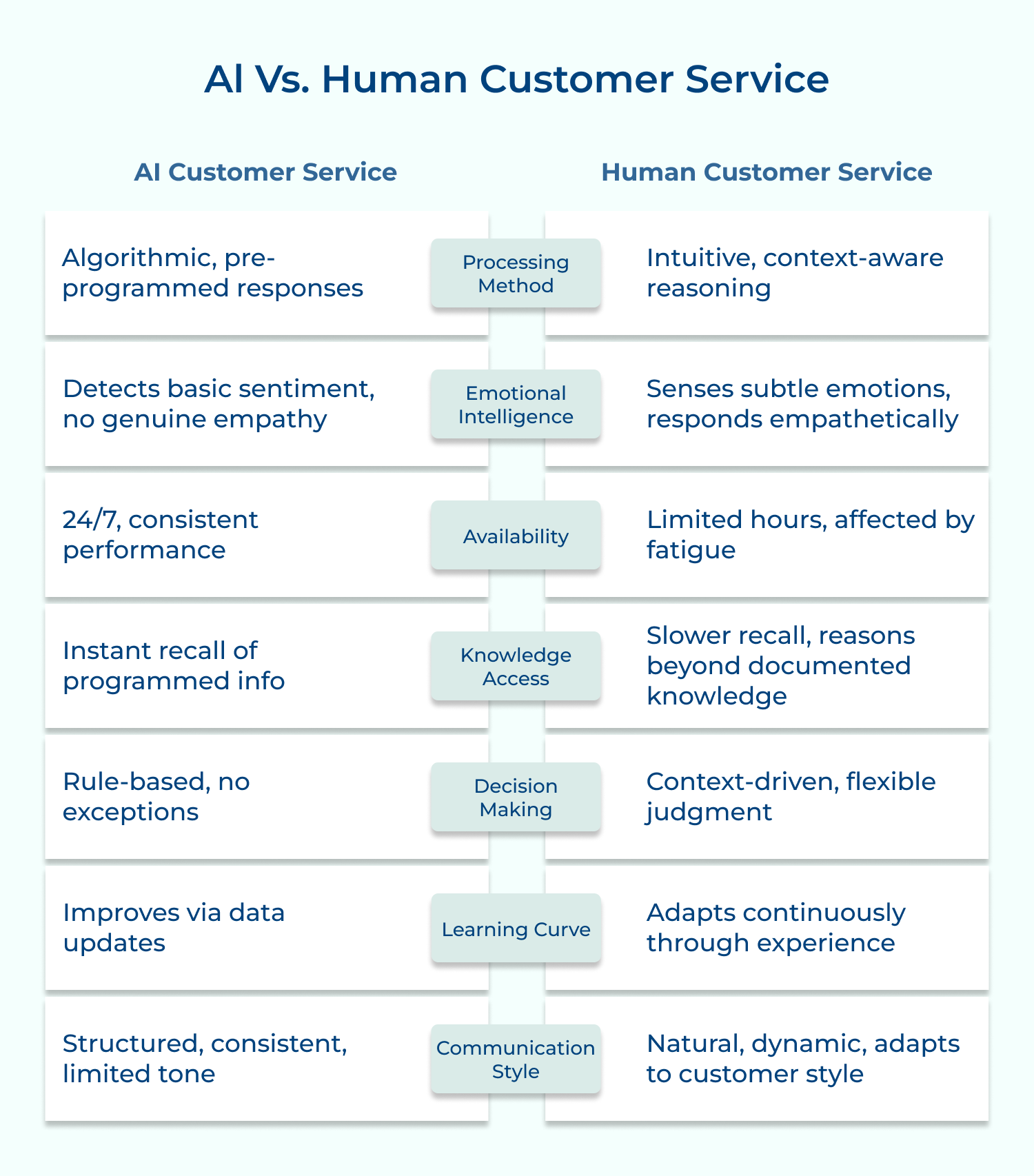
AI customer service analyzes patterns, keywords and question structures to deliver quick, template-based responses, but it lacks creativity as well as flexibility.
Human customer service relies on contextual reasoning and associative thinking, allowing representatives to understand nuance, make intuitive connections, while finding solutions that AI may overlook. This makes humans better suited for complex or ambiguous customer issues.
For example a customer contacts support saying, “The new update isn’t working for me.” An AI might immediately offer troubleshooting steps for the latest software version. A human agent might ask follow-up questions first, sensing that the customer’s definition of “not working” could mean anything from complete failure to minor aesthetic disappointment.
Key Takeaways:
AI-powered chatbots detect basic emotions through sentiment analysis, classifying feelings like anger or satisfaction and adjusting automated replies. However, they lack true emotional understanding.
Human customer service recognizes subtle cues such as hesitation or sarcasm and responds with genuine empathy. This allows representatives to adapt naturally, reassure customers and handle emotionally complex interactions more effectively than AI.
For example a customer writes, “Great job on the new design. It only took me an hour to figure out how to log in.” An AI might miss the sarcasm and respond with appreciation for the positive feedback. A human immediately recognizes the frustration behind the comment and addresses the login difficulty directly.
Key Takeaways:
AI customer service improves through structured, programmatic learning. It analyzes large volumes of interactions, identifies patterns and updates its algorithms slowly. Until its database is refreshed, AI often repeats standard responses.
Human customer service evolves faster through real-world experience. Agents learn from each interaction, share insights instantly while adjusting their approach on the spot.
For example, when a new product has issues, AI keeps suggesting default fixes, while human agents quickly find workarounds and apply them consistently. This makes humans better at handling situations beyond routine tasks.
Key Takeaways:
AI customer service relies on rule-based decision trees, matching customer inputs to predefined responses. This ensures consistency but leaves little room for flexibility when a situation doesn’t fit programmed rules.
Human customer service uses judgment, weighing context like customer history, intent and long-term relationship value.
For example, if a loyal customer requests a refund a day late, AI enforces policy, while a human agent reasonably approves the exception. This balance between structure and human discretion shapes the future of customer service.
Key Takeaways:
AI customer service handles high volumes effortlessly, delivering consistent responses and quality regardless of demand. It scales instantly during peak periods without extra costs or delays.
Human customer service, however, has natural limits—agents can experience fatigue and reduced focus when managing back-to-back inquiries. During busy periods, this can lead to slower responses and inconsistent service, highlighting the advantage of AI in managing routine tasks while humans handle complex issues.
Strategic Considerations:
AI customer service retrieves information instantly from databases, ensuring accurate, consistent answers based on documented knowledge. However, it’s limited to what’s been programmed.
Human customer service draws from training, experience, customer interactions and team collaboration. This builds deeper contextual understanding and flexibility, though knowledge levels can vary between agents. Combining both approaches ensures fast, reliable access while benefiting from human insight and judgment.
Strategic Considerations:
AI customer service uses preset language patterns to provide clear, consistent responses, ensuring efficiency but limiting natural conversation.
Human customer service adapts in real time, reading cues and adjusting tone, technical detail, as well as style to match the customer. This flexibility builds genuine rapport and understanding, though it can create slight variations in messaging. Combining both approaches balances consistency with personal connection.
Strategic Considerations:
AI customer service works within fixed knowledge limits, giving fast, accurate answers only on documented topics but unable to handle novel situations.
Human customer service adapts through reasoning and experience, making logical inferences while offering solutions even for unfamiliar issues.
For example, if a new accessory isn’t in the database, AI cannot confirm compatibility, while a human agent can provide a reasoned recommendation based on similar past products. This flexibility ensures customers get helpful guidance beyond routine tasks.
Strategic Considerations:
Let’s dive deeper into how AI and humans complement each other to deliver a seamless and superior customer service experience.
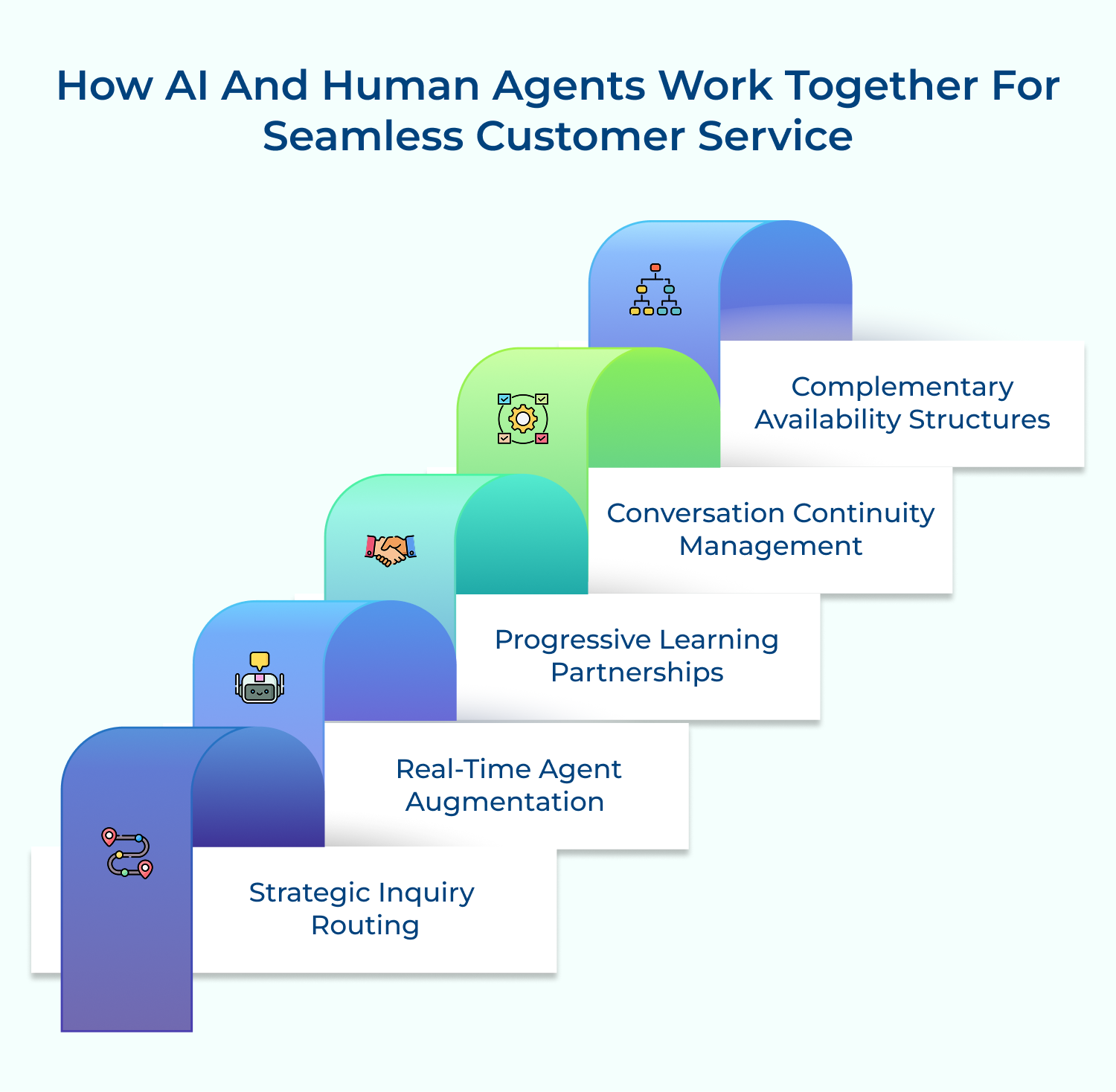
1. Strategic Inquiry Routing
AI systems perform initial analysis of incoming customer inquiries to determine complexity and emotional content. They handle straightforward questions immediately while smoothly transferring complex or emotionally charged issues to human agents.
The intelligent triage ensures each customer request follows the most appropriate path based on its specific characteristics rather than forcing all interactions through the same workflow. Impact of it:
2. Real-Time Agent Augmentation
While human agents interact with customers, AI assistants work silently in the background to retrieve relevant information and suggest potential solutions.
The AI monitors conversations to identify key topics, then instantly surfaces helpful knowledge articles, customer history, or resolution paths. This collaboration combines human empathy and judgment with AI’s perfect recall while processing speed in real time.
3. Conversation Continuity Management
Modern systems maintain context seamlessly as customers move between AI and human touchpoints throughout their journey. When a customer begins with AI and later needs human assistance, the representative receives complete transcripts as well as relevant data points. This contextual handoff eliminates frustrating repetition for customers and allows the human agent to continue the conversation naturally from the exact point where AI reached its limits.
4. Progressive Learning Partnerships
Human agents and AI systems create a continuous improvement cycle through their interactions. When AI encounters situations beyond its capabilities, human agents resolve them while the system observes and learns. These resolved cases become training examples that expand AI capabilities incrementally. Meanwhile, AI identifies patterns in successful human resolutions that can be shared across the human team as best practices.
5. Complementary Availability Structures
AI handles customer inquiries during overnight hours, weekends and holidays when human staffing is limited or unavailable. Human agents take over during business hours for complex issues while AI continues managing routine questions.
This layered availability ensures customers receive appropriate support regardless of when they reach out, creating a perception of truly around-the-clock service that feels responsive and attentive at all times.
Both human representatives and AI systems can deliver exceptional customer service when following established best practices. Here are some best practices to consider:
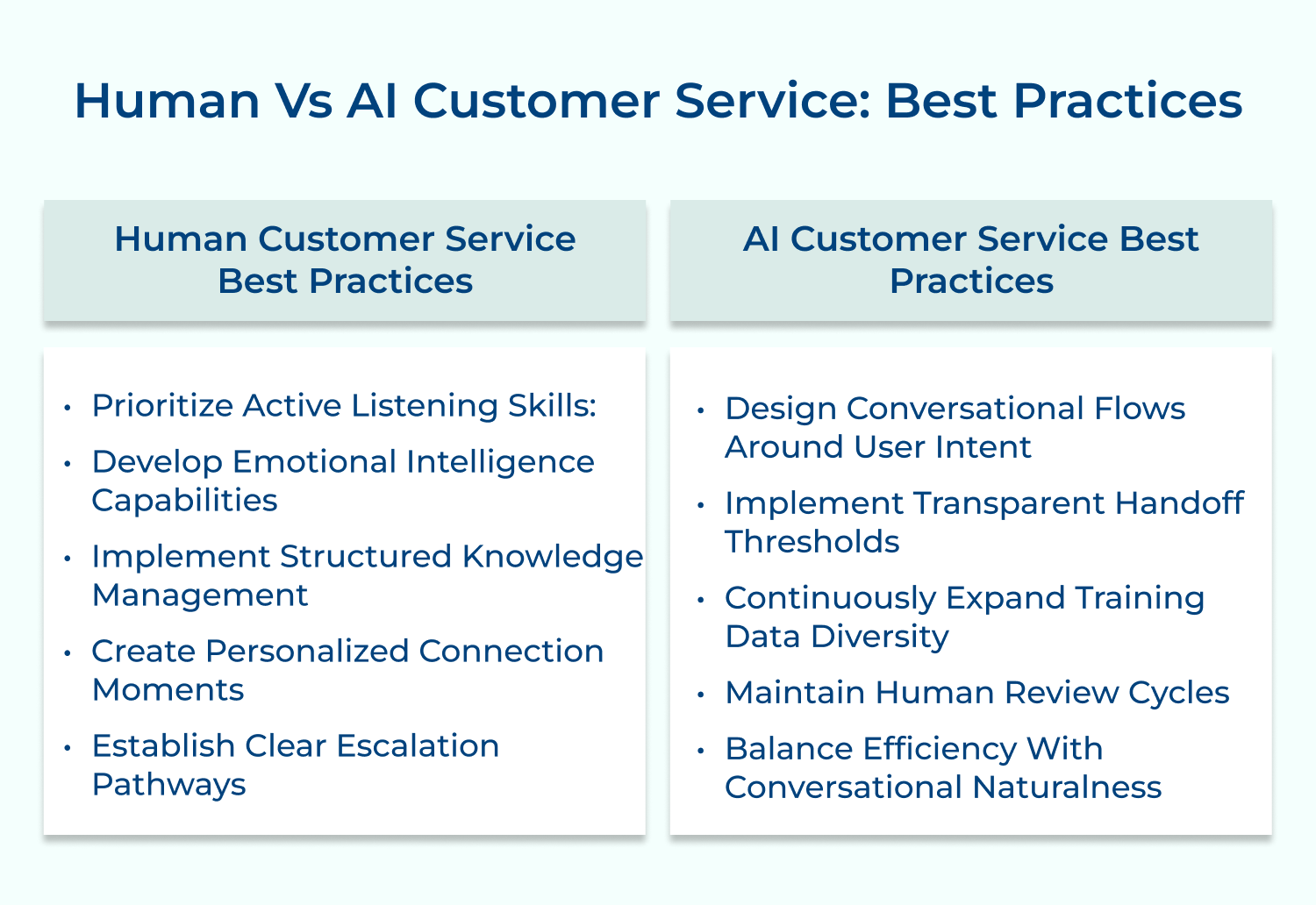
1. Prioritize active listening skills: Human agents should demonstrate comprehension by paraphrasing customer concerns before responding. This validation technique builds trust and ensures accurate understanding of the customer’s true needs rather than just addressing surface-level complaints.
2. Implement structured knowledge management: Teams should maintain centralized, searchable knowledge bases that agents can quickly reference during interactions. Regular knowledge sharing sessions allow experienced representatives to transfer tacit knowledge that isn’t easily documented but proves valuable in complex situations.
3. Establish clear escalation pathways: Representatives need well-defined guidelines for when and how to escalate issues beyond their scope. Proper escalation training prevents representatives from struggling with unsolvable problems while ensuring customers with complex needs reach appropriate expertise quickly.
1. Design conversational flows around user intent: AI systems should be structured around common customer goals rather than rigid keyword matching. Intent recognition should drive conversation paths, allowing customers to express needs in natural language rather than forcing them to learn specific trigger phrases.
2. Implement transparent handoff thresholds: AI should clearly communicate its capabilities and limitations to customers. Systems should identify situations beyond their scope early in conversations and offer seamless transfers to human agents without making customers repeat information already provided.
3. Balance efficiency with conversational naturalness: AI responses should incorporate appropriate conversational elements while remaining concise. Systems that sound too robotic create distance, while overly chatty AI wastes customer time. Finding the right balance creates efficient yet natural-feeling exchanges.
The choice between human and AI customer service requires strategic evaluation rather than an either-or approach. Successful businesses assess their unique customer needs, product complexity and operational constraints to determine where each solution delivers optimal value. Modern service ecosystems typically integrate both elements, leveraging AI for efficiency while preserving human connections for complex issues.
Your industry, customer demographics and service goals should guide this integration. Technical products with tech-savvy users might lean toward AI-first approaches, while luxury brands emphasize human touchpoints. The future of exceptional customer service combines technological efficiency with personal connection, creating experiences that feel simultaneously frictionless and genuinely attentive.

What are AI Customer Service Agents?
AI customer service agents are software systems powered by artificial intelligence that interact with customers through various channels like chat, voice or email. They use natural language processing to understand customer inquiries, access knowledge bases to find relevant information and deliver appropriate responses without human intervention. Modern AI agents can handle routine questions, process simple transactions, while learning from interactions to improve over time.
What is the difference between a customer service agent and AI?
Human customer service agents possess emotional intelligence, creativity and judgment that allow them to handle complex or unusual situations with empathy as well as nuance. AI excels at consistency, scalability, and around-the-clock availability while processing information rapidly. Humans build authentic connections through shared experiences and intuitive understanding. AI delivers precise, efficient responses based on programmed knowledge as well as pattern recognition without truly experiencing emotions or fatigue.
Why can’t AI replace humans in customer service?
AI cannot fully replace humans because it lacks genuine empathy, intuitive judgment and creative problem-solving abilities necessary for complex customer issues. It struggles with understanding cultural nuances, emotional subtext and unprecedented situations that haven’t appeared in its training data. High-value customers and emotionally charged interactions benefit significantly from human connection as well as the ability to make judgment calls that go beyond rigid protocols to preserve customer relationships.
What is the negative impact of AI in customer service?
Some customers feel frustrated when forced to interact with AI systems that don’t understand their specific needs or when they perceive companies are using technology primarily to reduce costs. AI may inadvertently create impersonal experiences that damage emotional connections to brands. Implementation challenges and technical limitations can lead to misunderstandings as well as incorrect responses that require additional customer effort to resolve, potentially increasing frustration rather than reducing it.
 https://omni24.io/wp-content/uploads/2026/05/Compassionate-Customer-Service.png
1256
2400
Tushar Joshi
https://omni24.io/wp-content/uploads/2023/04/Omni-Logo-1.svg
Tushar Joshi2026-06-19 07:33:132026-06-19 07:33:13How to Deliver Compassionate Customer Service: Top 8 Strategies
https://omni24.io/wp-content/uploads/2026/05/Compassionate-Customer-Service.png
1256
2400
Tushar Joshi
https://omni24.io/wp-content/uploads/2023/04/Omni-Logo-1.svg
Tushar Joshi2026-06-19 07:33:132026-06-19 07:33:13How to Deliver Compassionate Customer Service: Top 8 Strategies https://omni24.io/wp-content/uploads/2026/06/Social-CRM.png
1256
2400
Tushar Joshi
https://omni24.io/wp-content/uploads/2023/04/Omni-Logo-1.svg
Tushar Joshi2026-06-18 04:32:482026-06-19 10:15:22What Is Social CRM & How to Choose the Best One?
https://omni24.io/wp-content/uploads/2026/06/Social-CRM.png
1256
2400
Tushar Joshi
https://omni24.io/wp-content/uploads/2023/04/Omni-Logo-1.svg
Tushar Joshi2026-06-18 04:32:482026-06-19 10:15:22What Is Social CRM & How to Choose the Best One? https://omni24.io/wp-content/uploads/2026/06/Predictive-Customer-Service.png
1258
2400
Tushar Joshi
https://omni24.io/wp-content/uploads/2023/04/Omni-Logo-1.svg
Tushar Joshi2026-06-16 04:17:312026-06-16 04:17:31How to Create a Predictive Customer Service Strategy?
https://omni24.io/wp-content/uploads/2026/06/Predictive-Customer-Service.png
1258
2400
Tushar Joshi
https://omni24.io/wp-content/uploads/2023/04/Omni-Logo-1.svg
Tushar Joshi2026-06-16 04:17:312026-06-16 04:17:31How to Create a Predictive Customer Service Strategy?
Whether it’s about acquire, engage or support – Omni24 covers all your customer engagement needs in one complete platform.

Copyright ©2026 Veemo All rights reserved.
CA, Los Angeles, Hall Ave, 19011