What is First Call Resolution and How Can You Improve It?
Enhance support efficiency with first call resolution. Equip agents, optimize processes and leverage technology for swift issue resolution, boosting customer satisfaction.

Enhance support efficiency with first call resolution. Equip agents, optimize processes and leverage technology for swift issue resolution, boosting customer satisfaction.
Every time we contact customer service, the wait time can be really annoying. In fact, 33% of customers are most frustrated when having to wait on a call and 33% don’t like repeating their issues to multiple representatives.
Getting a resolution on the first call is what every customer hopes for and as a business, you need to have a similar goal. However, that isn’t always the case. Many businesses struggle offering first call resolution to their customers.
How do we maintain it without having to compromise on the service quality? We’re here to help you! Let’s explore the importance of First Call Resolution, its benefits and strategies to help businesses improve their service offerings.
First Call Resolution is a performance metric that measures the percentage of customer interactions that are resolved in a single contact with a customer service representative. It is a key indicator of customer satisfaction, operational efficiency and overall service quality.
Calculating FCR involves a relatively simple formula.
Divide the number of calls resolved on the first interaction by the total number of calls received during a specific period and then multiply the result by 100 to get the FCR percentage.
Let me put it in direct terms:
FCR (%) = (Number of calls resolved on first interaction / Total number of calls received) * 100
Let’s assume that a company received 500 calls in a month and successfully resolved 400 of those calls on the initial contact. Applying the formula, we get:
FCR (%) = (400 / 500) * 100 = 80%
Therefore, the FCR rate for this particular period is 80%.
Key objectives:
A survey conducted by SQM group explains how it calculated the FCR benchmark by collecting data from the post-call survey method. It explains the benchmark average for first call resolution is little below 70%.
What about the other 30%, you ask? This is the percentage where a customer will have a situation where they have to call back or re-open the ticket sooner than later.
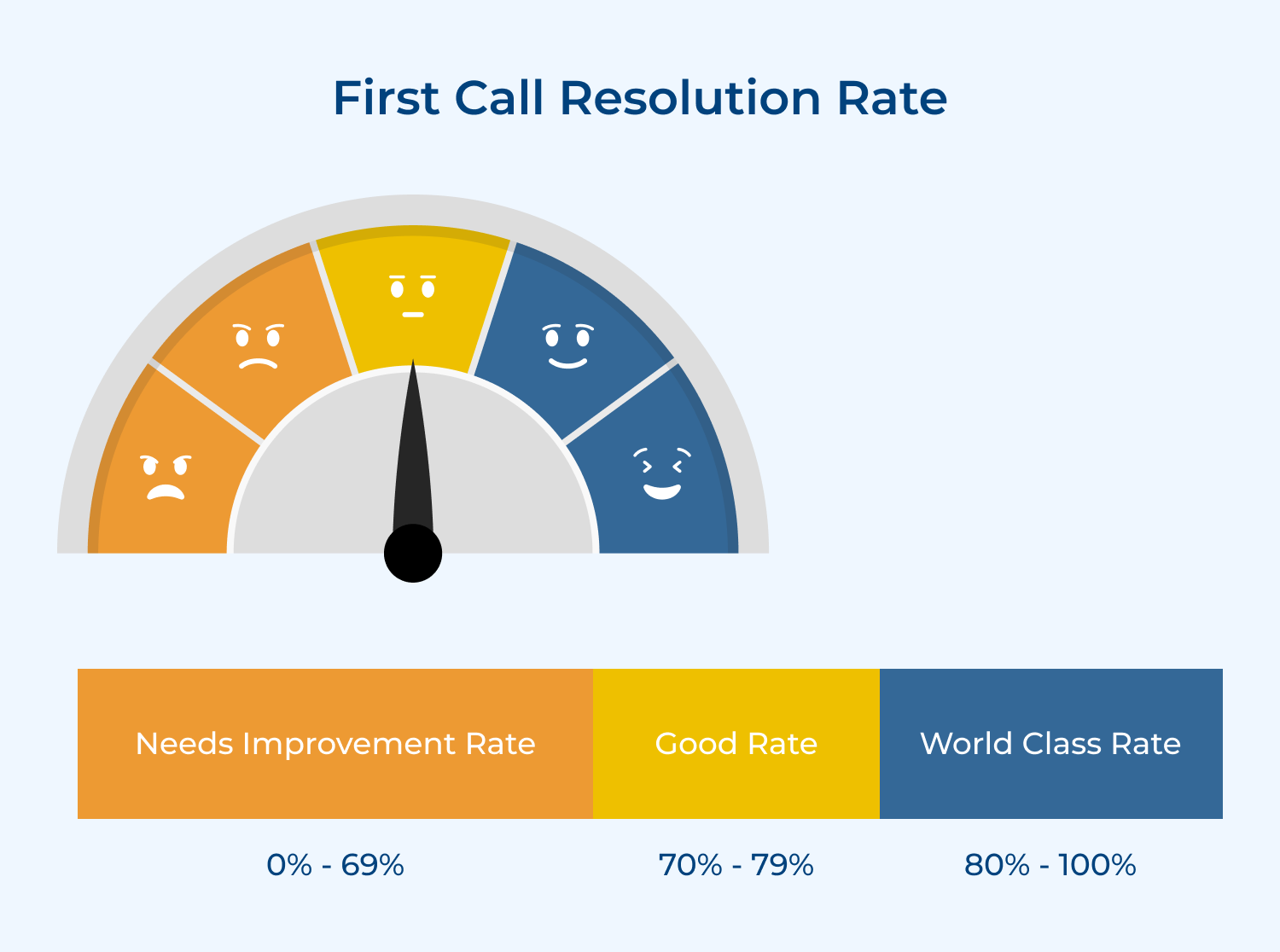
If your FCR average of customer calls are anywhere between 70% – 79%, then you’re on par with industry standard FCR metrics. But, if you go above 80% then you’re one of the top 5% world-class contact centers from around the world!
Do nothing more than just measuring your FCR at least once a year – it’ll automatically help you improve your FCR performance by up to 30%! This is just the beginning. Let’s look into the list now, shall we?
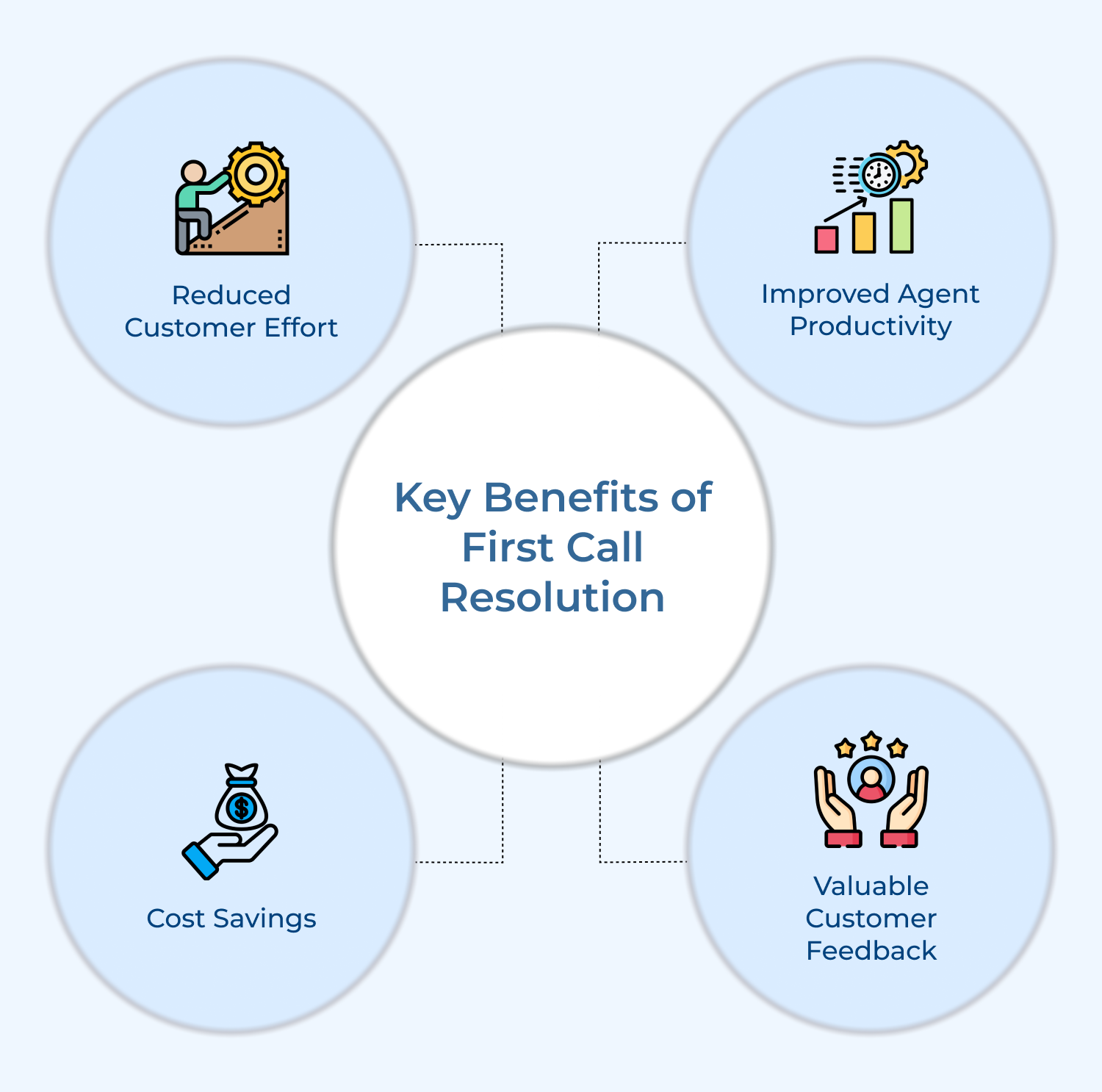
As per my research, here are some key benefits of focusing on First Call Resolution:
Many customers list poor customer service as their reason for churning. It’s not wrong either because they simply wouldn’t want to contact the service center multiple times just to resolve a single issue. Concentrating on FCR minimizes your customer effort and makes it easier for them to get their problems resolved.
One of the main benefits of First Call Resolution is that it allows customer service representatives to handle more calls within a given time frame. When they’re able to resolve issues on the first go, agents will be able to move on to new ones which eventually increases productivity. It not only boosts overall customer service efficiency but also reduces waiting times for customers.
Adopting a First Call Resolution approach results in significant cost savings for businesses. Resolving an issue on the first call directly equals reduced call volumes and less need for additional customer service resources. It also optimizes operational efficiency while reducing expenses related to customer service.
First Call Resolution allows customer service representatives to collect feedback from customers. Receiving an instant solution would also mean that customers are more likely to provide instant feedback as well as any concerns related to their customer experience. This response can be utilized to identify recurring issues, improve processes and enhance overall service quality.
A question that everybody’s desperate for an answer – how to improve my first call resolution? Different people have different approaches. I’ve compiled the best amongst the lot to help you find your perfect match. If you want to improve the first call resolution rate of your customer service team, here are some tips to consider:
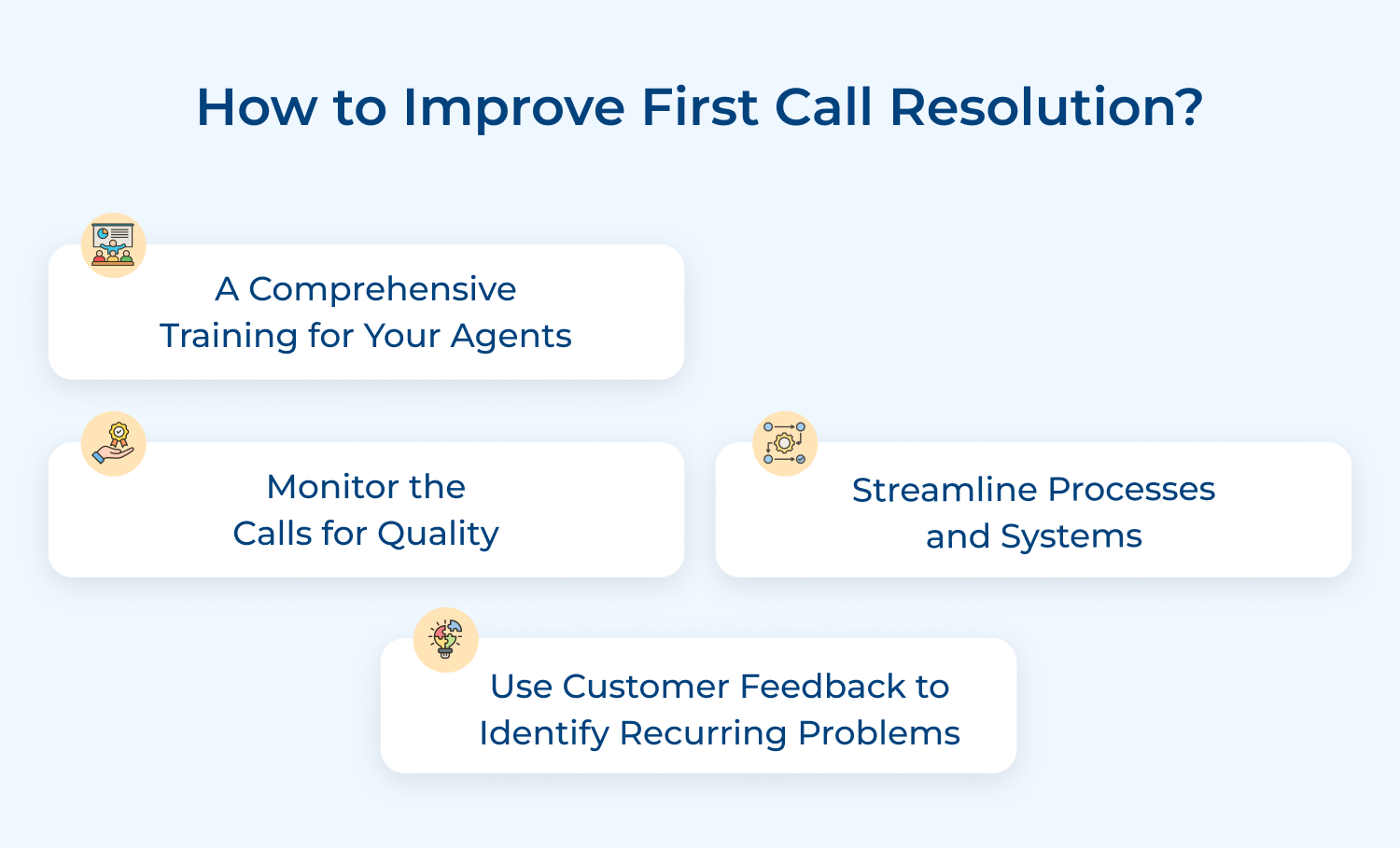
Provide your customer service representatives with thorough training on your products, services and the most common customer inquiries. It will equip them with the knowledge and skills needed to handle a wide range of customer issues effectively. Train them on effective communication techniques, active listening, problem-solving strategies, etc.
What to consider?
Utilize call routing technology to direct customers to the most suitable agent based on their needs and skill sets. Skills-based routing ensures that customers are connected to representatives who have the necessary expertise to resolve their specific issues, improving the chances of first call resolution.
What to consider?
Regularly monitor and review customer interactions to figure out areas for improvement. Call monitoring allows you to identify training needs, coach your agents, as well as ensure that they are following best practices. Quality assurance programs help you find any gaps in skills and make sure to have consistent service quality across your customer service team.
What to consider?
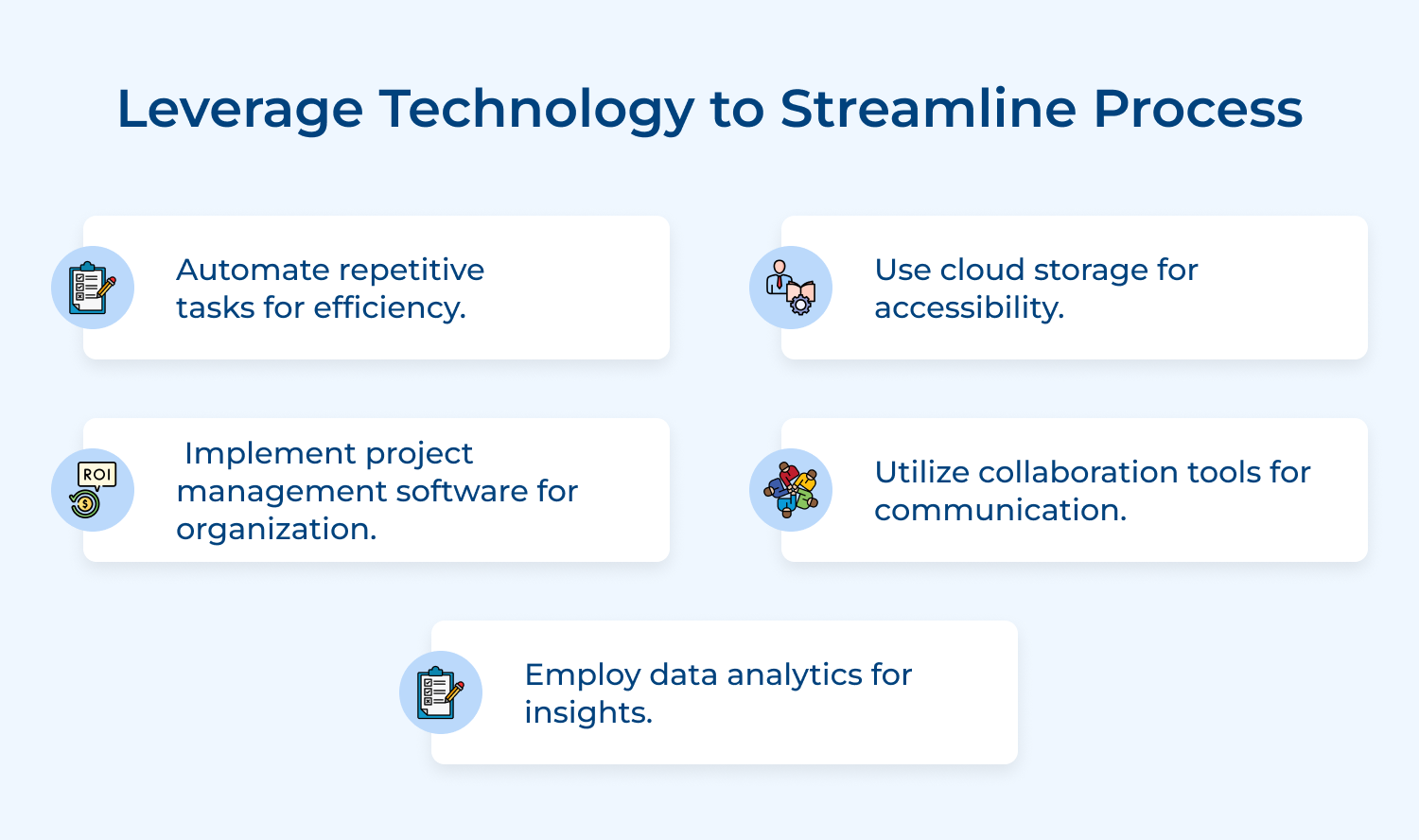
Evaluate your existing customer service processes and systems to ensure they are efficient as well as user-friendly. Simplify complicated workflows, eliminate unnecessary steps and provide agents with easy access to all relevant resources. Implement a knowledge base or a centralized database that allows agents to quickly search for solutions and access helpful documentation.
What to consider?
Regularly analyze customer feedback to know recurring issues or pain points. It helps you address the root causes of these problems and proactively work towards preventing them in the future. When you address such common issues, you significantly improve the chances of resolving them on the first call.
What to consider?
73% of customers say, time plays a crucial factor in discovering a good customer service experience from a bad one! Now being conscious of time is a best practice, but there are also other aspects you need to consider.
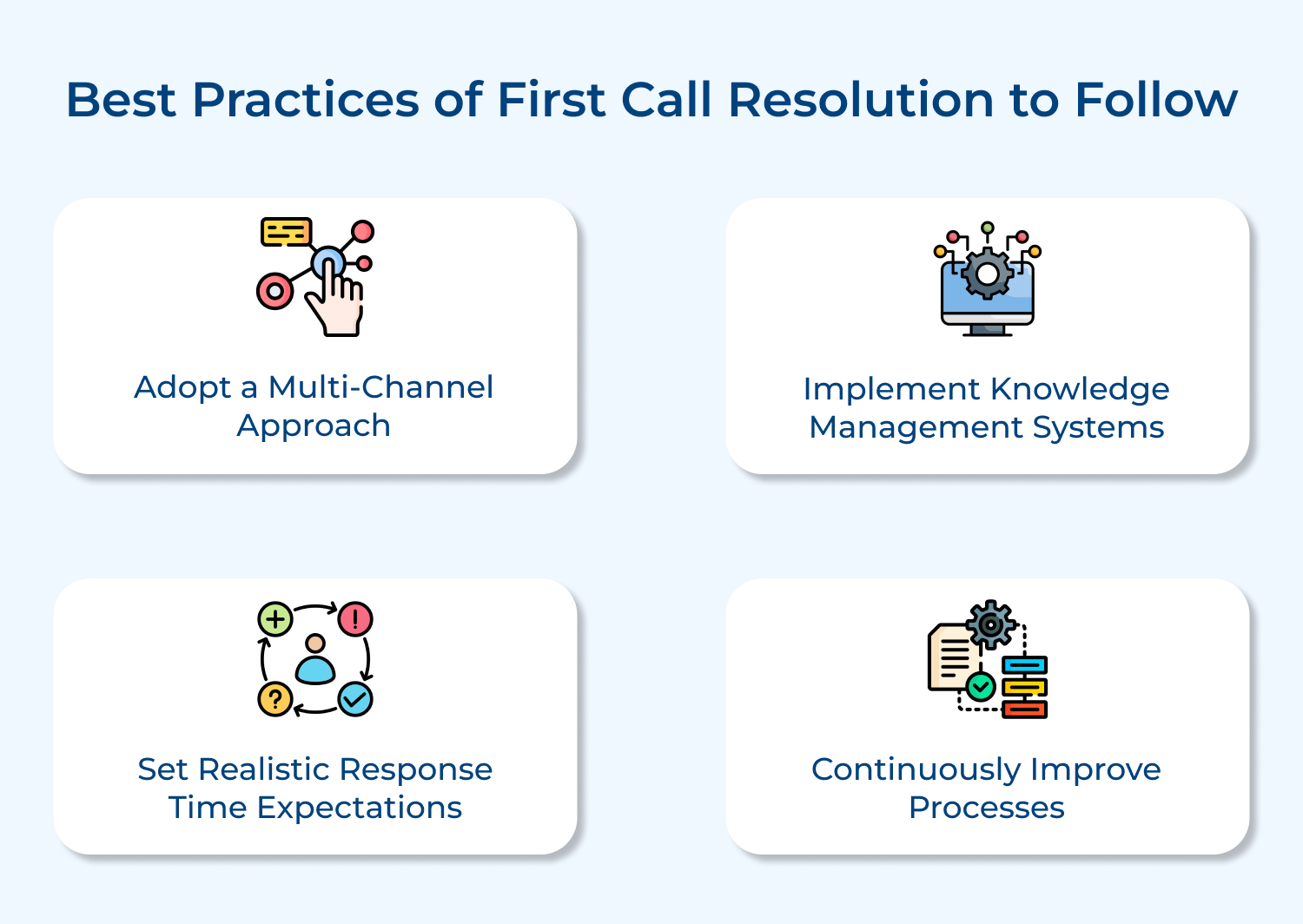
Here are the best practices to follow for first contact resolution:
Quite commonly, many confuse first call resolution with first contact resolution. They might sound the same at first, but they’re entirely two different concepts. If you were also just as confused, here’s the list that can help.
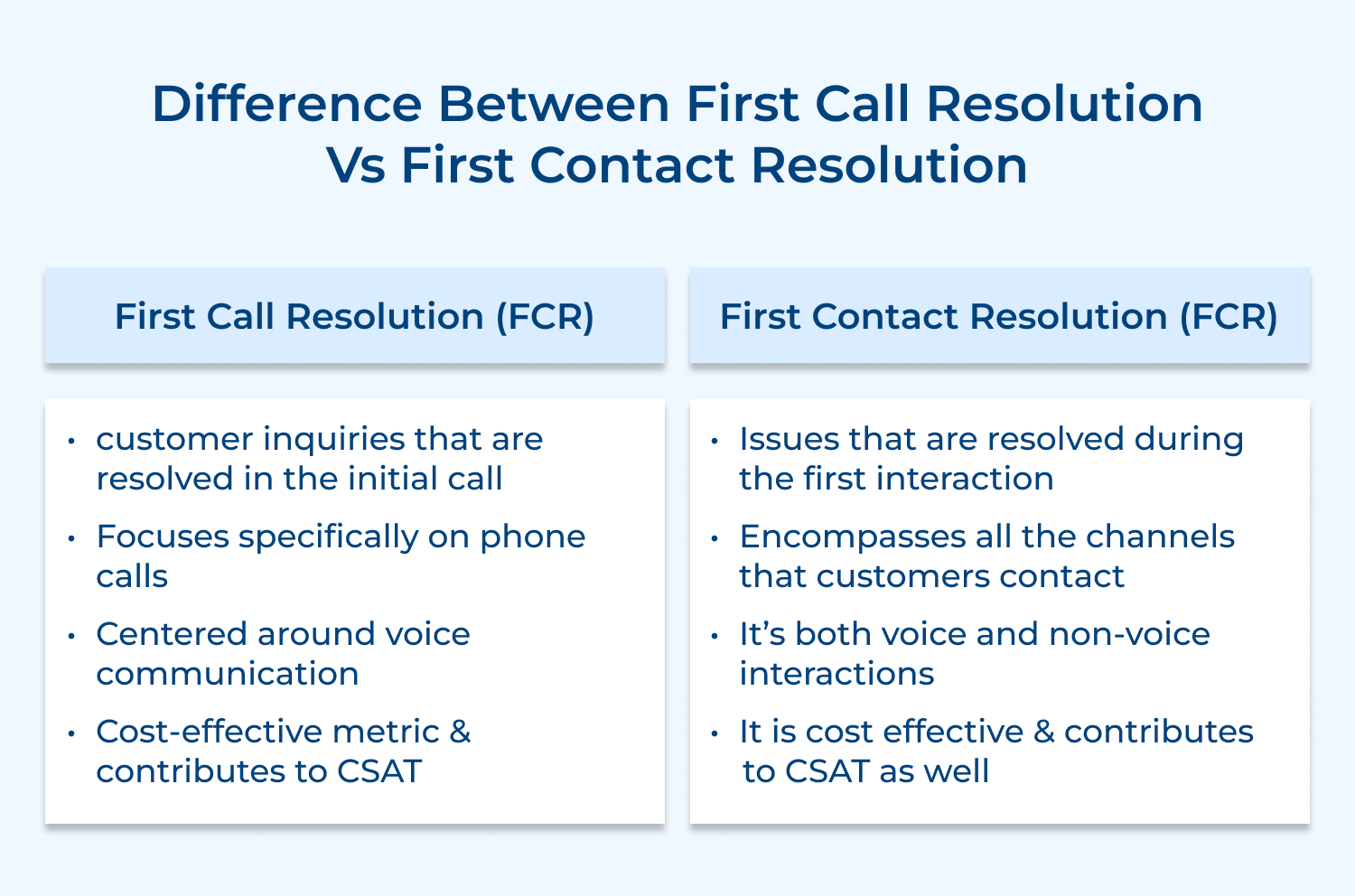
1. Definition
First Call Resolution (FCR): FCR measures the percentage of customer inquiries or issues that are resolved during the initial phone call.
First Contact Resolution (FCR): FCR measures the percentage of customer inquiries or issues that are resolved during the first interaction, regardless of the channel used (phone, email, chat, etc.).
2. Channels Involved
Focusing specifically on phone calls (First Call Resolution), where customers reach out to the customer service team over the phone.
First Contact Resolution encompasses all the channels through which customers can contact the support team, including phone calls, emails, chat, social media, etc.
3. Communication Medium
First Call Resolution is centered around voice communication and requires personal interaction between the customer as well as the support representative.
FCR encompasses both voice and non-voice interactions, as it includes channels that may not involve direct conversations, such as email or chat.
4. Skill Set Required
FCR relies heavily on the support representative’s ability to handle phone conversations effectively and efficiently.
First Contact Resolution requires support representatives to be proficient in various communication channels and have strong multi-channel problem-solving skills.
5. Cost Efficiency
It can be a cost-effective metric as First Call Resolution minimizes the need for customers to make multiple calls to resolve their issues.
FCR aims to reduce the overall cost for the company by resolving issues promptly in the first interaction, regardless of the channel used.
6. Customer Satisfaction
First Call Resolution as well as First Contact Resolution contributes to customer satisfaction, as customers appreciate having their issues resolved promptly and efficiently, regardless of the channel used.
7. Reporting and Metrics
First Call Resolution is a specific metric that measures the percentage of resolved issues within a phone call.
However, First Contact Resolution is a broader metric that includes all resolved issues regardless of the channel used, requiring more comprehensive tracking and reporting.
8. Employee Training
FCR requires specific training on effective phone communication skills for support representatives.
First Contact Resolution demands broader training that includes multi-channel communication, problem-solving, and technical skills across various platforms.
Achieving a high FCR rate leads to improved customer satisfaction and reduced costs for the company. There are some common mistakes that contact centers make when using FCR.
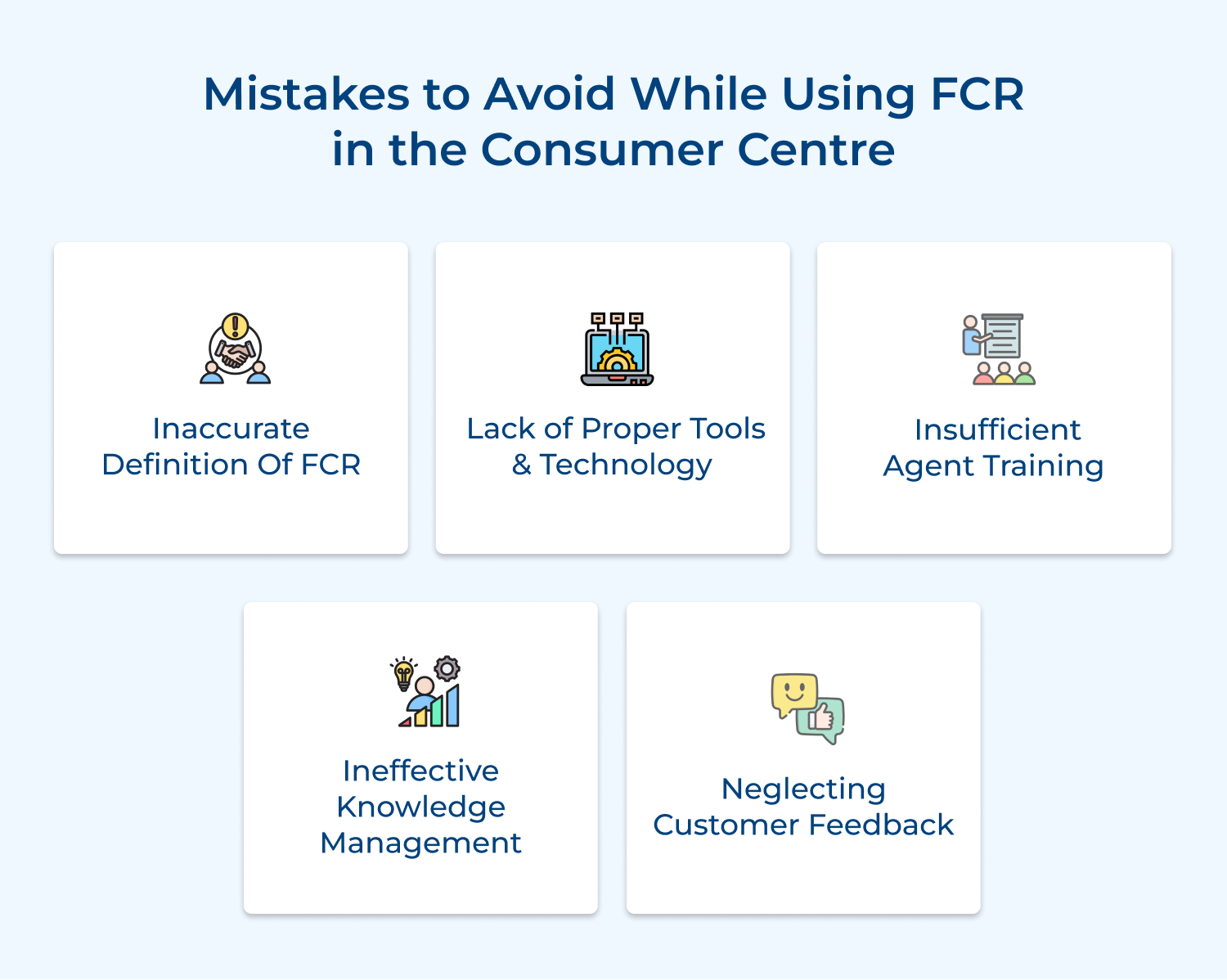
1. Inaccurate definition of FCR: One of the biggest mistakes contact centers make is not accurately defining what constitutes a first call resolution. FCR should be measured as resolving the customer’s query or issue fully in the first contact, without the need for callbacks, escalations, or transfers.
Solution: Contact centers should establish clear guidelines and definitions for FCR, ensuring that all agents as well as their teams are on the same page. Regular training and monitoring should also be implemented to maintain consistency in FCR measurement.
2. Lack of proper tools & technology: Another mistake is not investing in the right tools and technologies to support FCR. Contact centers need efficient call management systems, knowledge bases and CRM systems to provide agents with quick access to customer information as well as solutions.
Solution: Contact centers should invest in robust technology infrastructure that enables agents to retrieve relevant customer information promptly. Integration of systems provides a seamless experience for agents, allowing them to resolve issues efficiently and effectively.
3. Insufficient agent training: It is ethically incorrect to not provide adequate training to agents. They need to be equipped with product knowledge and problem-solving abilities to resolve customer issues in a single contact.
Solution: Contact centers should design comprehensive training programs that cover not only technical skills but also customer service and communication skills. Ongoing training and coaching sessions will help agents stay up-to-date with changing customer needs as well as emerging challenges.
4. Ineffective knowledge management: If contact centers do not have a centralized system for storing and agents may struggle to find accurate as well as relevant information during customer interactions. It can lead to increased handle times and lower FCR rates.
Solution: Implementing a robust knowledge management system is essential for contact centers. The system should allow agents to access updated and accurate information quickly. Regular reviews and updates of the knowledge base can ensure that agents have the latest solutions at their fingertips.
5. Neglecting customer feedback: Contact centers must actively seek and consider customer feedback related to FCR. Neglecting customer feedback prevents them from identifying gaps in service delivery and areas for improvement.
Solution: Implementing surveys, customer feedback forms or post-interaction calls help contact centers gather valuable insights into customer experiences. The feedback should be analyzed to identify trends and make necessary operational changes.
First call resolution (FCR) is a metric that measures the ability of customer support teams to resolve customer issues in a single interaction. It is an important indicator of support efficiency and customer satisfaction. A high FCR rate indicates that your team is efficient, knowledgeable, while also capable of addressing customer problems effectively.
Improving your support efficiency and FCR requires a combination of strong technical infrastructure, well-trained agents as well as continuous improvement efforts. I believe that by implementing these strategies and focusing on delivering high-quality support, you enhance customer satisfaction. So, invest in improving your first call resolution rate and watch your support efficiency improve.

Why is first call resolution important?
First call resolution plays a vital role in customer satisfaction. Resolving issues promptly not only saves valuable time for both customers and agents but also reduces frustration as well as enhances the overall customer experience. Improved FCR leads to higher customer loyalty, increased brand reputation and better chances of customer retention.
How do I measure first call resolution?
Measuring FCR requires tracking the number of calls resolved successfully on the first try, divided by the total number of calls received in a specific timeframe. The calculation provides a percentage that reflects how effectively the agents are resolving issues during initial contact. Utilizing customer feedback through surveys or monitoring call recordings can also provide valuable insights into FCR performance.
What affects first call resolution?
Several factors can influence FCR rates. These include agent training & expertise, access to comprehensive customer information systems, effective call routing & queuing systems, concise communication skills, as well as the availability of necessary resources & tools. High call volumes, complex queries, and technical limitations can impact FCR.
What is a good first call resolution rate?
While an ideal FCR rate may vary depending on the industry and specific business, aiming for a rate of 80% or above is generally considered good. It’s crucial to note that FCR rates can be challenging to achieve consistently, especially in industries with complex or niche products/services. Regular benchmarking against industry standards can help determine a realistic target for your organization.
How do I improve my first call resolution?
Improving FCR requires a comprehensive approach focusing on various aspects. Equip agents with extensive product knowledge and effective problem-solving techniques. Invest in robust customer relationship management (CRM) systems and knowledge bases to provide agents with quick access to relevant customer information. Implement an omnichannel approach, integrating phone, chat, email and social media, allowing customers to choose their preferred contact method. Regularly review call recordings, customer surveys and feedback to identify recurring issues as well as develop actionable solutions.
 https://omni24.io/wp-content/uploads/2026/08/Omnichannel-Chatbots.png
1256
2400
Tushar Joshi
https://omni24.io/wp-content/uploads/2023/04/Omni-Logo-1.svg
Tushar Joshi2026-08-13 04:43:302026-08-24 09:02:01How Omnichannel Chatbots Improve Your Customer Experience
https://omni24.io/wp-content/uploads/2026/08/Omnichannel-Chatbots.png
1256
2400
Tushar Joshi
https://omni24.io/wp-content/uploads/2023/04/Omni-Logo-1.svg
Tushar Joshi2026-08-13 04:43:302026-08-24 09:02:01How Omnichannel Chatbots Improve Your Customer Experience https://omni24.io/wp-content/uploads/2026/08/Ecommerce-Chatbots-1.png
1256
2400
Tushar Joshi
https://omni24.io/wp-content/uploads/2023/04/Omni-Logo-1.svg
Tushar Joshi2026-08-12 03:57:552026-08-24 09:03:22Ecommerce Chatbots: What are They and Their Use Cases
https://omni24.io/wp-content/uploads/2026/08/Ecommerce-Chatbots-1.png
1256
2400
Tushar Joshi
https://omni24.io/wp-content/uploads/2023/04/Omni-Logo-1.svg
Tushar Joshi2026-08-12 03:57:552026-08-24 09:03:22Ecommerce Chatbots: What are They and Their Use Cases https://omni24.io/wp-content/uploads/2026/08/Omnichannel-Ecommerce.png
1256
2400
Tushar Joshi
https://omni24.io/wp-content/uploads/2023/04/Omni-Logo-1.svg
Tushar Joshi2026-08-11 04:50:362026-08-24 09:00:45How to Create an Omnichannel Ecommerce Strategy: 7 Best Ways
https://omni24.io/wp-content/uploads/2026/08/Omnichannel-Ecommerce.png
1256
2400
Tushar Joshi
https://omni24.io/wp-content/uploads/2023/04/Omni-Logo-1.svg
Tushar Joshi2026-08-11 04:50:362026-08-24 09:00:45How to Create an Omnichannel Ecommerce Strategy: 7 Best Ways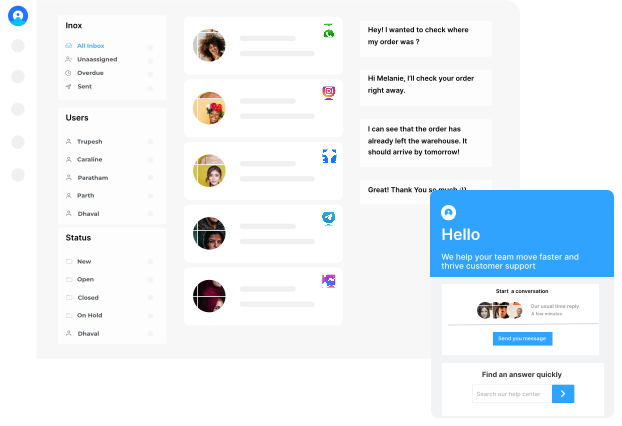
Whether it’s about acquire, engage or support – Omni24 covers all your customer engagement needs in one complete platform.

Copyright ©2026 Veemo All rights reserved.
CA, Los Angeles, Hall Ave, 19011