8 Best Chatbot Examples That Showcase AI Innovation
Chatbot examples highlight how AI improves customer service, streamlines operations and inspires effective, high-performing chatbot creation.

Chatbot examples highlight how AI improves customer service, streamlines operations and inspires effective, high-performing chatbot creation.
Businesses struggle to balance delivering exceptional customer experiences with controlling operational costs.. Traditional communication channels often fall short, creating frustrating delays for customers during peak periods.
87.2% of users rate chatbot interactions as positive or neutral and 80% report satisfaction with AI chatbot experiences.
Without effective automation, companies struggle to respond promptly across multiple channels. Meanwhile, employees are tied up with repetitive tasks instead of focusing on complex issues.
Chatbots have emerged as a transformative technology, bridging gaps in customer service and operational efficiency. Real-world examples demonstrate how they streamline processes, enhance interactions and deliver measurable business value while maintaining a personal customer experience.
A chatbot is a computer program designed to simulate conversation with human users through text or voice interactions. These digital assistants use various technologies to understand what people are asking and respond appropriately in natural language. Chatbots range from simple rule-based systems that follow predetermined conversation paths to sophisticated AI-powered assistants that can learn from interactions and handle complex requests.
Chatbots process user input through natural language processing to identify intent and extract key information. They then generate appropriate responses using either predefined rules or machine learning algorithms that analyze patterns from vast amounts of conversation data. The system delivers this response and prepares for the next interaction.
Key Objectives:
Chatbots have revolutionized how businesses interact with customers and manage internal processes. Let’s explore the key advantages they offer in today’s digital landscape.
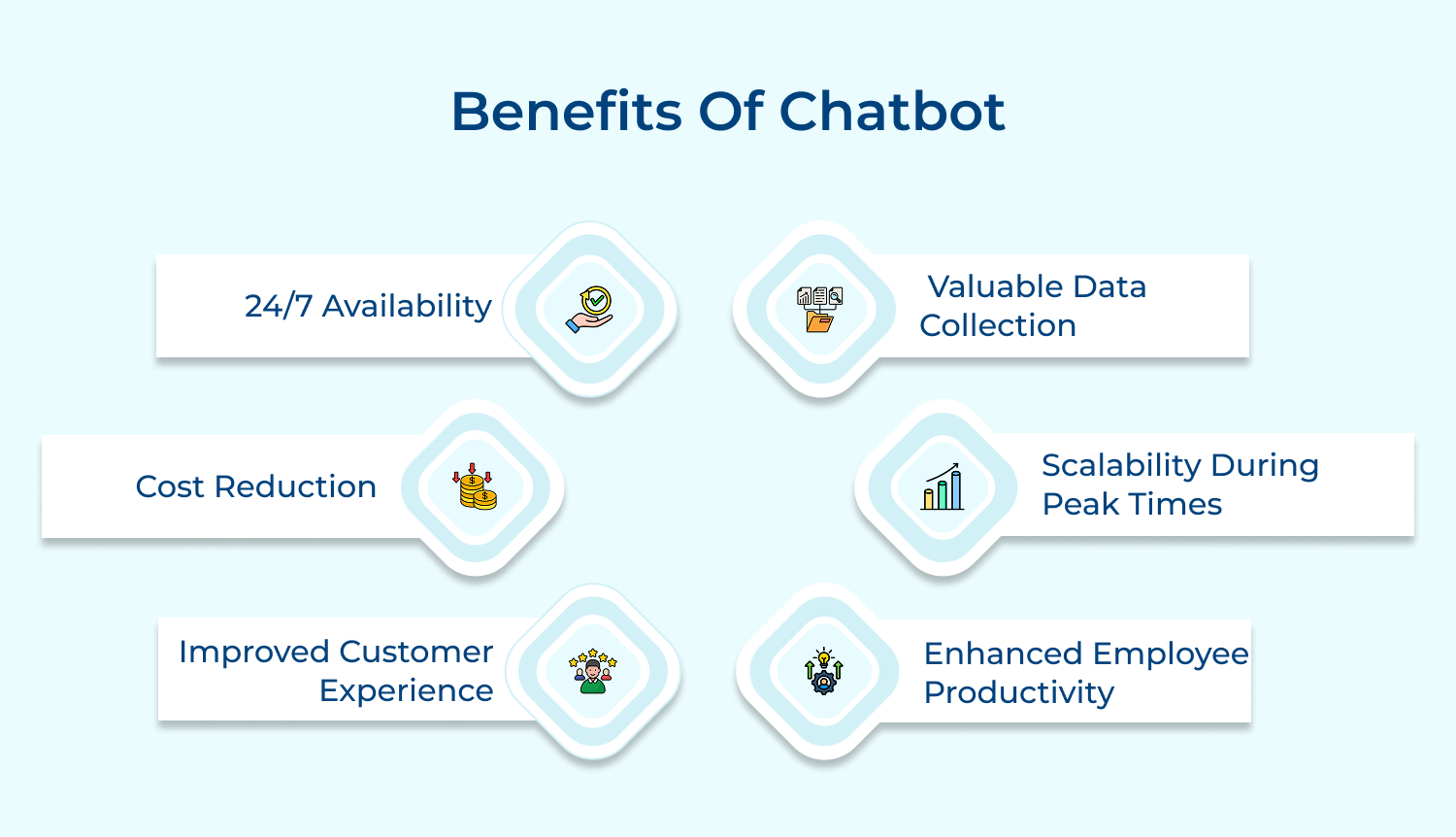
1. 24/7 availability: Chatbots provide consistent service around the clock. They can handle customer inquiries during holidays, weekends and after business hours, ensuring that users always receive immediate assistance regardless of time zone or day of the week.
2. Cost reduction: An AI-enabled chatbot can handle thousands of conversations simultaneously without additional cost, allowing human agents to focus on complex issues that truly require their expertise and emotional intelligence.
3. Improved customer experience: Bots deliver instant responses without making customers wait in long queues. They provide consistent answers to common questions and can maintain context throughout conversations, creating a smoother user experience that feels personalized to individual needs.
4. Valuable data collection: Every chatbot interaction generates insightful data about customer preferences and pain points. These conversations reveal patterns in customer behavior and highlight FAQs, giving actionable intelligence to improve products as well as refine their service approach.
5. Scalability during peak times: Chatbots handle sudden spikes in traffic without degradation in service quality. Whether during product launches, sales events, or unexpected service disruptions, they maintain consistent performance levels while processing multiple inquiries simultaneously without the need to hire temporary staff.
6. Enhanced employee productivity: By taking over repetitive questions and routine tasks, chatbots free up human workers for more meaningful work. Customer service reps can dedicate their time to solving complex problems rather than repeatedly answering the same basic questions.
We have narrowed down eight of the most impressive chatbot examples that demonstrate exceptional use cases on how these virtual assistants are redefining business operations.
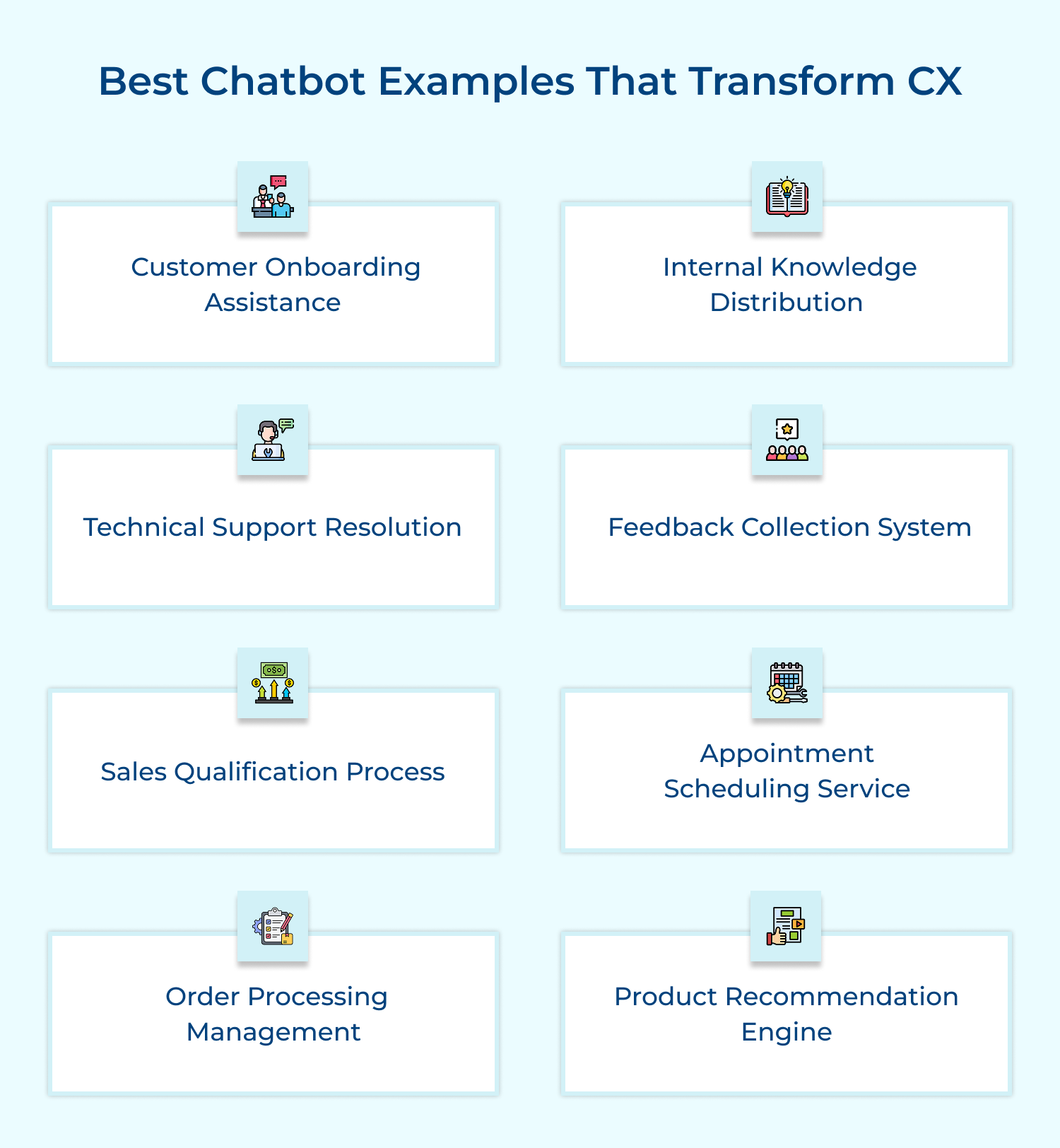
A comprehensive chatbot guides new users through early product adoption, reducing friction and supporting customers without overloading human teams.
It helps the new users in the following ways:
AI chatbots provide instant help for common technical issues, reducing wait times and freeing human agents for complex cases.
Here are the ways an AI bot assists in assisting technical support.
A sales chatbot is designed to capture prospect details, answer initial questions and connect qualified leads to sales reps.
Learn the different ways an AI bot helps in the sales eligibility procedure.
AI chatbots can manage the full order workflow from request to delivery—making the process seamless and reducing website navigation effort.
Customers can specify products, customize orders, share shipping details and make payments within one chat. The bot confirms details, validates addresses, calculates shipping and provides tracking updates.
For instance, a returning customer might say, “Reorder my usual coffee” and the chatbot replies with past order details, confirms preferences, processes payment and sends a tracking number—all in one conversation.
Pro Tips:
Chatbots function as centralized knowledge hubs within organizations, instantly delivering relevant company information to employees.
Conversational AI can collect and analyze customer feedback, capturing insights that traditional surveys might miss.
Here is how a bot helps in collecting feedback.
Chatbots streamline appointment scheduling across departments, eliminating back-and-forth coordination and allowing 24/7 access.
Connected to calendars, they check real-time availability, recommend time slots, account for meeting duration and match appointments with the right specialists.
Best Practices:
AI chatbots personalize shopping by turning static catalogs into interactive, guided conversations.
How does a chatbot help in product recommendation?
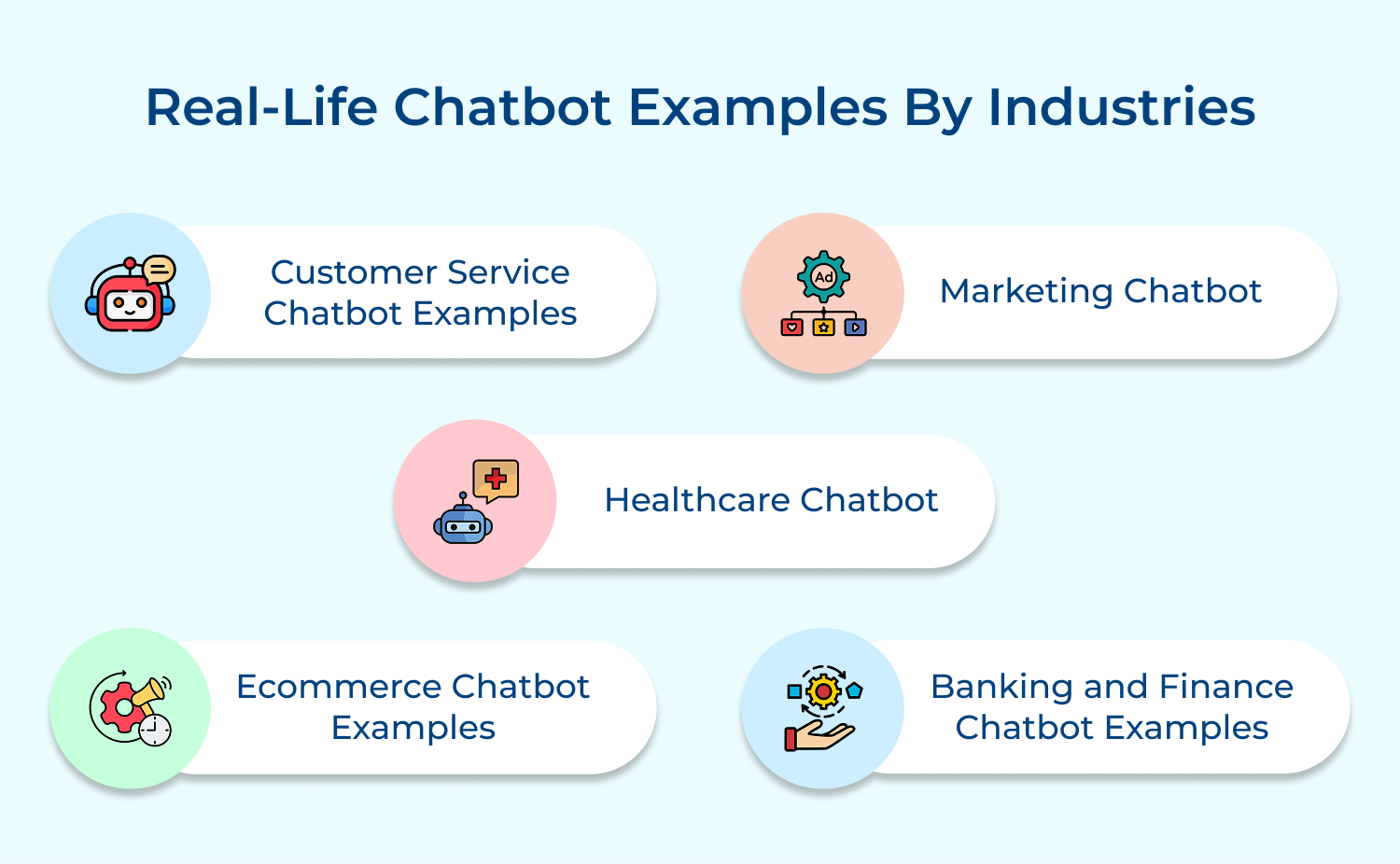
Join us as we explore how different sectors harness the power of chatbots to redefine their customer engagement strategies and remain competitive in the digital-forward age.
1. H&M’s Shopping Assistant
H&M employs a fashion-focused chatbot on their website and mobile app that helps customers find specific clothing items through conversational interaction. Shoppers can describe what they’re looking for using everyday language like “black dress for a summer wedding” and receive tailored product suggestions that match their style preferences, size requirements and occasion needs.
The implementation has transformed H&M’s customer support approach by significantly reducing response times for common inquiries. Customer service representatives now focus on complex styling questions and special orders while the chatbot handles routine size questions, store availability checks and basic product searches, creating a more efficient overall shopping experience.
2. Sephora’s Beauty Bot
Sephora’s chatbot serves as a beauty consultant through Facebook Messenger and their website, offering personalized makeup as well as skincare recommendations after asking users about their preferences, skin type or beauty concerns. The bot can suggest products, share application tips and even provide virtual try-on experiences for different makeup looks.
This virtual beauty assistant has enhanced Sephora’s relationship with customers by providing accessible expertise around the clock. The personalized recommendations foster stronger customer loyalty and increased satisfaction, as shoppers receive tailored advice that acknowledges their unique beauty profile rather than generic suggestions that might not suit their needs.
3. Domino’s Pizza Ordering Bot
Domino’s “Dom” chatbot allows customers to order pizza through Facebook Messenger, Twitter, or by simply texting a pizza emoji. The conversational interface walks customers through their order, suggests toppings & sides, processes payment information and provides real-time delivery tracking, all without requiring them to download a separate app.
This marketing tool has revolutionized Domino’s engagement strategy by meeting customers on platforms they already use daily. The conversational ordering experience has boosted repeat purchases and enhanced brand perception, positioning Domino’s as an innovative, customer-focused company that makes ordering convenient.
4. Starbucks’ Order Ahead Assistant
Starbucks implemented a voice-ordering chatbot within their mobile app called “My Starbucks Barista,” allowing customers to place orders through natural conversation. Users can specify complex coffee orders with customizations like “extra hot soy latte with an extra shot” just as they would speak to a human barista.
The chatbot has strengthened Starbucks’ digital ecosystem by creating a seamless ordering experience that feels personal and efficient. This technology has increased mobile order frequency and reduced in-store wait times, enhancing overall customer satisfaction while collecting valuable preference data that helps Starbucks refine their menu offerings.
5. Ada Health Symptom Checker
Ada’s AI health assistant engages users in conversational assessments about their symptoms, asking relevant follow-up questions based on their responses. The chatbot uses medical knowledge to suggest possible conditions, recommend appropriate care options and determine whether self-care is sufficient or medical attention is needed.
This implementation has transformed how people initially assess health concerns, providing reliable guidance before they seek professional care. Ada helps reduce unnecessary doctor visits while encouraging appropriate medical attention for concerning symptoms, ultimately improving healthcare resource allocation and patient outcomes through earlier intervention.
6. Babylon Health’s Triage Bot
Babylon Health offers a chatbot that conducts initial patient assessments through their mobile app, asking structured questions about symptoms and medical history. Based on this conversation, the bot recommends whether the patient should seek emergency care, schedule a doctor’s appointment, or try home remedies first.
This virtual triage system has revolutionized primary care delivery by directing patients to the appropriate level of care efficiently. Healthcare providers can focus on patients who truly need in-person attention while still providing guidance to those with minor concerns, reducing wait times and improving overall system effectiveness.
7. ASOS Digital Assistant
ASOS deployed a shopping assistant that helps customers navigate their extensive clothing catalog through natural conversation. The bot can search for specific items, recommend outfits based on style preferences, provide size guidance and answer questions about shipping policies.
This implementation has transformed the online shopping experience by making it more conversational and less overwhelming. Customers find products more quickly and with greater confidence in their purchases, leading to higher conversion rates as well as fewer returns as shoppers receive more tailored guidance throughout their journey.
8. eBay ShopBot
eBay’s ShopBot helps buyers find specific items among millions of listings by understanding conversational requests like “I need a vintage leather jacket under $100.” The assistant can understand price ranges, product categories, conditions and style preferences through natural dialogue rather than requiring precise search terms.
This conversational interface has revolutionized how people discover products on the massive marketplace. Simplifying the search process helped connect sellers with more qualified buyers who are specifically interested in their product offerings.
9. Bank of America’s Erica
Bank of America’s virtual financial assistant Erica helps customers manage their finances through their mobile banking app. The chatbot can answer account questions, facilitate transactions, provide spending insights, and offer proactive notifications about unusual charges, upcoming bills, or potential savings opportunities.
This implementation has transformed how customers interact with their finances by providing 24/7 personalized guidance and support. Bank of America has seen increased mobile banking engagement and improved customer satisfaction as users gain greater control over their financial lives through conversations that feel helpful rather than transactional.
10. Capital One’s Eno
Capital One’s text-based assistant Eno monitors accounts for unusual activity, answers questions about balances or transactions and helps customers manage their credit card accounts through natural conversation. Customers can text questions like “What’s my available credit?” or “Did I pay my bill last month?” and receive immediate answers.
This chatbot has revolutionized Capital One’s fraud prevention and customer service approach by combining security monitoring with conversational support. The proactive alerts and instant responses have strengthened customer trust while reducing call center volume for routine inquiries, creating a more efficient service model overall.
Chatbots have transformed how businesses interact with customers across industries, creating personalized experiences that were once impossible at scale. From guiding customers through complex purchases to providing immediate technical support, these conversational assistants bridge the gap between automated efficiency and human-like engagement.
The versatility of chatbots extends beyond external customer communication into critical internal functions. They distribute organizational knowledge, streamline appointment scheduling and gather actionable feedback—all while maintaining consistent availability that human teams alone cannot match. This multifaceted utility makes them valuable across every department.
As chatbot technology continues to advance, the line between automated and human conversation grows increasingly blurred. The most successful implementations don’t aim to replace human interaction but rather enhance it by handling routine inquiries, gathering essential information and creating space for meaningful connections when human expertise is truly needed.

What are the best chatbot examples for businesses?
The most effective business chatbots include Bank of America’s Erica for financial management, Sephora’s beauty consultant for personalized recommendations and Domino’s ordering assistant for streamlined purchasing. Other standout examples include H&M’s shopping assistant, Ada Health’s symptom checker and Starbucks’ voice ordering system—each demonstrating how conversational AI can enhance customer experiences while reducing operational costs.
What are the successful chatbot examples used by businesses to boost conversions?
ASOS’s digital assistant has significantly improved conversions by helping shoppers navigate their extensive catalog through natural conversation and providing personalized style recommendations. Similarly, eBay’s ShopBot has boosted sales by simplifying the discovery of specific items among millions of listings, while Domino’s ordering bot has increased repeat purchases by making the ordering process frictionless and available across multiple messaging platforms.
What are the real-life chatbot examples in support, sales and marketing?
In support, technical troubleshooting chatbots like those used by telecommunications companies diagnose common device issues and provide step-by-step resolution guidance. For sales, Capital One’s Eno qualifies prospects by understanding their financial needs before connecting them with appropriate specialists. In marketing, Starbucks’ mobile ordering assistant drives engagement while collecting valuable preference data that informs future product development and promotional campaigns.
What makes a chatbot example truly effective?
The most effective chatbots combine accurate natural language understanding with contextual awareness that remembers conversation history. They provide genuinely helpful solutions rather than simply redirecting users to human agents. Successful implementations like Sephora’s beauty bot deliver personalized recommendations based on individual preferences, while maintaining conversational flow that feels natural rather than robotic and gracefully handling the transition to human support when necessary.
How do different industries customize chatbots for their unique needs?
Banking chatbots prioritize security features and transaction verification while providing financial insights through conversational interfaces. Retail implementations focus on product discovery and purchase assistance with visual elements like product images. Healthcare chatbots emphasize privacy compliance and symptom assessment accuracy, while travel industry bots excel at complex itinerary building across multiple service providers. Each industry adapts the technology to address their specific customer journeys and business objectives.
 https://omni24.io/wp-content/uploads/2026/08/AI-Customer-Service-Agents.png
1256
2400
Webvision Solution
https://omni24.io/wp-content/uploads/2023/04/Omni-Logo-1.svg
Webvision Solution2026-09-21 04:48:512026-09-21 04:48:51How to Build an AI Customer Service Agents: 8 Key Steps
https://omni24.io/wp-content/uploads/2026/08/AI-Customer-Service-Agents.png
1256
2400
Webvision Solution
https://omni24.io/wp-content/uploads/2023/04/Omni-Logo-1.svg
Webvision Solution2026-09-21 04:48:512026-09-21 04:48:51How to Build an AI Customer Service Agents: 8 Key Steps https://omni24.io/wp-content/uploads/2026/08/Omnichannel-Conversational-AI.png
1256
2400
Tushar Joshi
https://omni24.io/wp-content/uploads/2023/04/Omni-Logo-1.svg
Tushar Joshi2026-09-16 03:51:072026-09-16 03:51:07How to Build Omnichannel Conversational AI Strategy
https://omni24.io/wp-content/uploads/2026/08/Omnichannel-Conversational-AI.png
1256
2400
Tushar Joshi
https://omni24.io/wp-content/uploads/2023/04/Omni-Logo-1.svg
Tushar Joshi2026-09-16 03:51:072026-09-16 03:51:07How to Build Omnichannel Conversational AI Strategy https://omni24.io/wp-content/uploads/2026/08/Customer-Service-Teams.png
1256
2400
Tushar Joshi
https://omni24.io/wp-content/uploads/2023/04/Omni-Logo-1.svg
Tushar Joshi2026-09-15 04:01:522026-09-15 04:02:16How to Build Customer Service Teams: 6 Key Steps
https://omni24.io/wp-content/uploads/2026/08/Customer-Service-Teams.png
1256
2400
Tushar Joshi
https://omni24.io/wp-content/uploads/2023/04/Omni-Logo-1.svg
Tushar Joshi2026-09-15 04:01:522026-09-15 04:02:16How to Build Customer Service Teams: 6 Key Steps
Whether it’s about acquire, engage or support – Omni24 covers all your customer engagement needs in one complete platform.

Copyright ©2026 Veemo All rights reserved.
CA, Los Angeles, Hall Ave, 19011