How to Create an Effective Chatbot Marketing Strategy?
Chatbot marketing enables instant, personalized customer interactions that boost engagement, streamline support and drive conversions in the digital marketplace.
Chatbot marketing enables instant, personalized customer interactions that boost engagement, streamline support and drive conversions in the digital marketplace.
Businesses are constantly seeking innovative ways to connect with their audience. Chatbot marketing – a game-changing strategy that’s transforming the way companies interact with customers.
35–40% of businesses use chatbots in marketing, sales and support and 1 in 5 consumers would consider purchasing goods or services from a chatbot.
From lead generation to post-purchase support, chatbots are revolutionizing the way businesses interact with their customers. That’s the power of chatbot marketing.
Let us delve into the benefits of chatbot marketing, explore best practices and provide real-world examples of successful chatbot implementations.
Chatbot marketing is a modern digital strategy that leverages AI-powered conversational interfaces to engage customers, provide support and drive sales. These automated chatbots interact with users through messaging platforms, websites or mobile apps, offering personalized experiences at scale.
AI-powered bots can answer queries, recommend products and guide users through various processes 24/7 by simulating human-like conversations. The approach combines the immediacy of instant messaging with the efficiency of automation. Chatbot marketing represents a shift towards interactive digital communication, on-demand assistance and information.
Key objectives:
As businesses increasingly embrace technology, chatbots have emerged as a powerful tool in digital marketing strategies. Here are several benefits of using chatbots in marketing:
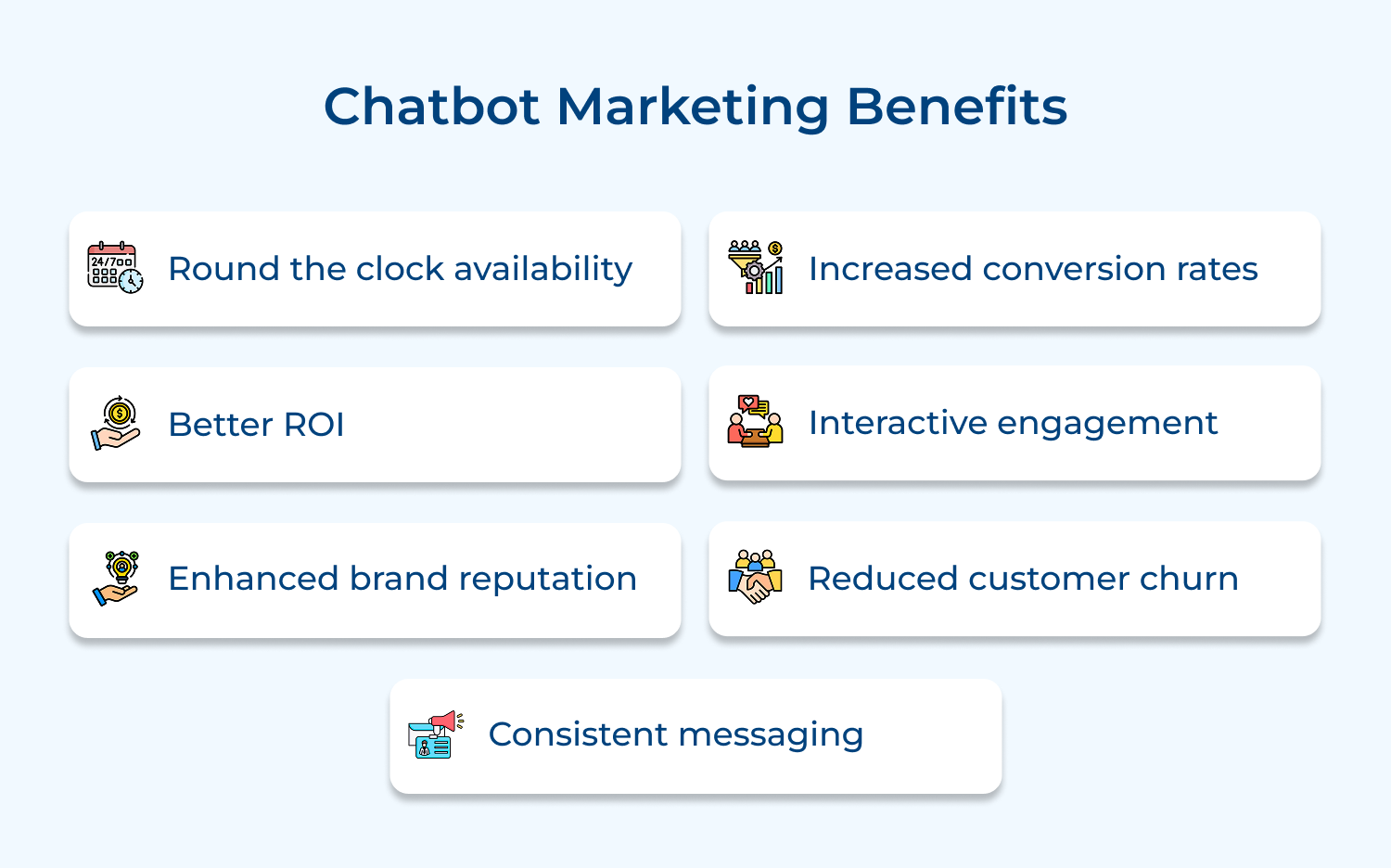
Developing a successful chatbot marketing strategy requires careful planning, implementation and optimization.
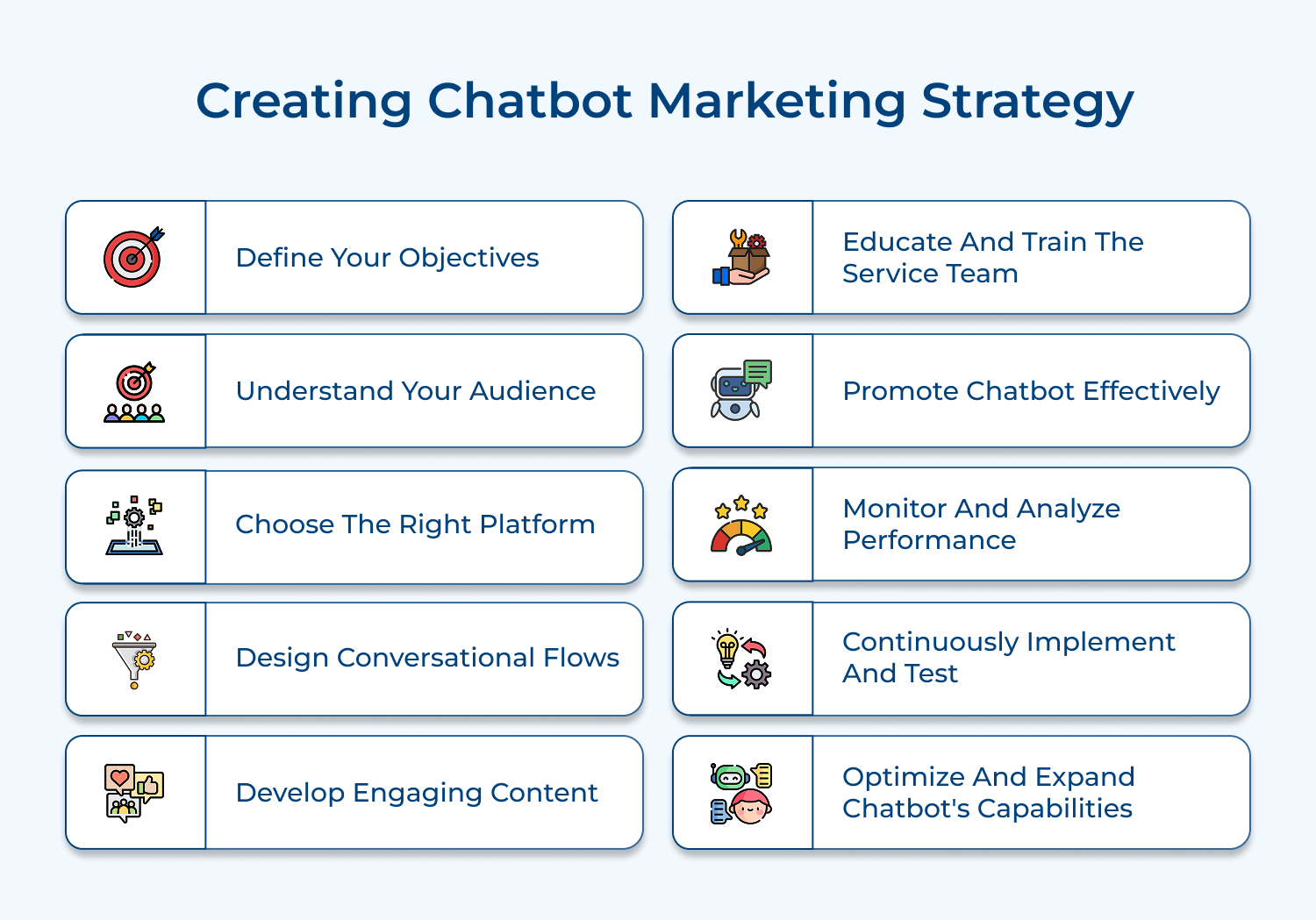
Clearly outline the goals you want to achieve with your chatbot. Whether it’s improving customer service, generating leads, or increasing sales, having specific objectives will guide your strategy.
Consider your short-term and long-term goals to ensure they align with your overall marketing as well as business objectives. This clarity will help you measure success and make informed decisions throughout the process.
Pro Tips:
Conduct thorough research to understand your target audience’s preferences, pain points and behavior. Analyze customer data, conduct surveys and review previous interactions to gain insights.
This understanding will help you create a chatbot personality and conversational flow that resonates with your audience, increasing engagement.
Pro Tips:
Select a chatbot platform that aligns with your objectives and technical requirements. Consider factors such as ease of use, integration capabilities, analytics features and scalability.
Evaluate whether you need a simple rule-based chatbot or a more advanced AI-powered solution. The right platform will enable you to create, deploy and manage your chatbot effectively.
Pro Tips:
Map out the conversation paths your chatbot will follow. Create a logical flow that guides users towards your objectives while providing a natural, engaging experience.
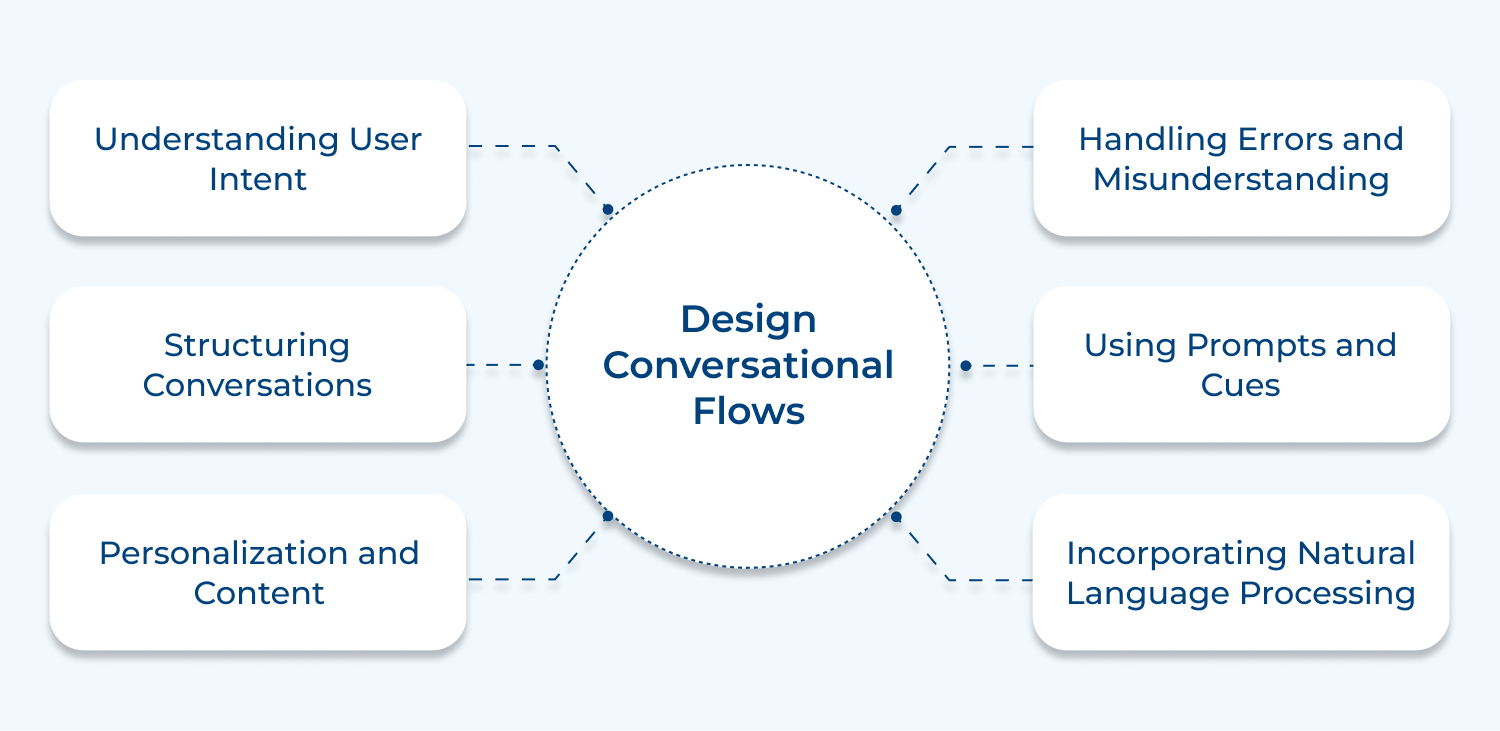
Anticipate various user inputs and design appropriate responses. Include options for users to easily navigate or restart conversations to prevent frustration.
Pro Tips:
Create compelling, concise content for your chatbot responses. Use a consistent tone that aligns with your brand voice. Incorporate multimedia elements like images or GIFs where appropriate to enhance engagement.
Ensure your content is informative, helpful, and drives users towards your marketing objectives.
Pro Tips:
Educate your marketing, sales and customer service teams about the chatbot’s capabilities and limitations.
Ensure they understand how to leverage the chatbot in their roles and how to handle situations where human intervention is necessary. The alignment will help create a seamless experience for customers across all touchpoints.
Pro Tips:
Develop a promotion strategy to encourage users to engage with your chatbot. Highlight its benefits and capabilities across your marketing channels.
Consider creating tutorial content or offering incentives for first-time users. Integrate the chatbot prominently on your website and social media platforms to maximize visibility and usage.
Pro Tips:
Regularly review chatbot analytics to assess performance against your objectives. Track metrics such as engagement rates, conversion rates and user satisfaction.
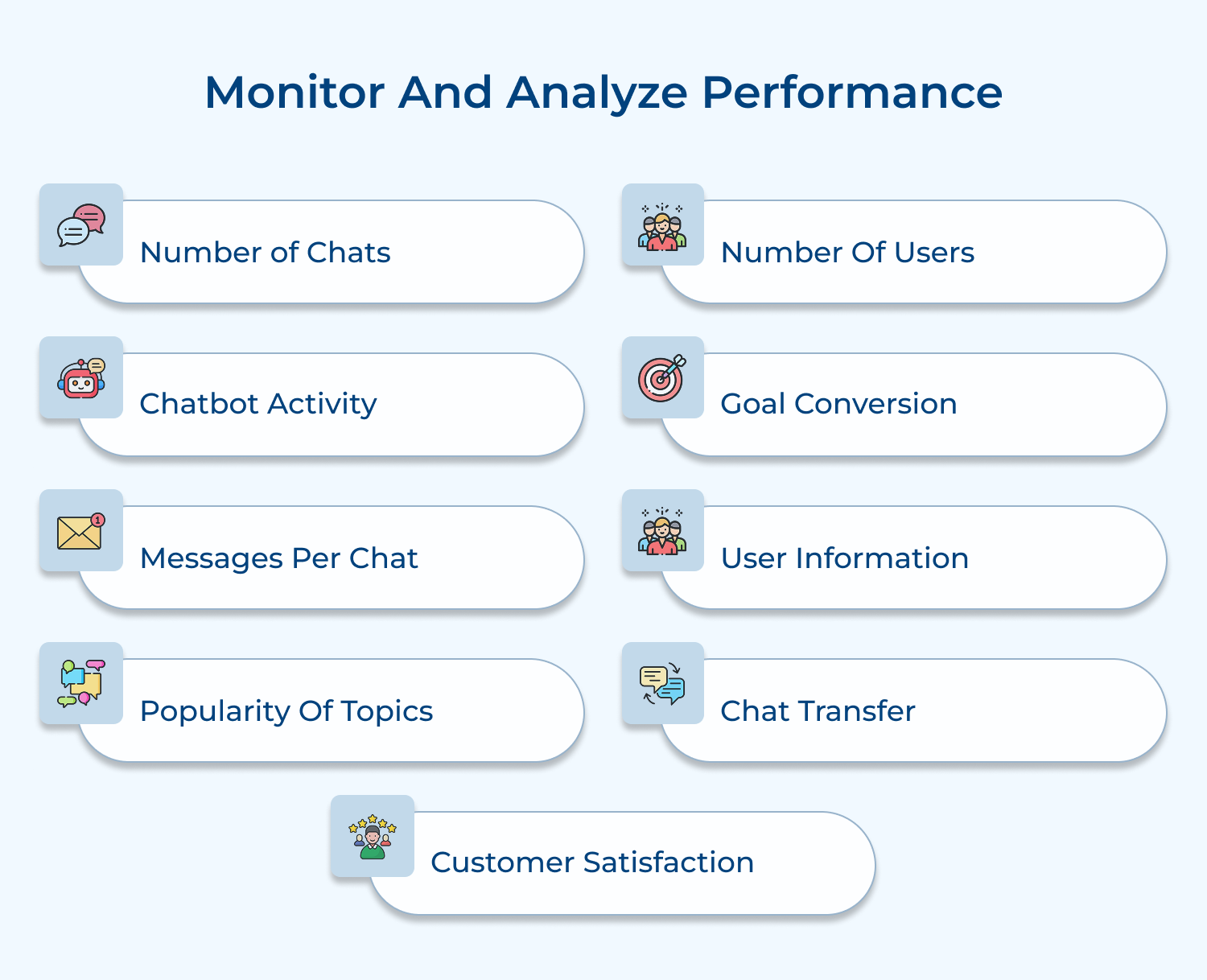
Analyze conversation logs to identify common issues or opportunities for improvement. Use these insights to refine your chatbot’s functionality and content continuously.
Pro Tips:
Deploy your chatbot on your chosen platforms and conduct thorough testing. Check for bugs, usability issues and accuracy of responses.
Test various scenarios to ensure the chatbot handles different user inputs effectively. Gather feedback from a small group of users or team members to identify areas for improvement.
Pro Tips:
Based on performance data and user feedback, make ongoing improvements to your chatbot. Refine conversational flows, update content and add new features to enhance functionality.
Consider expanding the chatbot’s capabilities to cover new use cases or integrate with additional platforms as your strategy evolves.
Pro Tips:
Chatbot marketing uses AI-powered conversational interfaces to enhance customer engagement and drive sales.
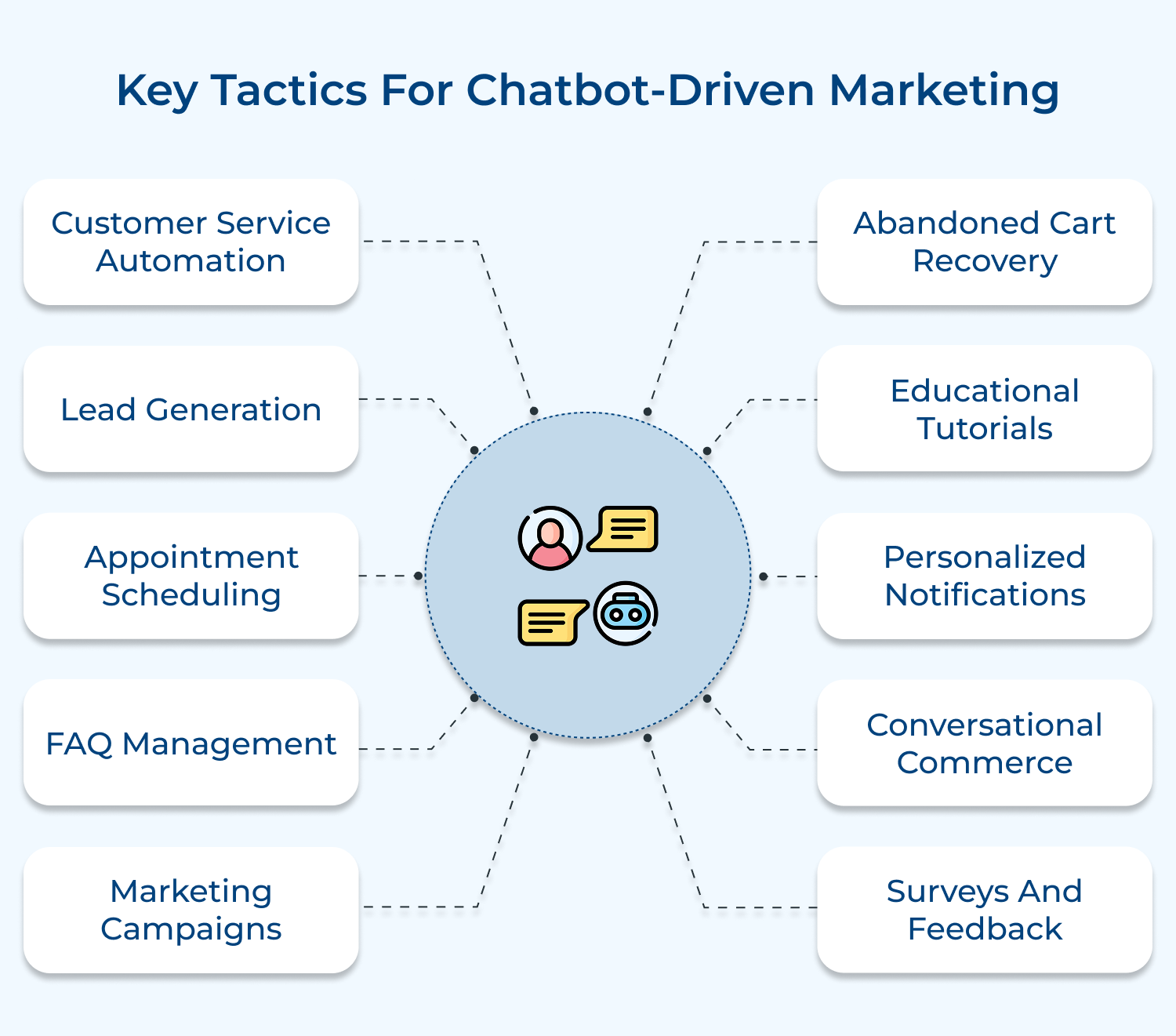
1. Customer Service Automation
Chatbots can handle routine customer inquiries 24/7, providing instant responses to common questions. The automation significantly reduces response times, improves customer satisfaction, and frees up human agents to focus on more complex issues. By offering consistent, chatbots enhance the overall customer experience.
2. Lead Generation
AI bots excel at capturing and qualifying leads through interactive conversations. They can engage website visitors, ask qualifying questions and collect contact information. The process not only generates more leads but also pre-qualifies them based on set criteria. Chatbots can nurture these leads by providing relevant information and guiding them through the sales funnel.
3. Appointment Scheduling
Integrating chatbots with scheduling systems streamlines the appointment-booking process. Customers can easily check availability, book, reschedule, or cancel appointments through conversational interfaces. The convenience reduces no-shows, improves customer satisfaction and saves time for both customers and staff.
4. FAQ Management
Chatbots serve as an efficient tool for managing frequently asked questions. They can quickly provide accurate answers to common queries, reducing the workload on customer support teams. The instant access to information improves customer satisfaction and can be continuously updated to address new questions.
5. Marketing Campaigns
Chatbots can play a crucial role in executing and enhancing marketing campaigns. They can deliver personalized content, promote special offers and engage users with interactive quizzes or games. Chatbots can also gather valuable data during these interactions, helping to refine marketing strategies.
6. Abandoned Cart Recovery
Chatbots can be programmed to follow up with customers who have abandoned their shopping carts. They can send reminders, offer assistance, address concerns, or provide incentives to complete the purchase. The proactive approach can significantly improve recovery rates, boosting sales and customer retention.
7. Educational Tutorials
Chatbots can deliver interactive, step-by-step tutorials on product usage or industry-related topics. This approach enhances customer education, improves product adoption and positions your brand as an industry authority. Chatbots can adapt the tutorial content based on user responses, ensuring a personalized learning experience.
8. Personalized Notifications
Leveraging user data and preferences, chatbots can send targeted, personalized notifications about sales, restocks, or relevant news. These timely, tailored messages can significantly boost engagement and conversions. Chatbots can also allow users to set their notification preferences, ensuring relevance and reducing the risk of message fatigue.
9. Conversational Commerce
Chatbots enable seamless shopping experiences by guiding customers through product selection, answering questions and facilitating purchases within the chat interface. The conversational approach can increase sales by providing personalized recommendations and addressing concerns in real time.
10. Surveys and Feedback
Chatbots provide an interactive, engaging way to collect customer feedback while conducting surveys. Their conversational nature can increase response rates compared to traditional survey methods. Chatbots can ask follow-up questions based on responses, gathering more detailed and valuable insights.
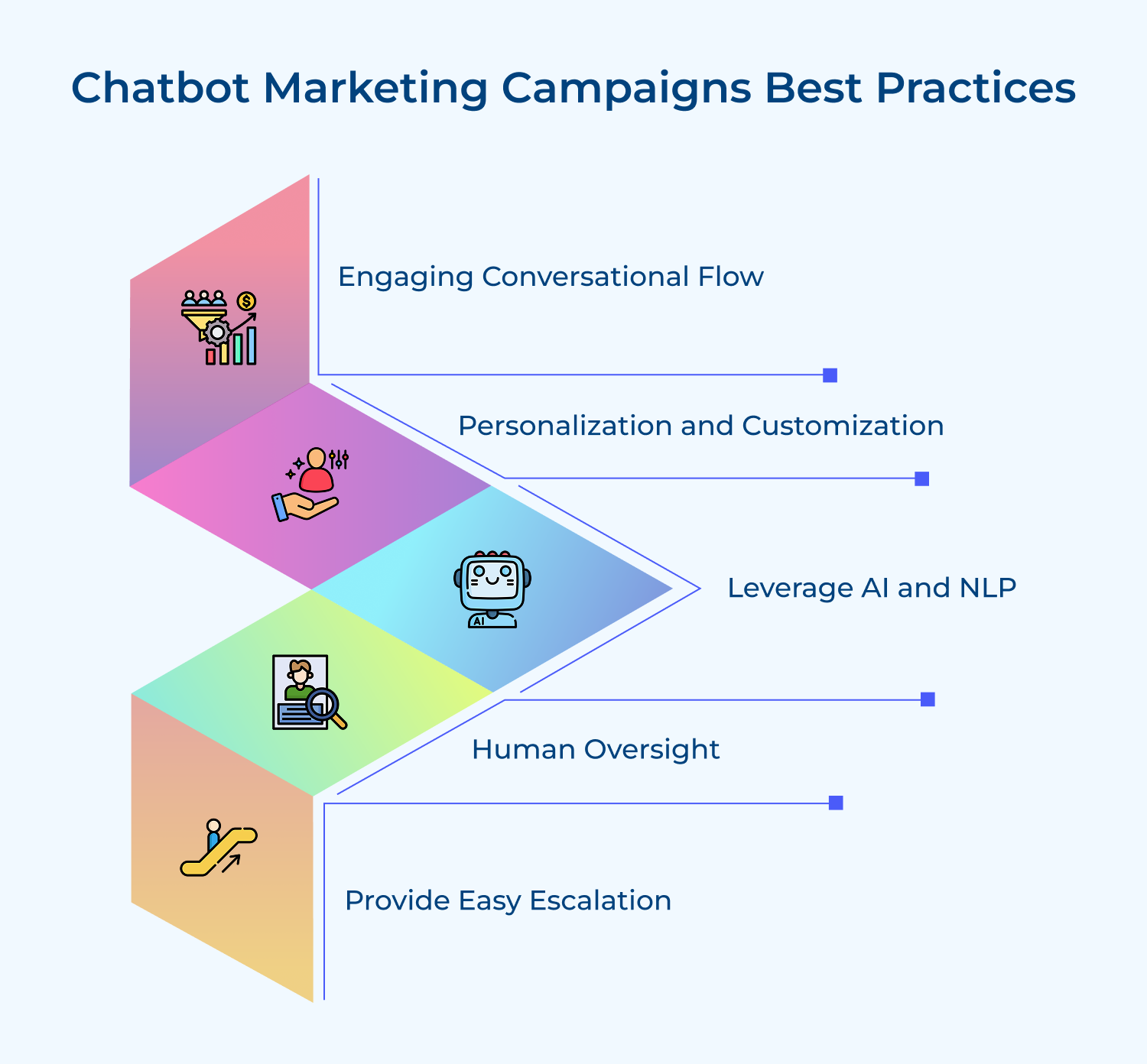
Maximizing chatbot marketing success involves strategic planning and execution. Adopting best practices ensures that your chatbot engages users effectively to achieve your marketing goals.
Chatbot marketing leverages AI-powered conversational interfaces to engage customers, provide support and drive sales.
1. Sephora’s Beauty Bot (Retail)
Sephora’s Facebook Messenger chatbot offers personalized makeup recommendations and tutorials. Users can upload selfies for virtual makeovers, book in-store appointments and receive product suggestions based on their preferences. The interactive approach enhances customer engagement while providing valuable beauty advice, seamlessly bridging the gap between online browsing and in-store purchases to boost Sephora’s omnichannel marketing strategy.
2. Marriott’s Chatbot Concierge (Hospitality)
Marriott International’s chatbot serves as a virtual concierge for hotel guests. Available through Facebook Messenger and Slack, it assists with reservation management, local recommendations and service requests. By providing instant, 24/7 assistance, the chatbot enhances guest experiences, reduces front desk workload and increases guest satisfaction, ultimately driving repeat bookings and positive reviews.
3. Spotify’s Playlist Bot (Entertainment)
Spotify’s Facebook Messenger bot helps users discover new music and create playlists. By analyzing listening history and preferences, the bot suggests tracks as well as generates custom playlists. The personalized experience enhances user engagement, increases time spent on the platform and helps Spotify differentiate itself in the competitive music streaming market.
4. Bank of America’s Erica (Finance)
Bank of America’s AI-powered chatbot, Erica, assists customers with various financial tasks through the mobile app. From checking balances and transferring money to providing spending insights and credit score information, Erica offers personalized financial guidance. 24/7 virtual assistant improves customer service, promotes financial literacy and encourages more frequent engagement with banking services.
5. Lidl’s Winebot (Grocery)
Lidl’s Facebook Messenger chatbot, Margot, acts as a virtual sommelier, helping customers choose the perfect wine. Users can get wine pairing suggestions, learn about wine characteristics, receive recommendations based on their preferences and budget. The educational and interactive approach not only boosts wine sales but also positions Lidl as a customer-centric retailer in the competitive grocery market.
As we’ve explored, chatbots have become an indispensable tool in modern marketing strategies. Their ability to provide personalized, instant interactions at scale has revolutionized customer engagement and streamlined various marketing processes. From lead generation and customer service to personalized product recommendations and interactive campaigns, chatbots offer versatile solutions that can significantly enhance your marketing efforts.
The key to success lies in thoughtful implementation. By clearly defining objectives, understanding your audience as well as continuously optimizing based on data and feedback, you can create a chatbot that not only meets but exceeds customer expectations. As AI technology continues to advance, the potential for chatbots in marketing will only grow, offering exciting opportunities for businesses to innovate and stay ahead in the competitive digital landscape.

How can you use chatbots in marketing?
Chatbots can be used in marketing to engage customers 24/7, qualify leads, provide personalized product recommendations, offer instant customer support and gather valuable customer data. They can also automate routine tasks like appointment scheduling, conduct surveys and deliver targeted content or promotions based on user interactions.
What are the advantages and disadvantages of the chatbot marketing strategy?
Advantages: 24/7 availability, instant responses, scalability, personalized interactions, data collection, and cost-effectiveness. Disadvantages: Potential for misunderstanding complex queries, lack of human empathy, initial setup costs, maintenance requirements and the risk of frustrating users if not well-designed or if the AI limitations aren’t properly managed.
How to set up marketing chatbots with landbot?
To set up a marketing chatbot with Landbot, start by defining your objectives. Then, use Landbot’s drag-and-drop interface to design your conversation flow. Integrate with your existing tools, customize the bot’s appearance and add engaging elements like images or videos. Test thoroughly before launching, and continuously optimize based on user interactions.
Why is a chatbot important in marketing?
Chatbots are important in marketing because they provide instant, personalized customer engagement at scale. They can qualify leads, answer FAQs and guide customers through the sales funnel 24/7. Chatbots also collect valuable customer data, improve response times and free up human resources for more complex tasks, enhancing overall marketing efficiency.
 https://omni24.io/wp-content/uploads/2026/07/Customer-Data-Platform.png
1256
2400
Tushar Joshi
https://omni24.io/wp-content/uploads/2023/04/Omni-Logo-1.svg
Tushar Joshi2026-07-08 03:58:592026-07-08 03:58:59How a Customer Data Platform Unlocks Unified Customer Insights
https://omni24.io/wp-content/uploads/2026/07/Customer-Data-Platform.png
1256
2400
Tushar Joshi
https://omni24.io/wp-content/uploads/2023/04/Omni-Logo-1.svg
Tushar Joshi2026-07-08 03:58:592026-07-08 03:58:59How a Customer Data Platform Unlocks Unified Customer Insights https://omni24.io/wp-content/uploads/2026/07/Unified-Customer-View.png
1256
2400
Tushar Joshi
https://omni24.io/wp-content/uploads/2023/04/Omni-Logo-1.svg
Tushar Joshi2026-07-07 03:37:342026-07-07 03:37:34How a Unified Customer View Transforms Customer Experience
https://omni24.io/wp-content/uploads/2026/07/Unified-Customer-View.png
1256
2400
Tushar Joshi
https://omni24.io/wp-content/uploads/2023/04/Omni-Logo-1.svg
Tushar Joshi2026-07-07 03:37:342026-07-07 03:37:34How a Unified Customer View Transforms Customer Experience https://omni24.io/wp-content/uploads/2026/06/Omnichannel-CRM.png
1256
2400
Tushar Joshi
https://omni24.io/wp-content/uploads/2023/04/Omni-Logo-1.svg
Tushar Joshi2026-07-06 03:49:012026-07-06 04:00:22How to Implement Omnichannel CRM Strategy: 7 Key Steps
https://omni24.io/wp-content/uploads/2026/06/Omnichannel-CRM.png
1256
2400
Tushar Joshi
https://omni24.io/wp-content/uploads/2023/04/Omni-Logo-1.svg
Tushar Joshi2026-07-06 03:49:012026-07-06 04:00:22How to Implement Omnichannel CRM Strategy: 7 Key Steps
Whether it’s about acquire, engage or support – Omni24 covers all your customer engagement needs in one complete platform.

Copyright ©2026 Veemo All rights reserved.
CA, Los Angeles, Hall Ave, 19011