How to Build a Customer Service Forecasting Model: 7 Strategies
Learn how to forecast customer service demand using data-driven models, modern tools and collaborative processes to optimize staffing while enhancing customer experience.

Learn how to forecast customer service demand using data-driven models, modern tools and collaborative processes to optimize staffing while enhancing customer experience.
Are you constantly struggling with understaffed customer service teams during peak periods, leaving customers frustrated and agents overwhelmed? Perhaps you’re facing the opposite problem, overstaffed contact centers during quiet periods with idle agents draining your budget.
Fortunately, customer service forecasting offers a powerful solution to these persistent challenges. By scientifically predicting future contact volumes and patterns, organizations can align their staffing as well as resources precisely with actual customer demand. This strategic approach transforms reactive service operations into proactive centers of excellence, where the right agents with the right skills are available at exactly the right moments to meet customer needs efficiently as well as effectively.
Customer service forecasting is the process of predicting future customer support demand to ensure optimal staffing and resource allocation. It involves analyzing historical data, identifying patterns, as well as applying statistical methods to anticipate when, where and how many customer interactions will occur across different channels. This strategic planning approach helps organizations maintain service quality while controlling costs through efficient workforce management.
Customer service forecasting begins with collecting comprehensive historical data about customer interactions, including timestamps, duration and resolution types. This data is then cleansed as well as organized to identify meaningful patterns related to time of day, day of week, seasonality and special events that influence contact volumes.
The prepared data feeds into various forecasting models that calculate future demand using statistical methods like moving averages or machine learning algorithms. These predictions are continuously refined through feedback loops that compare forecasted volumes against actual results to improve future accuracy and account for changing customer behaviors.
Key Principles:
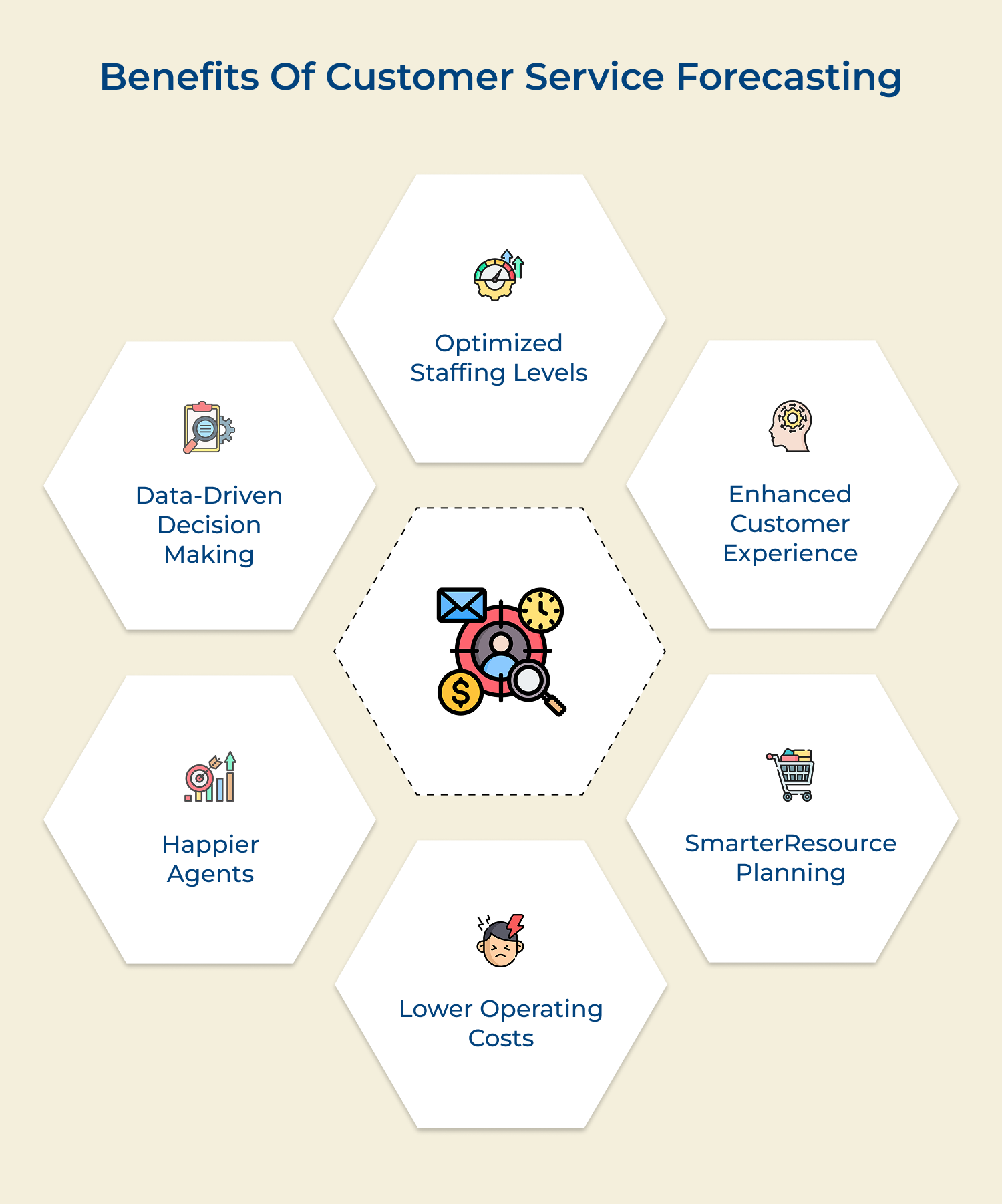
Let’s delve into five compelling advantages of customer service forecasting and why it’s an essential practice for any forward-thinking organization.
1. Optimized Staffing Levels
Forecasting helps you match agent staffing perfectly to expected call volumes. This avoids overstaffing during quiet times and understaffing during busy periods. The result? Balanced workloads that keep costs in check and maintain great service without stress for managers.
2. Enhanced Customer Experience
When you forecast accurately, customers get connected to support quickly with minimal wait times. Agents aren’t rushed and can resolve issues properly on the first try. This consistent support builds customer trust, they know help is ready whenever they need it.
3. Smarter Resource Planning
Forecasting isn’t just about daily schedules, it helps plan for the long term. You can time hiring, training and tech upgrades well in advance, so your team’s ready for busy seasons as well as growth without last-minute scramble.
4. Lower Operating Costs
Good forecasts cut down on overtime and costly emergency hires. You can use smart scheduling like staggered shifts or flexible hours that fit demand patterns, often revealing savings that would otherwise be missed.
5. Happier Agents
Predictable schedules reduce burnout and keep agents satisfied. No more unexpected workload spikes means less stress as well as higher retention. Keeping your experienced team intact saves money and keeps service quality high.
6. Data-Driven Decision Making
Forecasting uncovers trends in customer behavior and operational bottlenecks. These insights help leaders improve products, streamline processes and enhance self-service options before issues escalate.
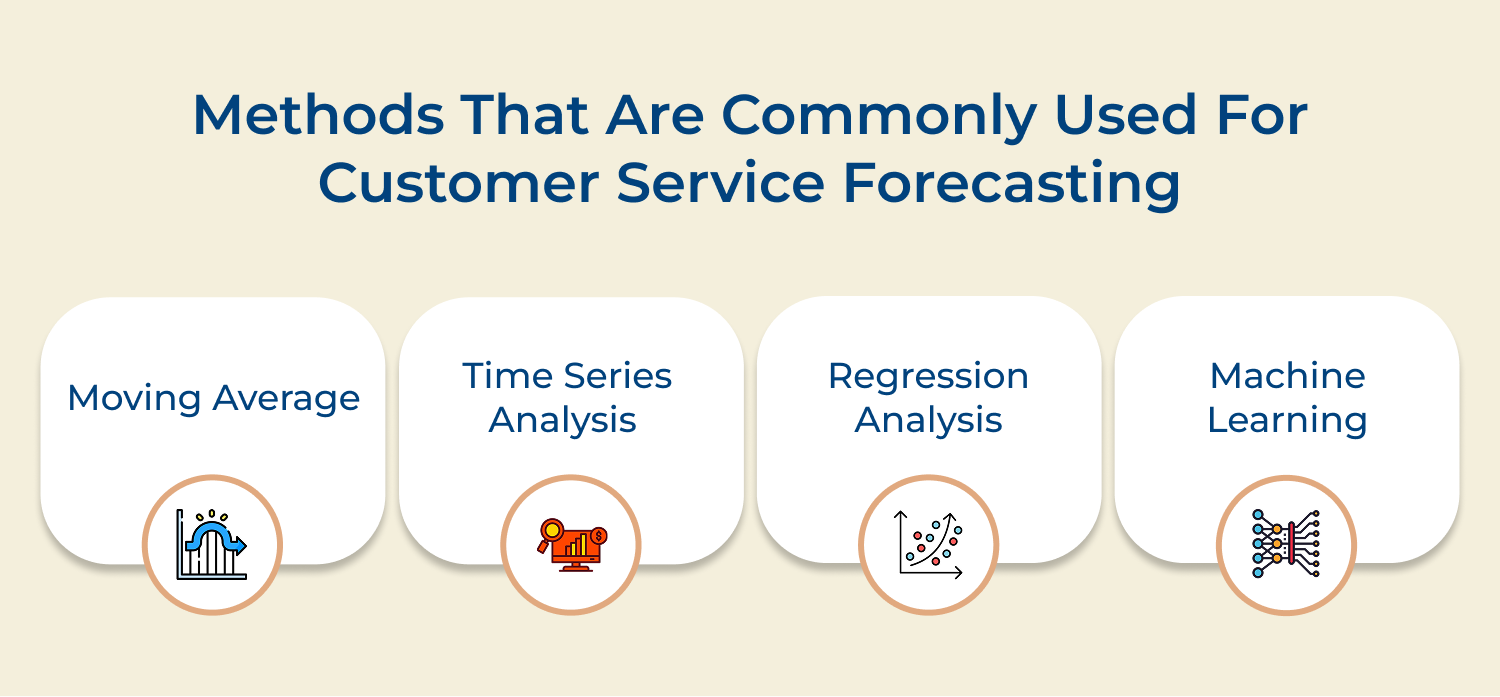
Accurately predicting future customer service demand requires selecting the right forecasting methodology. These approaches vary in complexity, data requirements and predictive power.
1. Moving Average
This method takes the average of contact volumes from recent time periods to predict what’s coming. It’s simple and easy to use, perfect for teams without a stats background. It smooths out random spikes and dips, making it ideal for contact centers with steady traffic. But it has a downside: it reacts slowly to real changes and treats all past data equally, even if newer data is more relevant.
2. Time Series Analysis
Time series forecasting breaks your data into trends, seasonality and random changes. It picks up on daily, weekly and yearly patterns like the common “Monday morning spike” seen across industries. With tools like ARIMA models, you can forecast multiple seasonal trends at once, which is great for retail or other cyclical businesses. It’s more advanced but much more insightful.
3. Regression Analysis
Regression looks at how outside factors like marketing campaigns or weather affect contact volume. It’s great when past trends alone can’t predict what’s next. Ask yourself: Do you know how big launches impact your support team? Are you tracking system outages or social buzz? Multivariate regression can weigh all these variables to tell you not just what’s likely to happen, but why.
4. Machine Learning
Machine learning takes things to the next level. Algorithms like neural networks and random forests analyze huge datasets to spot patterns traditional methods miss. These models learn and improve as they go, making them perfect for fast-changing environments and complex customer behaviors.
If you’re ready to transform your customer service operations, here are seven strategies to help you develop a forecasting model that delivers results.
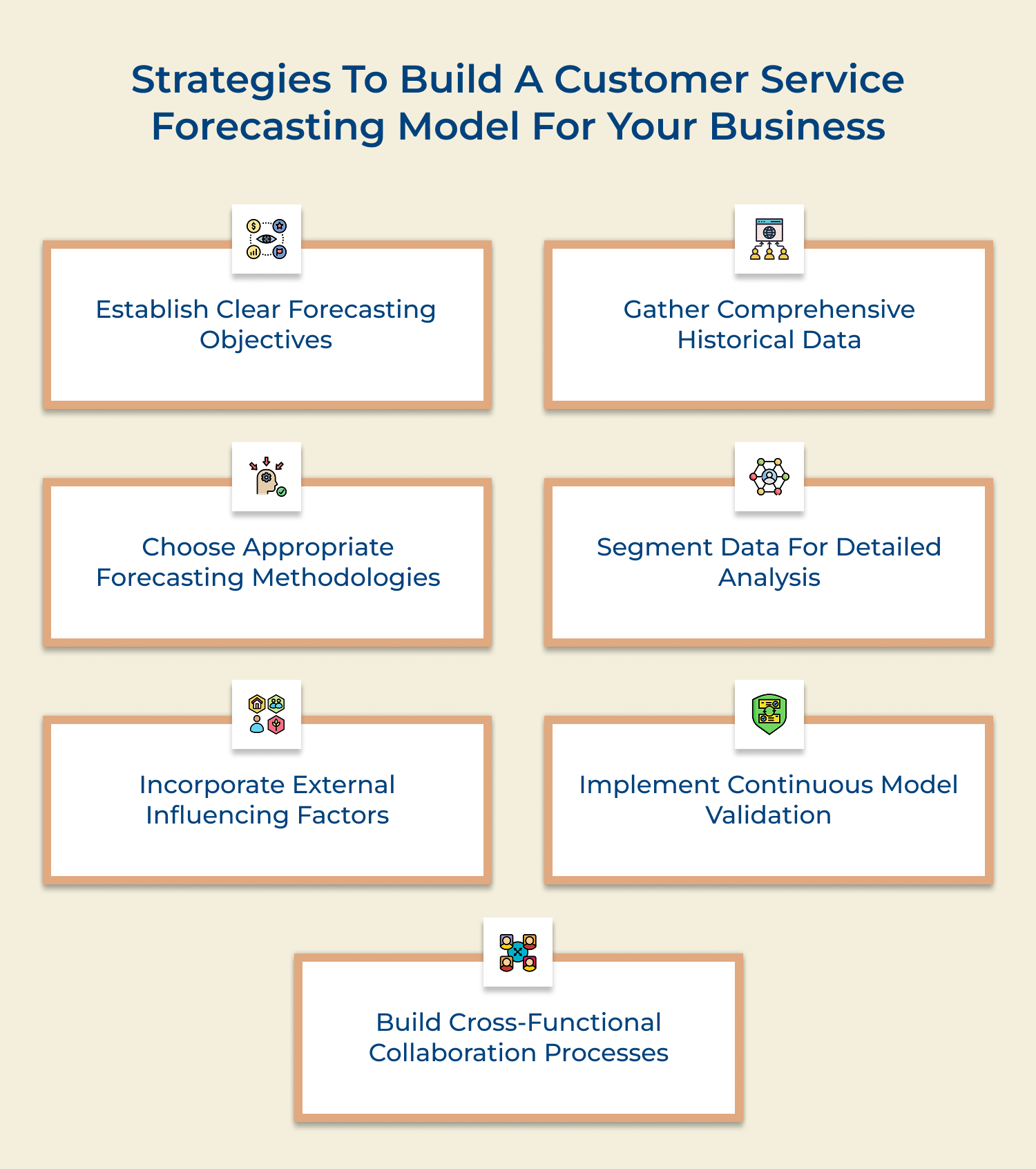
Clear forecasting goals set the stage for smart, effective planning. Without them, your predictions lack focus and impact. Start by asking: What are we trying to predict and how will it help us make better decisions?
There are four main types of goals:
A great first step? Talk to stakeholders – operations, HR, finance, leadership. Find out what they need from your forecasts, when they need it and why. Then turn that input into clear as well as measurable objectives for your forecasting model.
Strong forecasts start with strong historical data. Without it, even the smartest algorithms can’t find meaningful patterns, leading to missed staffing targets and poor customer experiences.
Historical data helps your forecasting models learn from the past. They spot daily, weekly, as well as seasonal trends across channels (calls, chats, emails, etc) and link them to business events like product launches or promotions. This way, your forecasts separate random spikes from real trends.
Take retail, for example. One company only used call center data at first and missed chat surges during sales. Once they added chat data and promo history, their accuracy jumped from 65% to 88%, cutting down on costs as well as missed contacts.
Best practices:
Choosing the right forecasting method depends on your business needs, data and team skills, it’s not one-size-fits-all.
For stable environments, simple methods like moving averages or basic time series work well. But if your business is more volatile you’ll need advanced models like ARIMA or machine learning to stay accurate.
The amount and quality of your data matter too. If you’ve got years of clean, structured data, you can explore machine learning. If not, stick to methods that work with limited inputs.
Time horizon is another key factor: short-term forecasts (like next-day staffing) often require different techniques than long-term planning (like yearly growth projections).
And finally, match your model to your team’s capabilities. You don’t need neural networks if you don’t have data scientists on hand.
Segmenting your contact volume data helps uncover patterns that get lost when everything’s lumped together. Instead of treating all customer interactions the same, break them into meaningful groups to make your forecasts sharper and more useful.
Segment by:
One streaming company found tech issues spiked by device type, while billing questions peaked around renewals. Segmenting lets them forecast smarter and staff accordingly.
Boost forecast accuracy by looking beyond your own contact history and factor in external events that impact customer behavior. Support demand doesn’t happen in a vacuum. It reacts to things like marketing campaigns, product launches and seasonal trends.
By mapping past volume spikes to known events, you can train your models to adjust forecasts based on what’s coming. This proactive approach helps you prepare for demand changes before they happen.
Regularly validating your forecasting model is key to keeping predictions accurate as customer behavior shifts. It’s not just about building a good model, it’s about making sure it stays good.
Comparing predicted vs. actual volumes regularly (by day, channel, or issue type) will help you spot patterns that highlight where your model is working and where it’s not. This helps fine-tune your approach, improving accuracy over time and preventing staffing mismatches.
Example:
A telecom company held weekly validation reviews. They found Monday chat volumes were always underestimated. The culprit? Customers delayed reporting weekend tech issues until Monday. Adjusting for this dropped abandoned chats by 27%.
Pro tips:
Creating strong cross-functional collaboration is key to accurate, proactive forecasting. When departments like marketing, product and billing regularly share upcoming plans, your forecasting team can adjust staffing models in advance. Thus, avoiding last-minute scrambles or customer service disruptions.
Why it matters:
Without this collaboration, forecast teams are left reacting to volume spikes they didn’t see coming. But with shared calendars, scheduled syncs and automated alerts, forecasting becomes a strategic tool, not just an operational one. It strengthens relationships across teams as well as keeps customer service ahead of the curve.
Best practices:
Let’s delve into the essential tools commonly used for customer service forecasting and discover how they can revolutionize your approach.
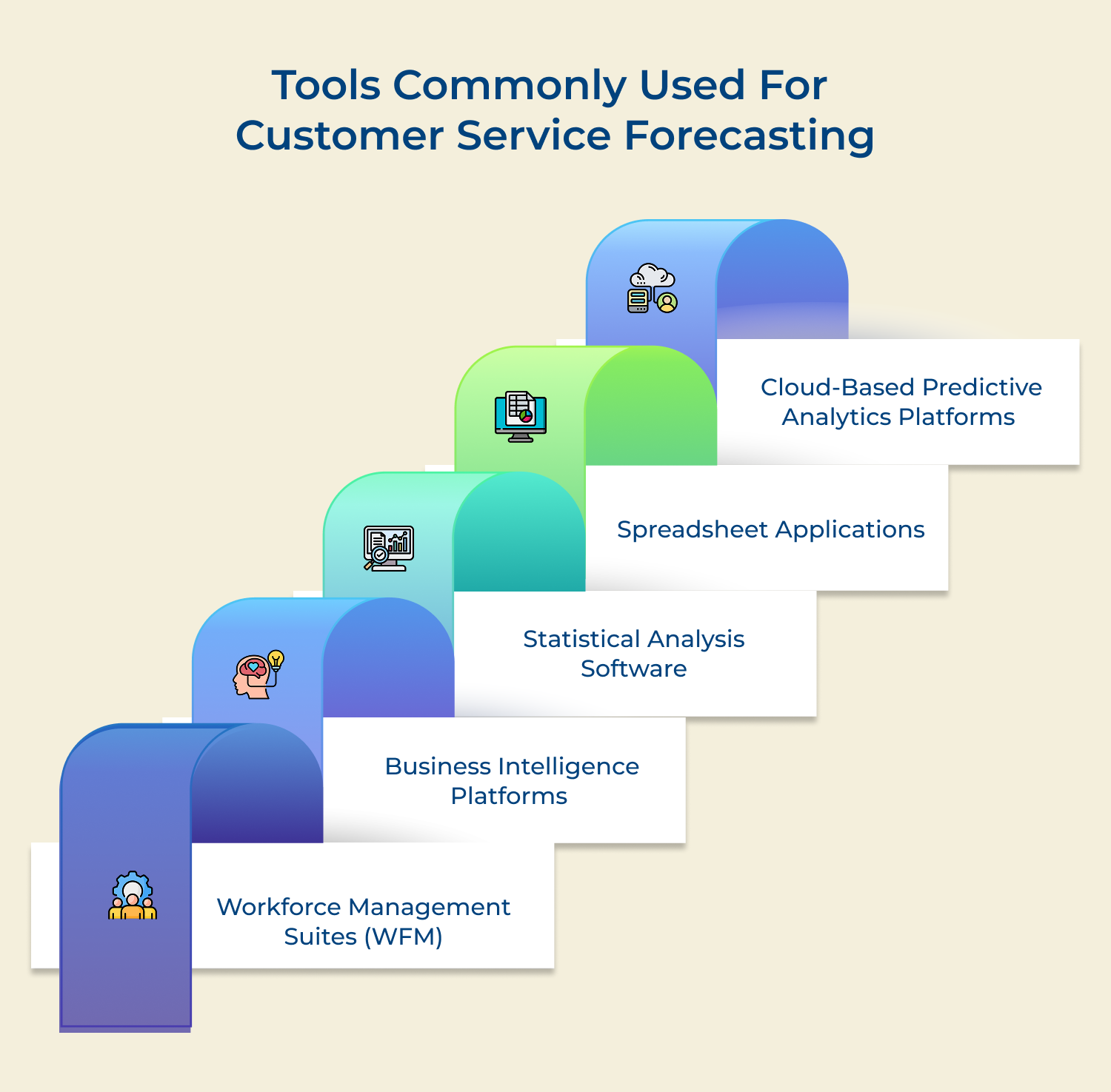
Workforce Management Suites are all-in-one platforms designed for contact centers to forecast demand and schedule agents effectively. They combine past contact data with advanced algorithms to predict how many agents you’ll need.
Key features include:
These tools make the shift from raw forecast numbers to actual staffing plans seamless. By integrating forecasting with scheduling, they reduce manual work, help maintain service levels and balance agent workloads. Hence, ensuring all crucial for smooth operations and happy customers.
Business Intelligence (BI) platforms offer a flexible way to build customized forecasting models that fit your specific needs. They pull data from various sources like contact centers, marketing, CRM systems to give a fuller picture.
What makes BI tools stand out:
By centralizing diverse data, BI platforms help uncover hidden links between business activities and customer contacts. This leads to more accurate predictions and better-informed decisions.
Statistical analysis software is perfect for teams wanting deep insights through advanced forecasting models. These tools offer powerful math-driven methods like time series analysis, regression and machine learning.
Why use statistical software?
If your team has strong analytical skills, this software allows you to create precise forecasts that consider both obvious cycles and nuanced shifts in customer behavior.
Cloud-based predictive platforms bring powerful forecasting capabilities to your fingertips without the need for heavy IT infrastructure. These user-friendly tools combine advanced algorithms with real-time data updates.
Benefits include:
By democratizing advanced forecasting, cloud platforms empower organizations of all sizes to leverage accurate predictions, optimize staffing and adapt quickly to changing customer demands.
Forecasting customer service demand comes with a few common challenges that can throw off even the best models:
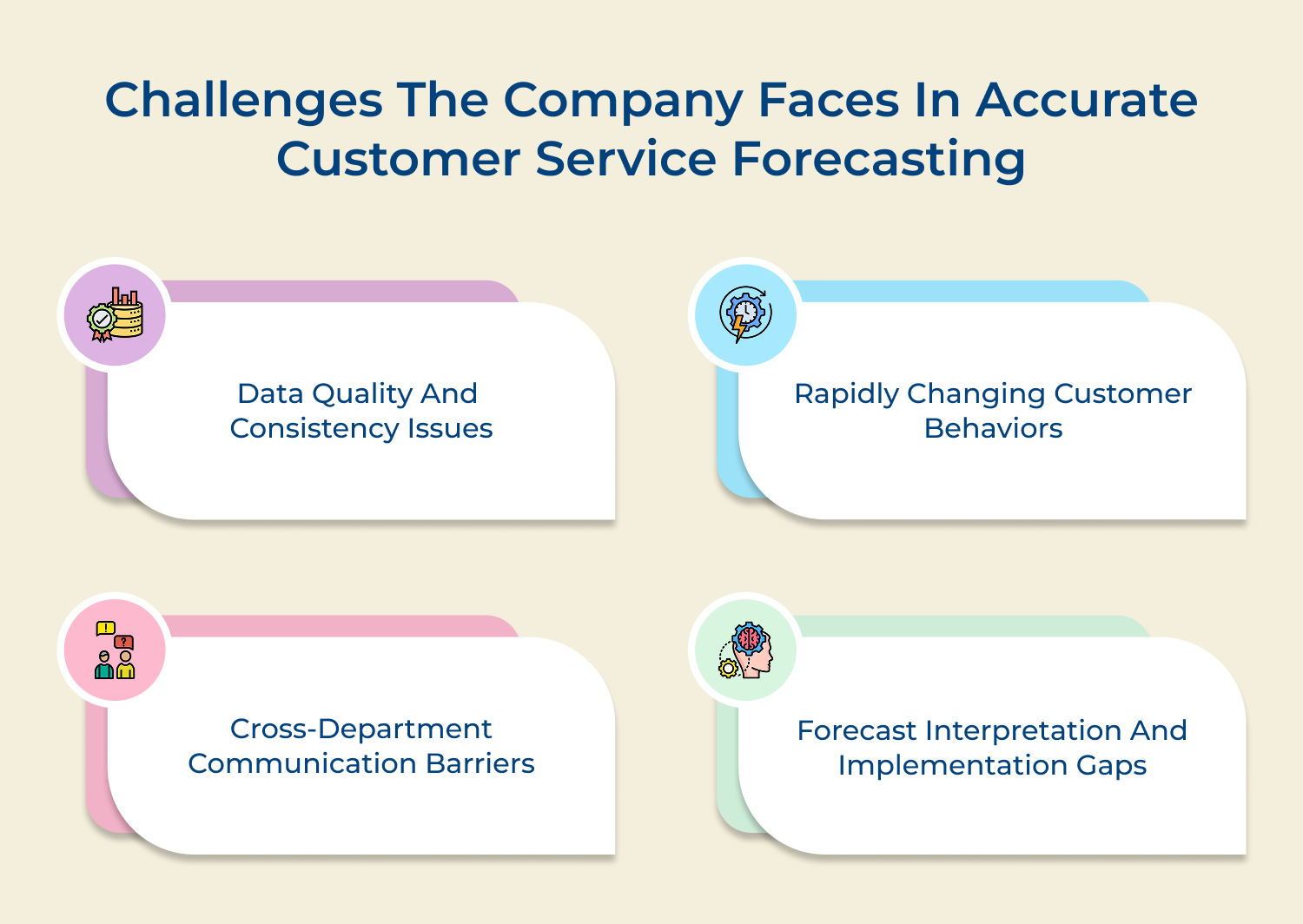
Historical data often has gaps, misclassifications, or missing timestamps. If the data isn’t clean, forecasting models struggle to find true patterns, leading to unreliable predictions.
Customer preferences evolve quickly with new self-service tools and shifting communication channels. Because of this, past trends might not always predict future demand well.
Many volume drivers like marketing campaigns or product launches come from other teams. Without early communication, forecasting misses these signals, causing unexpected spikes.
Even with accurate forecasts, staffing and budget constraints can prevent timely adjustments, creating a disconnect between predictions as well as real-world actions.
To overcome these hurdles, consider:
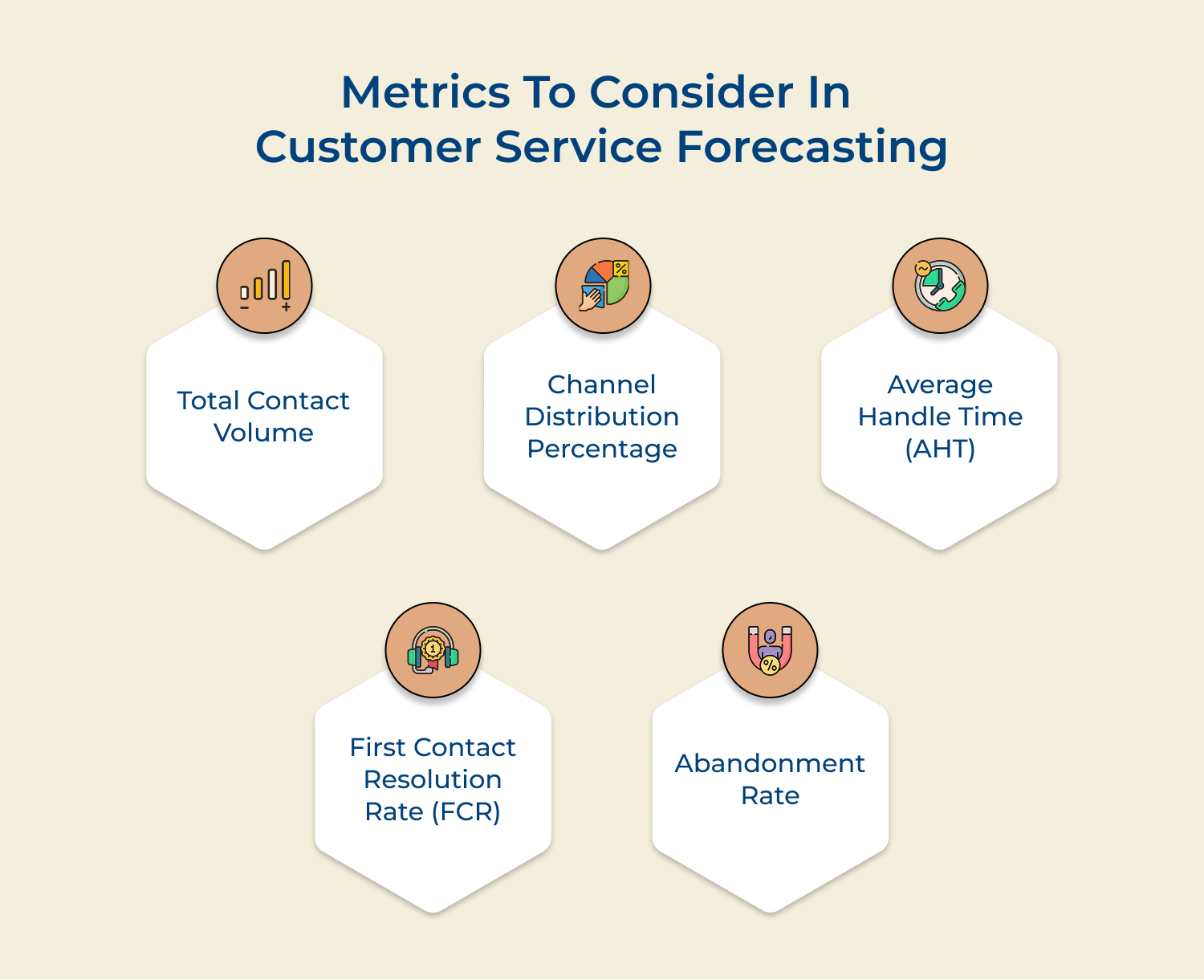
Let’s explore five essential metrics that could revolutionize how you approach customer service forecasting.
Questions to Consider in Customer Service Forecasting:
Customer service forecasting transforms reactive support operations into proactive service powerhouses. By anticipating future contact volumes and patterns, organizations can align staffing with actual customer needs, ensuring accessibility without waste. This strategic capability eliminates the costly cycle of understaffing and overstaffing that undermines both customer experience along with operational efficiency.
The most successful organizations recognize that forecasting isn’t merely a scheduling tool but a strategic advantage. When prediction accuracy improves, wait times decrease, agent burnout diminishes and customer satisfaction climbs. By continually refining your forecasting approach, you position your organization to deliver exceptional service experiences while maintaining operational efficiency regardless of what challenges tomorrow brings.

What is forecasting in BPO?
Forecasting in BPO (Business Process Outsourcing) is the systematic process of predicting future contact volumes and workload across different channels. This practice uses historical data, statistical analysis and business intelligence to anticipate customer interaction patterns. Thus, allowing operations to align agent staffing with expected demand while minimizing both wait times and excess capacity.
How does forecasting enhance efficiency in customer service operations?
Forecasting enhances efficiency by ensuring optimal resource distribution across time periods, channels and skill groups. By accurately predicting when and where customer demand will emerge, organizations can schedule the right number of appropriately skilled agents for each interval. This precision eliminates both costly overstaffing during slow periods and service-damaging understaffing during peak times.
Why is accurate forecasting crucial for optimizing resource allocation in customer support?
Accurate forecasting is crucial because customer support resources—particularly agent time—represent both significant costs and service quality determinants. Without precise predictions, organizations either waste money on idle agents or damage customer relationships through long wait times. Forecasting creates the foundation for balancing these competing priorities through data-driven staffing decisions.
How far in advance should customer service forecasts be created?
Customer service forecasts typically operate across multiple timeframes. Long-term strategic forecasts project 12-18 months ahead for hiring and facility planning while mid-term tactical forecasts look 1-3 months ahead for training as well as scheduling. The short-term operational forecasts predict 1-4 weeks ahead for daily staffing adjustments. Each time frame serves different business decisions with appropriate levels of detail.
 https://omni24.io/wp-content/uploads/2026/07/Customer-Data-Platform.png
1256
2400
Tushar Joshi
https://omni24.io/wp-content/uploads/2023/04/Omni-Logo-1.svg
Tushar Joshi2026-07-08 03:58:592026-07-08 03:58:59How a Customer Data Platform Unlocks Unified Customer Insights
https://omni24.io/wp-content/uploads/2026/07/Customer-Data-Platform.png
1256
2400
Tushar Joshi
https://omni24.io/wp-content/uploads/2023/04/Omni-Logo-1.svg
Tushar Joshi2026-07-08 03:58:592026-07-08 03:58:59How a Customer Data Platform Unlocks Unified Customer Insights https://omni24.io/wp-content/uploads/2026/07/Unified-Customer-View.png
1256
2400
Tushar Joshi
https://omni24.io/wp-content/uploads/2023/04/Omni-Logo-1.svg
Tushar Joshi2026-07-07 03:37:342026-07-07 03:37:34How a Unified Customer View Transforms Customer Experience
https://omni24.io/wp-content/uploads/2026/07/Unified-Customer-View.png
1256
2400
Tushar Joshi
https://omni24.io/wp-content/uploads/2023/04/Omni-Logo-1.svg
Tushar Joshi2026-07-07 03:37:342026-07-07 03:37:34How a Unified Customer View Transforms Customer Experience https://omni24.io/wp-content/uploads/2026/06/Omnichannel-CRM.png
1256
2400
Tushar Joshi
https://omni24.io/wp-content/uploads/2023/04/Omni-Logo-1.svg
Tushar Joshi2026-07-06 03:49:012026-07-06 04:00:22How to Implement Omnichannel CRM Strategy: 7 Key Steps
https://omni24.io/wp-content/uploads/2026/06/Omnichannel-CRM.png
1256
2400
Tushar Joshi
https://omni24.io/wp-content/uploads/2023/04/Omni-Logo-1.svg
Tushar Joshi2026-07-06 03:49:012026-07-06 04:00:22How to Implement Omnichannel CRM Strategy: 7 Key Steps
Whether it’s about acquire, engage or support – Omni24 covers all your customer engagement needs in one complete platform.

Copyright ©2026 Veemo All rights reserved.
CA, Los Angeles, Hall Ave, 19011