What are Customer Testimonials and How to Use Them?
Customer testimonials, case studies, reviews and star‑ratings build trust by showing real experiences and helping buyers make informed decisions.

Customer testimonials, case studies, reviews and star‑ratings build trust by showing real experiences and helping buyers make informed decisions.
Customer testimonials are a vital component of any successful marketing strategy. They provide authentic, third-party validation of your product or service, helping to build trust and credibility with potential customers.
72% of consumers say positive testimonials and reviews increase their trust in a business.
Modern consumers are increasingly skeptical of traditional advertising and real-life feedback from satisfied customers serves as powerful social proof. Whether through written reviews, video endorsements, or detailed case studies, testimonials offer compelling evidence of your brand’s value.
Let us explore the significance of customer testimonials, effective ways to use them and how they can drive your business success.
Customer testimonials are defined as the authentic statements or endorsements from satisfied clients describing their positive experiences with a product, service or company. These firsthand accounts serve as social proof, validating a business’s claims and showcasing real-world benefits to potential customers.
Genuine user experiences carry significant weight in influencing purchasing decisions. Customer testimonials provide relatable stories that resonate with prospects, addressing common concerns and highlighting key advantages.
Key objectives:
Understanding the different types can help you choose the most effective ones for your needs. Here’s a breakdown of the main types of customer testimonials and their benefits:
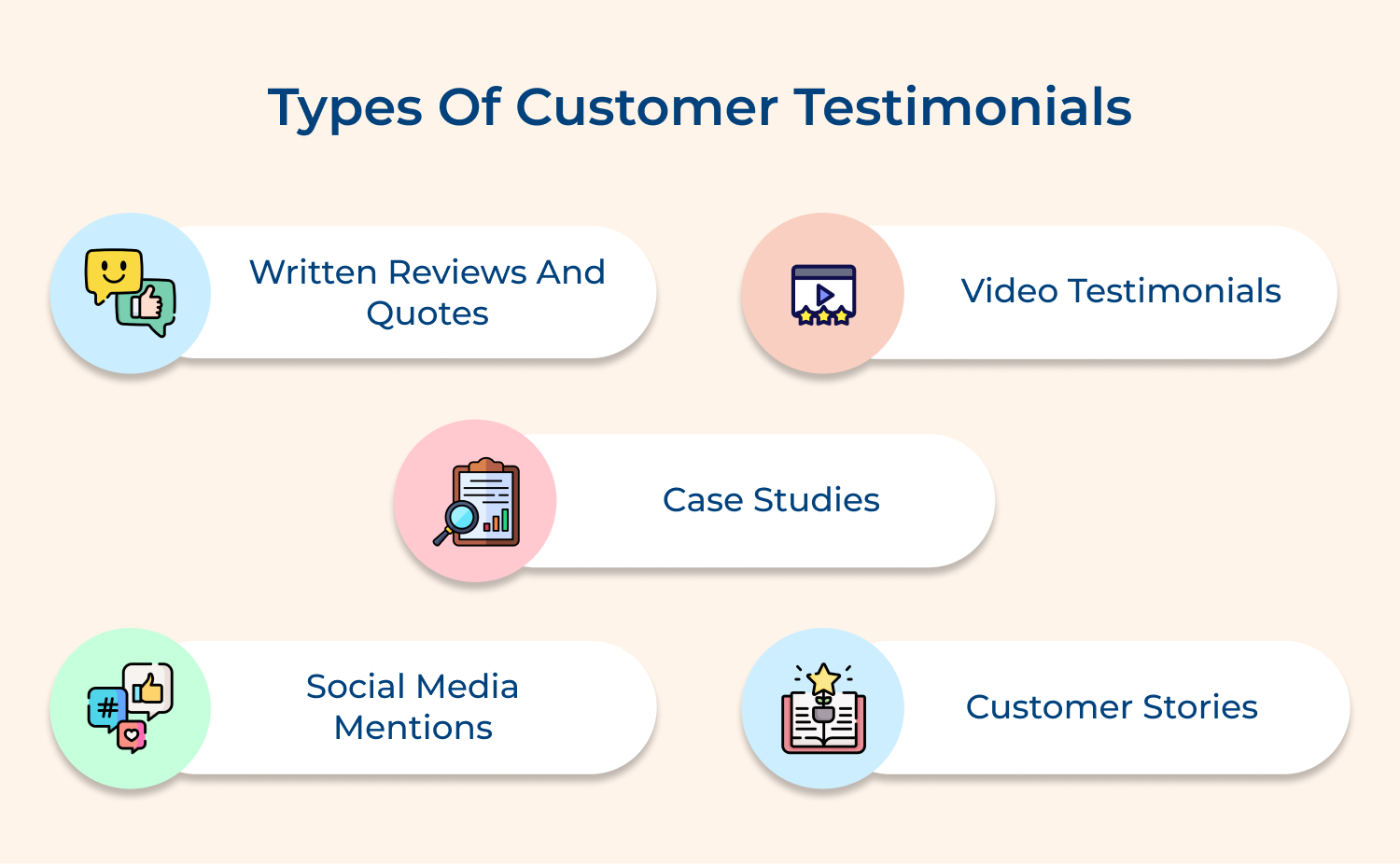
Written reviews or quotes are the traditional and widely used forms of testimonials. They typically appear as short endorsements on websites, product pages, or marketing materials.
Written testimonials are easy to collect and can be featured prominently to highlight customer satisfaction. They provide concise, direct feedback that potential customers can quickly read and digest. For maximum impact, include the customer’s name, photo and location to add credibility.
Video testimonials are powerful tools that bring customer feedback to life. They provide a more personal touch, as viewers can see and hear real customers sharing their experiences. The format enhances authenticity and trust, as potential buyers can gauge the enthusiasm of the reviewer.
Video testimonials can be used on websites, social media platforms and in promotional videos. They often lead to higher engagement and a stronger emotional connection with the audience.
Case studies offer an in-depth look at how a customer has benefited from your product or service. They typically include detailed narratives, data and analysis, showcasing specific results or successes.
Case studies are especially useful for B2B businesses and complex products, as they provide comprehensive evidence of value or effectiveness. They help potential customers understand the tangible benefits and real-world applications of your offerings.
Social media mentions include positive feedback or endorsements shared by customers on platforms like Twitter, Facebook, or Instagram. These testimonials can be spontaneous and reflect genuine customer sentiment. They are valuable for their immediacy and authenticity.
Sharing these mentions can boost your brand’s visibility and demonstrate real-time customer satisfaction. Encourage customers to tag your business or use specific hashtags to make it easier to find and share these mentions.
Customer stories go beyond traditional testimonials by providing a narrative of the customer’s journey and experiences. These stories often include personal anecdotes, challenges faced and how your product or service made a difference.
They create a compelling, relatable connection with potential customers by highlighting real-life applications and emotional impact. Customer stories can be shared through blog posts, social media, or as part of your marketing collateral.
Customer testimonials can significantly boost your brand’s credibility and drive sales. Acquiring them involves more than simply asking for feedback.
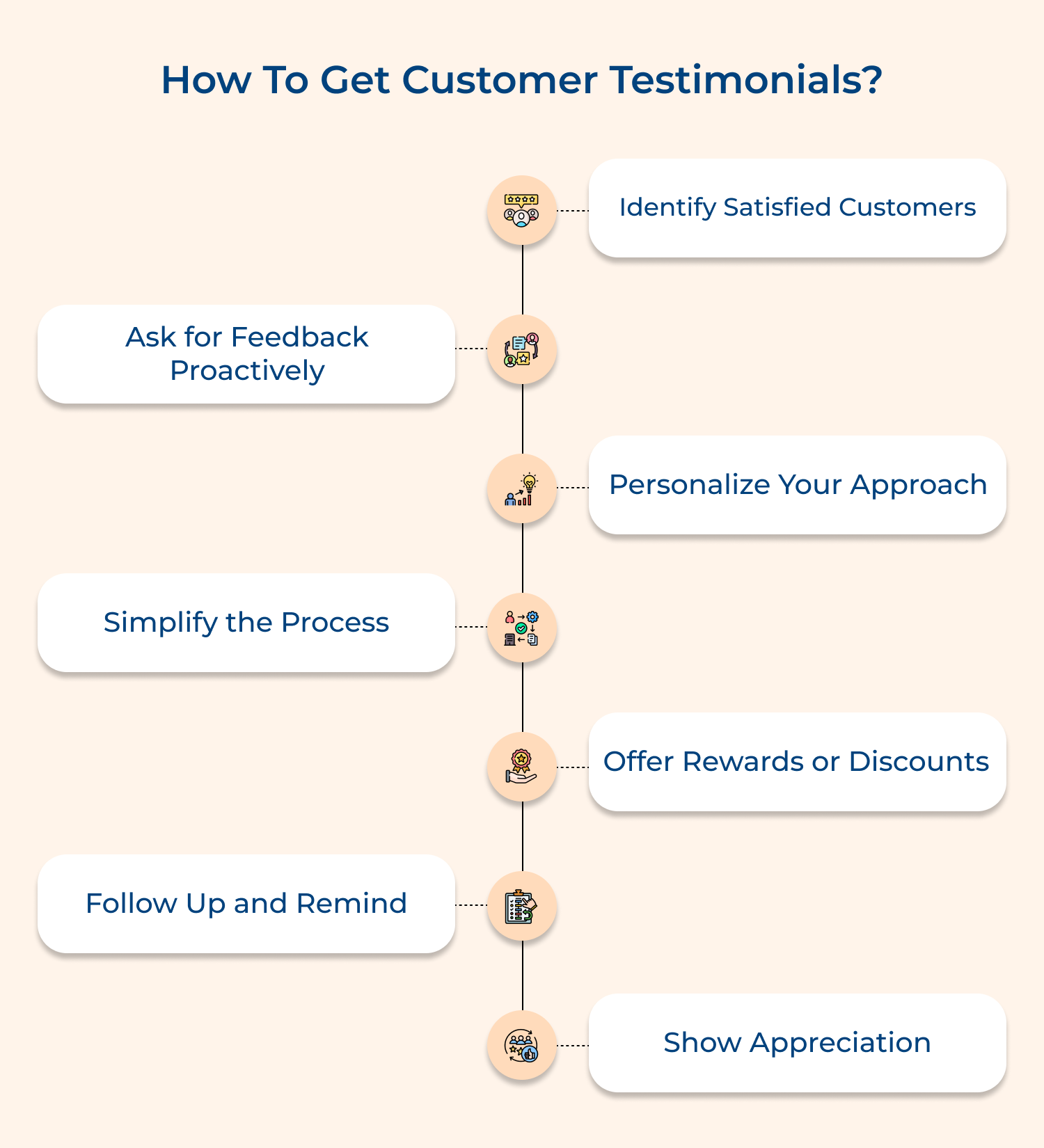
Identifying satisfied customers is crucial because they are more likely to provide positive, genuine testimonials. These customers have experienced the value of your product or service firsthand and can offer authentic insights. Their satisfaction indicates a higher likelihood of willingness to share their experiences, making them ideal candidates for testimonials.
Use customer satisfaction surveys, Net Promoter Score (NPS) data or feedback from your support team to identify happy customers. Look for those who have achieved significant results with your product or have been long-term clients. These indicators help you target the right individuals for testimonial requests, increasing your chances of success.
Pro Tips:

Proactively asking for feedback demonstrates that you value customer opinions and are committed to improvement. It opens communication channels and increases the likelihood of receiving testimonials. By initiating the conversation, you create opportunities for customers to share their experiences, both positive and constructive, which can lead to valuable testimonials.
Implement automated feedback requests at key points in the customer journey, such as after purchase, product implementation, or customer support interactions. Use email campaigns, in-app messages or direct outreach from account managers to solicit feedback. Frame your requests in a way that encourages detailed responses about their experience with your product or service.
Pro Tips:
Personalization shows customers that you value their individual experiences and aren’t just sending mass requests. It increases the likelihood of a response by making the customer feel recognized and appreciated. A personalized approach can also help you tailor your request to the specific experiences or achievements of each customer, resulting in more relevant testimonials.
Use customer data to customize your testimonial requests. Reference specific products they’ve used, results they’ve achieved, or interactions they’ve had with your company. Personalize the tone as well as content of your request based on your relationship with the customer and their communication preferences. The tailored approach can significantly increase response rates.
Pro Tips:
A simple, streamlined process reduces barriers to participation and increases the likelihood of customers providing testimonials. Many customers are willing to help but may be deterred by complex or time-consuming procedures. By making it easy, you respect your customers’ time and increase the number of testimonials you receive.
Create user-friendly forms or questionnaires that guide customers through the testimonial process. Offer multiple options for providing feedback, such as written responses, video recordings, or phone interviews. Provide clear instructions and examples to help customers understand what you’re looking for. Consider using software tools designed for collecting and managing testimonials.
Pro Tips:
Offering rewards or discounts can provide additional motivation for customers to take the time to give a testimonial. It shows appreciation for their effort and can increase participation rates. It’s important to ensure that the incentives don’t compromise the authenticity of the testimonials or violate any ethical guidelines.
Implement a program that offers small incentives for providing testimonials, such as discount codes for future purchases, exclusive content access, or entry into a prize draw. Clearly communicate the reward system to customers when requesting testimonials. Ensure that the rewards are appropriate and don’t appear to be “buying” positive reviews.
Pro Tips:
Following up and sending reminders is essential because customers often intend to provide testimonials but forget due to busy schedules. Gentle reminders show that you value their input and increase the likelihood of receiving testimonials. It also allows you to address any concerns or questions they might have about the process.
Implement a follow-up system that sends polite reminders at appropriate intervals. Use a mix of automated emails and personal outreach. In your follow-ups, reiterate the importance of their feedback and offer assistance if needed. Be persistent but respectful and know when to stop if a customer is not responding.
Pro Tips:
Showing appreciation is crucial for maintaining positive relationships with customers who provide testimonials. It acknowledges their time and effort, encouraging them to remain engaged with your brand. Expressing gratitude can also motivate customers to provide more detailed feedback or agree to additional promotional activities in the future.
Send personalized thank-you messages to customers who provide testimonials. Share how their feedback will be used and its value to your business. Consider following up with information about how their testimonial has helped other customers or impacted your business. Maintain ongoing communication to nurture the relationship.
Pro Tips:
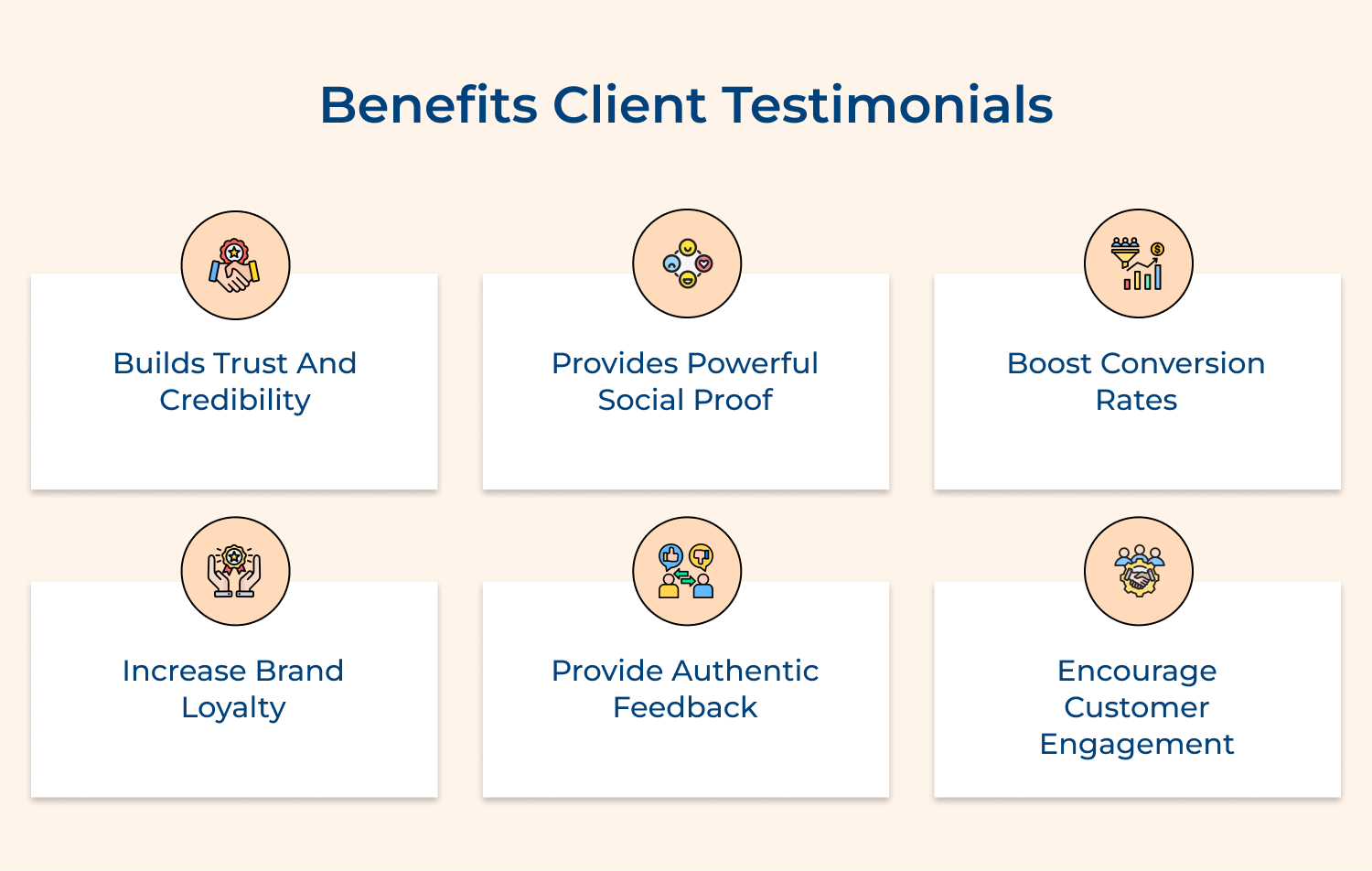
Client testimonials play a crucial role in shaping consumer perceptions. Here are the benefits they offer:
Testimonials are a potent tool in marketing; it’s crucial to measure their impact effectively. Here’s a detailed approach to measuring the impact of testimonials:
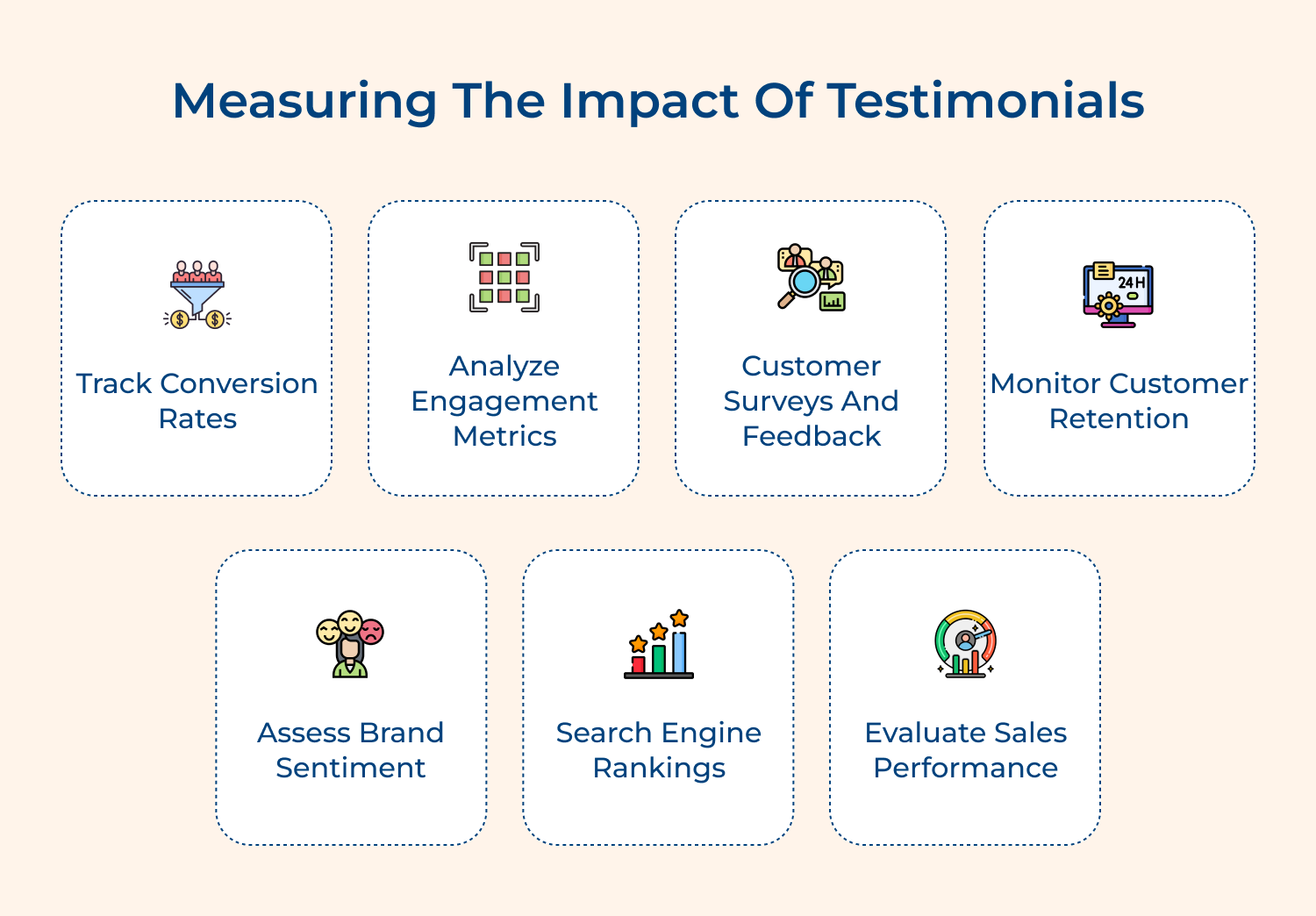
Conversion rates are a fundamental metric for assessing the effectiveness of testimonials. The metric indicates the percentage of visitors who complete a desired action, such as making a purchase or filling out a form. To measure the impact of testimonials, compare conversion rates before and after integrating them into your marketing strategy.
For example, if you add testimonials to your landing pages or product pages, monitor the changes in conversion rates. Tools like Google Analytics can help track these metrics, providing insights into how testimonials influence customers’ decisions to take action.
Engagement metrics reveal how well testimonials resonate with your audience. Key metrics include time spent on testimonial pages, click-through rates such as likes, shares and comments. By analyzing these metrics, you can gauge the level of interest and engagement that testimonials generate.
For instance, if video testimonials receive a high number of views, it suggests that they are engaging and persuasive. Use tools like social media analytics platforms and website heatmaps to track these engagement metrics as well as understand how testimonials impact user behavior.
Direct customer feedback provides valuable insights into the effectiveness of testimonials. Conduct surveys or solicit feedback from customers to understand how testimonials influenced their purchase decisions.
You can include questions such as: “Did the testimonials help you decide to buy?” or “How convincing did you find the testimonials?” The feedback helps you gauge the perceived value of testimonials and their role in the customer decision-making process. Analyzing responses can also reveal areas for improvement and guide future testimonial strategies.
Customer retention metrics indicate how well testimonials contribute to maintaining long-term customer relationships. Track metrics such as repeat purchase rates, customer lifetime value, and churn rates.
Testimonials can enhance customer satisfaction by reinforcing positive experiences and building trust. By monitoring these retention metrics, you can assess whether testimonials help in retaining customers and encouraging repeat business.
An increase in repeat purchases or customer lifetime value following the introduction of testimonials may indicate their effectiveness in fostering loyalty.
Brand sentiment analysis involves evaluating the overall perception of your brand based on customer feedback, reviews and testimonials. Positive testimonials often correlate with improved brand sentiment, as they reflect satisfied customer experiences.
Use sentiment analysis tools to monitor changes in brand sentiment over time, particularly after implementing new testimonials. The analysis helps you understand the broader impact of testimonials on your brand’s reputation and customer trust, providing a measure of their influence on overall brand perception.
Testimonials can also impact search engine optimization (SEO) and rankings. Search engines value fresh, relevant content and customer testimonials can contribute to this. By including testimonials on your website, especially those with keywords related to your products or services, you can improve your search engine visibility.
Monitor changes in search engine rankings and organic traffic following the addition of testimonials. Tools like Google Search Console can help track these changes and assess how testimonials influence your SEO performance.
Sales performance metrics provide a direct measure of the financial impact of testimonials. Compare sales figures before and after adding testimonials to your marketing materials. Look at metrics such as total sales, average order value and sales growth rates.
Testimonials can drive higher conversions and increase sales, particularly for products or services highlighted in the testimonials. Analyzing these sales metrics helps you understand the direct contribution of testimonials to revenue and overall business performance.
Consumer testimonials are a powerful way to build trust and drive engagement, but to maximize their impact, it’s essential to follow best practices.
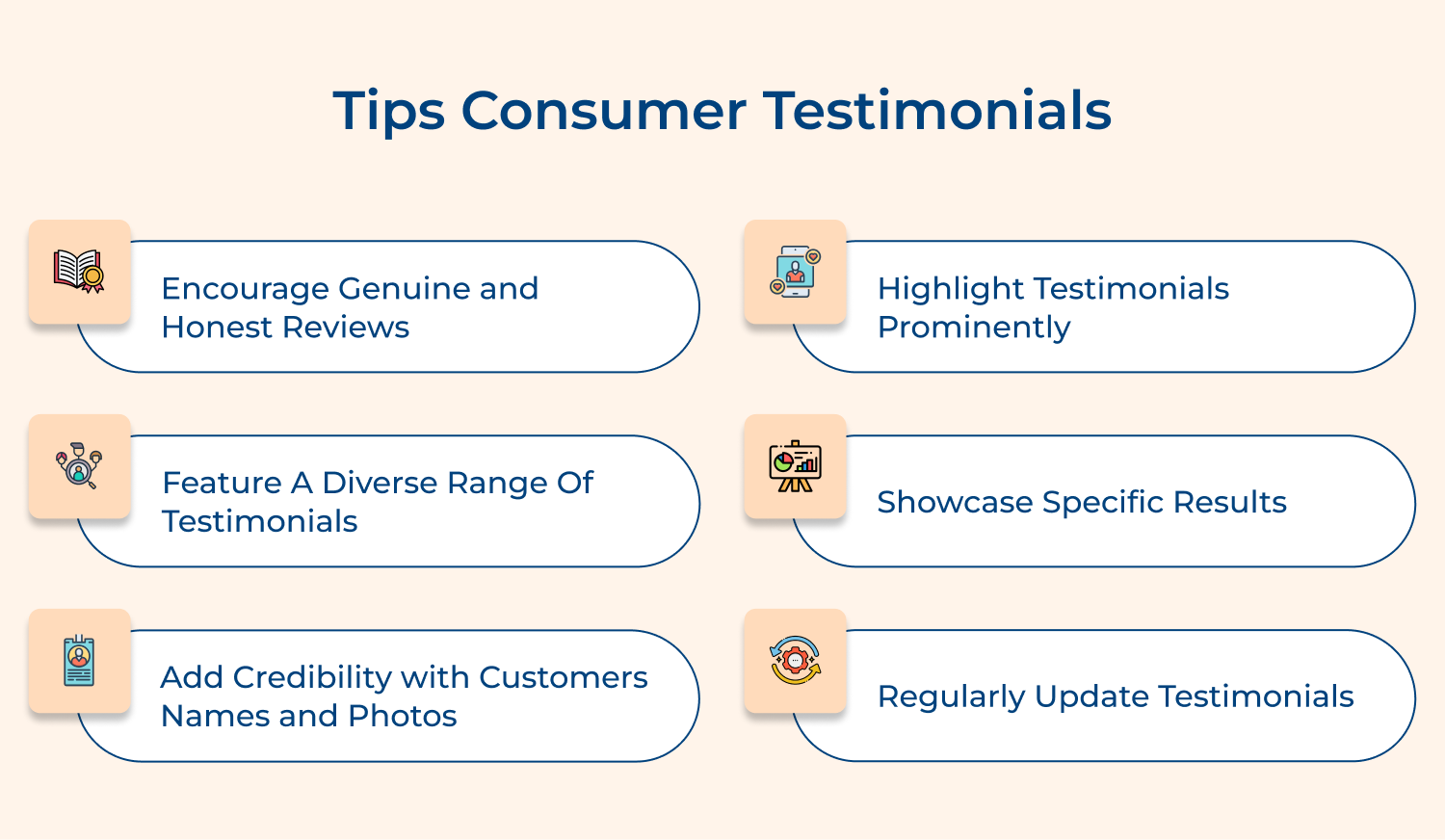
Authenticity is key when it comes to testimonials. Encourage customers to provide genuine and honest feedback rather than scripted or overly polished reviews. Authentic testimonials resonate more with potential customers because they reflect real experiences and emotions.
To facilitate this, create a straightforward process for customers to share their thoughts and offer guidance on what aspects to cover, such as their experience with your product or service, without dictating their exact wording. The more genuine the testimonial, the more credible it appears.
Diversity in testimonials ensures that different customer perspectives and experiences are represented. Feature testimonials from a variety of customer demographics, including different ages, professions and locations.
The approach helps potential customers see that your product or service is effective for a broad audience and in various scenarios. Highlighting different use cases or benefits through diverse testimonials can also appeal to a wider audience and address varied customer concerns.
Including real names and photos of customers adds a layer of credibility to testimonials. When potential customers see a real person’s name, it enhances the authenticity of the testimonial.
Ensure that you have obtained proper permissions from customers before publishing their names and photos. The practice not only adds credibility but also makes the testimonials more relatable and personal.
To maximize the impact of testimonials, place them prominently on your website and marketing materials. Feature them on high-traffic pages such as your homepage, product pages and landing pages.
In marketing materials like brochures or social media posts, make sure testimonials stand out and are easy to find. By giving testimonials high visibility, you increase their chances of influencing potential customers and building trust in your brand.
Testimonials that highlight specific results and tangible benefits are more persuasive. Instead of vague praise, encourage customers to share detailed outcomes they experienced, such as improvements in efficiency, cost savings or other measurable benefits. Using concrete examples or statistics helps potential customers understand the real-world impact of your product or service and can be a powerful motivator for making a purchase.
Keeping testimonials current is crucial for maintaining their relevance and effectiveness. Regularly update your testimonials to reflect recent customer experiences and showcase ongoing satisfaction with your product or service.
Remove outdated testimonials that may no longer accurately represent the current state of your offerings. By regularly refreshing your testimonials, you ensure that they remain relevant and continue to resonate with potential customers.
Here are the real-life examples of customer testimonials and how they positively impacted sales:
Testimonial: “Shopify made setting up my online store a breeze. The intuitive interface and excellent support allowed me to launch my business quickly. Within six months, my sales doubled, and I couldn’t be happier!” — Emily H., E-Commerce Entrepreneur
Impact on Sales: Emily’s testimonial highlights Shopify’s ease of use and effective support. By showcasing how Shopify helped her business grow, the testimonial serves as powerful social proof. The real-world success story can attract new users by demonstrating the platform’s potential to boost sales to streamline operations, thereby driving more sign-ups and increased revenue for Shopify.
Testimonial: “Dropbox transformed the way our team collaborates. Sharing files is seamless, and the synchronization between devices is flawless. Since integrating Dropbox into our workflow, our productivity has increased by 30%!” — Alex M., IT Manager
Impact on Sales: Alex’s testimonial emphasizes Dropbox’s role in enhancing team productivity and collaboration. The quantifiable impact on productivity provides concrete evidence of Dropbox’s value, which can be persuasive for potential customers. This kind of testimonial helps Dropbox attract business clients who are seeking effective solutions to improve team efficiency and collaboration.
Testimonial: “AWS has been a game-changer for our infrastructure. The reliability and scalability of their services have allowed us to handle peak traffic effortlessly. We’ve seen a 40% reduction in costs and a significant improvement in performance.” — Mark R., CTO at FinTech Solutions
Impact on Sales: Mark’s testimonial highlights AWS’s reliability, scalability and cost savings. By providing specific metrics and positive outcomes, the testimonial serves as persuasive evidence of AWS’s effectiveness. Potential customers are more likely to choose AWS when they see real-world results and measurable benefits, boosting AWS’s sales or market share.
Testimonial: “Adobe Creative Cloud has transformed my design process. The range of tools and seamless integration between apps has made my work more efficient and creative. It’s an indispensable part of my daily workflow.” — Laura P., Graphic Designer
Impact on Sales: Laura’s testimonial emphasizes the efficiency and creative benefits of Adobe Creative Cloud. Her positive experience and the integration of various tools highlight the product’s value to professionals. The testimonial can attract more designers or creative professionals, driving subscriptions and increasing Adobe’s revenue.
Testimonial: “Blue Apron has made meal planning and cooking so much easier. The recipes are delicious, and the convenience of having fresh ingredients delivered to my door has saved me time and effort. I’ve already recommended it to my entire family!” — John S., Blue Apron Subscriber
Impact on Sales: John’s testimonial focuses on the convenience and quality of Blue Apron’s meal kits. His recommendation to family and friends serves as a form of word-of-mouth marketing, encouraging new subscribers. By highlighting the ease as well as enjoyment of using the service, John’s testimonial helps Blue Apron attract more customers and increase its subscription base.
Incorporating customer testimonials into your marketing strategy is a powerful way to build trust, enhance credibility and drive sales. Genuine feedback from satisfied customers offers authentic proof of your product or service’s value, resonating with potential buyers and addressing their concerns. By actively showcasing diverse, detailed, and personalized testimonials, you can effectively leverage social proof to attract new customers and reinforce your brand’s reputation.
Remember to make the process easy for your customers and show appreciation for their contributions. Utilizing these insights not only boosts your credibility but also supports your overall business growth and success.

What is a testimonial quote?
A testimonial quote is a brief statement from a satisfied customer or client that endorses a product, service, or business. It typically highlights positive experiences, specific benefits, or results achieved. Testimonial quotes are used in marketing materials to provide social proof, build trust and influence potential customers’ purchasing decisions. They can range from a single sentence to a short paragraph.
How do you write a customer testimonial?
To write an effective customer testimonial, start by identifying specific benefits or results you experienced. Use clear, concise language and include quantifiable data if possible. Share your initial problem and how the product or service solved it. Be genuine and avoid overly promotional language. Include your name, title and company (if applicable) to add credibility. Keep it brief and focused on the most impactful aspects of your experience.
What type of Customer Testimonial Page is right for your business?
The right type of Customer Testimonial Page depends on your business and target audience. Consider a mix of formats like written quotes, video testimonials and case studies. Organize testimonials by industry, product, or problem solved. Include a search or filter function for easy navigation. Ensure mobile responsiveness and regular updates. The page should align with your brand’s style and effectively showcase diverse customer experiences to appeal to various potential clients.
What is the difference between B2B and B2C testimonials?
B2B (Business-to-Business) testimonials typically focus on ROI, efficiency improvements and long-term business impact. They often include specific data or industry jargon and are from company representatives. B2C (Business-to-Consumer) testimonials usually emphasize personal experiences, emotional benefits and ease of use. They’re generally more relatable, use everyday language, and come from individual consumers. B2B testimonials are usually longer or more detailed, while B2C testimonials tend to be shorter and more focused on immediate benefits.
 https://omni24.io/wp-content/uploads/2026/09/Social-commerce-scaled.png
1340
2560
Webvision Solution
https://omni24.io/wp-content/uploads/2023/04/Omni-Logo-1.svg
Webvision Solution2026-10-23 12:18:272026-10-23 12:18:27What is Social Commerce and Why Does It Matter?
https://omni24.io/wp-content/uploads/2026/09/Social-commerce-scaled.png
1340
2560
Webvision Solution
https://omni24.io/wp-content/uploads/2023/04/Omni-Logo-1.svg
Webvision Solution2026-10-23 12:18:272026-10-23 12:18:27What is Social Commerce and Why Does It Matter? https://omni24.io/wp-content/uploads/2026/08/AI-Customer-Service-Agents.png
1256
2400
Webvision Solution
https://omni24.io/wp-content/uploads/2023/04/Omni-Logo-1.svg
Webvision Solution2026-09-21 04:48:512026-09-21 04:48:51How to Build an AI Customer Service Agents: 8 Key Steps
https://omni24.io/wp-content/uploads/2026/08/AI-Customer-Service-Agents.png
1256
2400
Webvision Solution
https://omni24.io/wp-content/uploads/2023/04/Omni-Logo-1.svg
Webvision Solution2026-09-21 04:48:512026-09-21 04:48:51How to Build an AI Customer Service Agents: 8 Key Steps https://omni24.io/wp-content/uploads/2026/08/Omnichannel-Conversational-AI.png
1256
2400
Tushar Joshi
https://omni24.io/wp-content/uploads/2023/04/Omni-Logo-1.svg
Tushar Joshi2026-09-16 03:51:072026-09-16 03:51:07How to Build Omnichannel Conversational AI Strategy
https://omni24.io/wp-content/uploads/2026/08/Omnichannel-Conversational-AI.png
1256
2400
Tushar Joshi
https://omni24.io/wp-content/uploads/2023/04/Omni-Logo-1.svg
Tushar Joshi2026-09-16 03:51:072026-09-16 03:51:07How to Build Omnichannel Conversational AI Strategy
Whether it’s about acquire, engage or support – Omni24 covers all your customer engagement needs in one complete platform.

Copyright ©2026 Veemo All rights reserved.
CA, Los Angeles, Hall Ave, 19011