How to Build a Winning Conversational Marketing Strategy
Conversational marketing revolutionizes customer engagement via real-time, personalized chatbots, live chat and AI interactions, boosting CX and sales efficiency.

Conversational marketing revolutionizes customer engagement via real-time, personalized chatbots, live chat and AI interactions, boosting CX and sales efficiency.
Once upon a time, the customers had to wait for 24-48 business hours (minimum) to get a response from the customer service. There was a standard process and script that every interaction was supposed to consist of.
However, thanks to the advent of tech, things have changed. People now get resolutions, if not a response, within an hour or two. The conversations are free-flowing, real-time and personalized!
Conversational marketing, as we call it, has gained traction in recent years. Why? It provides quick support to the customers while also enabling businesses to build one-on-one conversations with high efficiency.
Let’s explore the concept of conversational marketing and I’ll also explain how it benefits your business.
Conversational marketing is a modern approach that involves engaging prospective customers in real-time conversation. It involves using targeted messaging, chatbots and other tools to initiate a conversation with prospects. You guide your potential customers through the purchasing process and building a personal relationship.
The conversation is seamless where you answer your customer’s queries while also providing value-add information. All this (conversational approach) is done to help your customers make an informed purchase decision. No wonder, in 2021, online live chat and emails were the most popular channels for communication.
Here are some of the key ways conversational marketing works:
65% of consumers feel better about themselves when they resolve an issue with having to talk to any customer rep! Now, hold that thought and walk a few steps back with me.
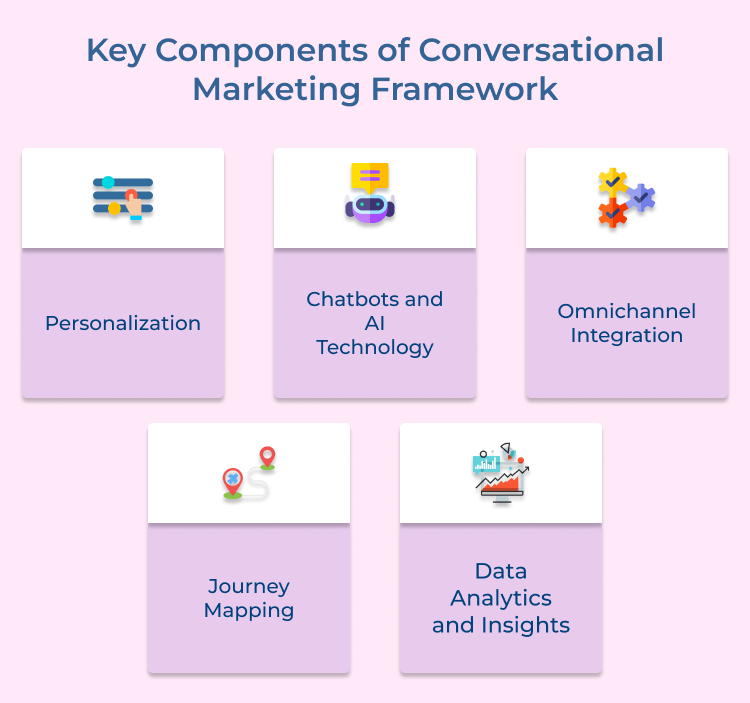
Here are the key components of an effective conversational marketing framework:
The way we buy and sell things have changed drastically. Cold calling used to be a hit before, but chatbots have replaced it now. Chatbots have increased sales by an average of 67%! Not to mention, 26% of all sales are starting through chatbot interaction.
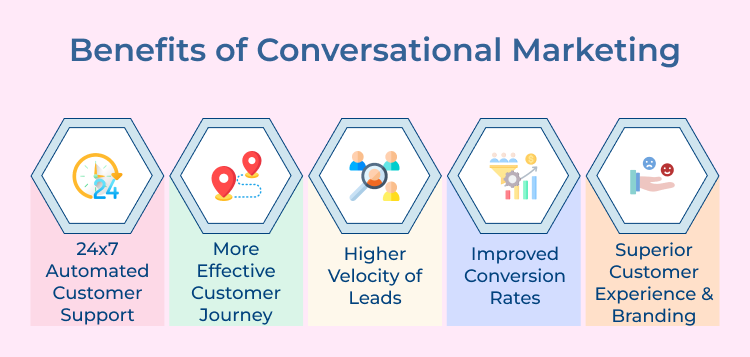
1. All around the clock support
Conversational marketing uses chatbots and AI to provide real-time conversations with customers, even outside of regular business hours. Customers appreciate getting help when they need it and the 24×7 availability leads to greater customer satisfaction.
2. Simplified Customer Journey
Thanks to customer data and AI-powered chatbots, customers get a more streamlined and personalized customer journey. Conversational marketing allows you to create tailored journeys for individual customers, rather than a one-size-fits-all approach.
3. Higher Velocity of Leads
Conversational marketing used its real-time approach to drive leads more quickly than traditional methods. Chatbots gather information from customers and schedule appointments, demos, or consultations in real-time, leading to a faster sales cycle.
4. Improved Conversion Rates
Get instant answers to customer queries, personalize offerings and a seamless purchase process using a conversational marketing platform. It enhances the customer experience and makes it more likely that customers will convert.
5. Superior CX & Branding
Businesses that put a customer-first attitude in their marketing strategy often see positive benefits. It increases customer satisfaction, improves word-of-mouth referrals and a reputation for being innovative.
Customers these days want an open form content where they can easily access and decide if they want to go ahead with a purchase. Especially when it comes to tech, 81% of buyers encountering gated content simply prefer not to buy it!
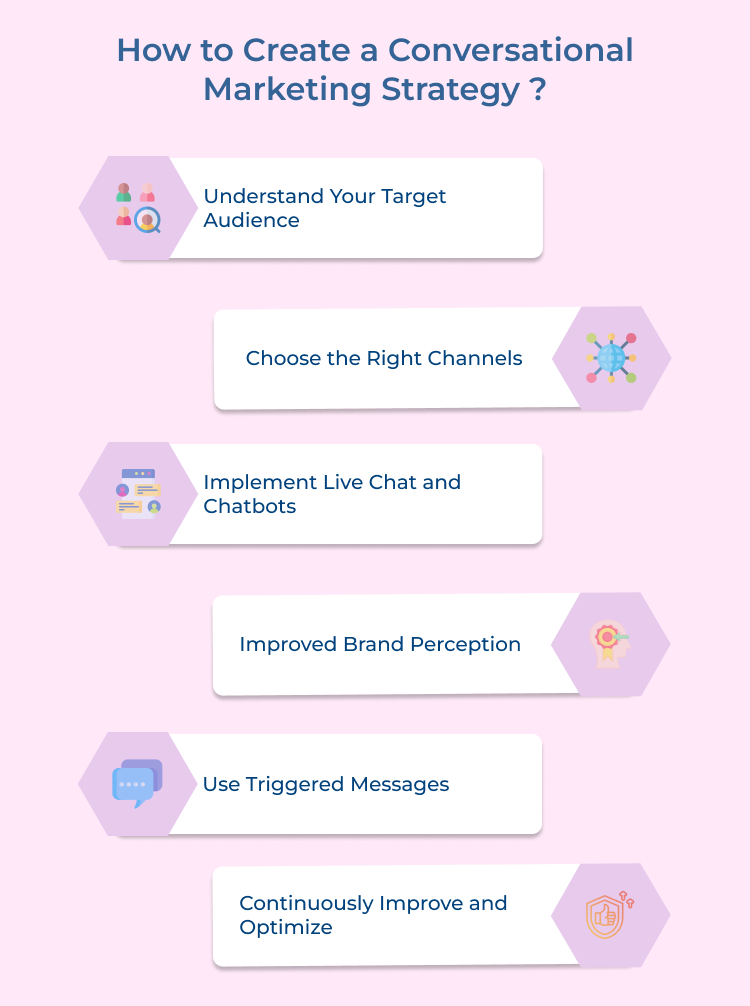
Before you effectively engage in conversations with your audience, you need to understand who they are. Conduct market research to identify your ideal customers and their preferences. Dive deep into their demographics, interests, pain points, communication preferences, etc. The information will help you tailor your conversations to resonate with your audience.
Consider these tips:
Conversational marketing can take place on every channel a customer is willing to communicate. It includes social media platforms, live chat on your website, chatbots, messaging apps and email. Determine where your target audience spends the most time and which channels align with your brand’s personality / voice. Focus your efforts on those channels to maximize your impact.
Consider these tips:
Live chat allows you to engage with website visitors in real-time, answering their questions as well as providing assistance. Chatbots, on the other hand, handle simple queries and automate basic interactions, freeing up your team to focus on more complex conversations. Make sure these tools are seamlessly integrated into your website and provide a smooth experience for users.
Consider these tips:
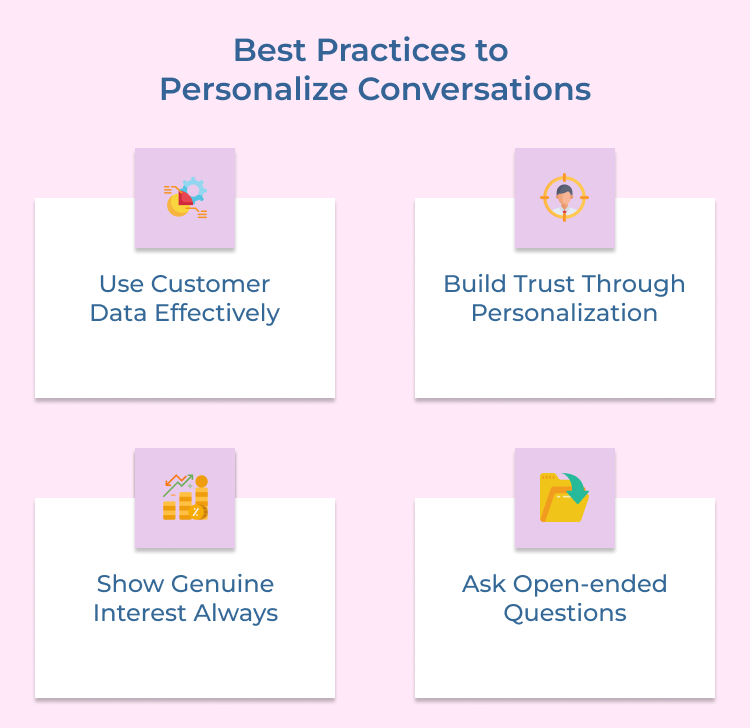
One of the main benefits of conversational marketing is the ability to provide personalized experiences. Address customers by their names, reference previous interactions and recommend products or services based on their preferences. The level of personalization shows that you value your customers, building their trust and loyalty.
Consider these tips:
Triggered messages are automated messages that are sent based on specific actions or behaviors. For example, if a customer abandons their shopping cart, you send a message to remind them and offer a discount. These messages guide customers through their journey and nudge them towards conversion. Implement triggered messages strategically to enhance the conversational experience.
Consider these tips:
Like any marketing strategy, conversational marketing requires continuous improvement and optimization. Analyze data and metrics to measure the success of your conversations. Monitor response rates, customer satisfaction, conversion rates and other relevant indicators. Use the information to identify areas for improvement and make necessary adjustments to enhance your strategy over time.
Consider these tips:
Technology’s evolution has birthed traditional and conversational marketing—two distinct strategies promoting products through contrasting customer interaction approaches.
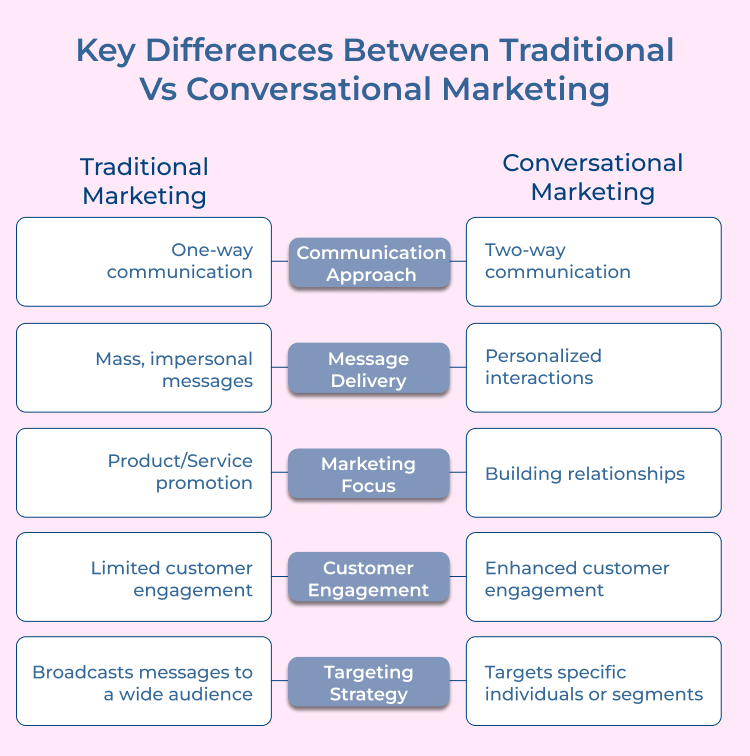
Traditional Marketing: Relying heavily on one-way communication, it typically involves pushing the message out to the masses through various channels such as TV, radio, print media and billboards. The communication is impersonal and lacks interaction with the audience.
Conversational Marketing: The focus here is on two-way communication. It aims to have meaningful conversations with individual customers. It leverages various channels like social media, live chat, chatbots and messaging apps to engage in real-time conversations.
Traditional Marketing: In traditional marketing, the messages are often generic and meant to reach a wide audience. Marketers have limited control over who sees their messages, as they are broadcasted to a broad demographic. The focus is on catching the attention of as many people as possible.
Conversational Marketing: It allows for personalized and targeted message delivery. Businesses get to tailor messages specific to the customers needs after engaging with customers enough. The personalized approach increases the chance of capturing the audience’s attention and building stronger connections.
Traditional Marketing: Mainly focuses on promoting products or services. The goal is to generate brand awareness, drive sales and increase market share. The emphasis is on selling, with less emphasis on building customer relationships.
Conversational Marketing: Conversational marketing puts a strong emphasis on building relationships with customers. The goal is to engage in meaningful conversations that address customer’s concerns and preferences.
Traditional Marketing: Traditional marketing is designed to capture attention briefly and prompt immediate action, such as making a purchase. Once the transaction is complete, the interaction generally ends and the customer may not feel a strong connection to the brand.
Conversational Marketing: Conversational marketing aims to create an active and ongoing engagement with customers. Meaningful conversations and continual engagement deepens the relationship with customers, leading to long-term loyalty as well as advocacy.
Traditional Marketing: Traditional marketing often relies on demographic targeting, where messages are delivered to a broad audience based on age, gender, location and other general characteristics. While the approach can be effective, it may result in reaching people who are not interested in the products being promoted.
Conversational Marketing: Conversational marketing allows for more precise targeting. By engaging and gathering customer data, businesses tailor their marketing efforts to specific individuals. The targeted approach ensures that messages reach the right audience, increasing the chances of conversion and customer satisfaction.
Conversational marketing enables businesses to engage customers interactively via real-time tools, answering queries, providing support and boosting sales.
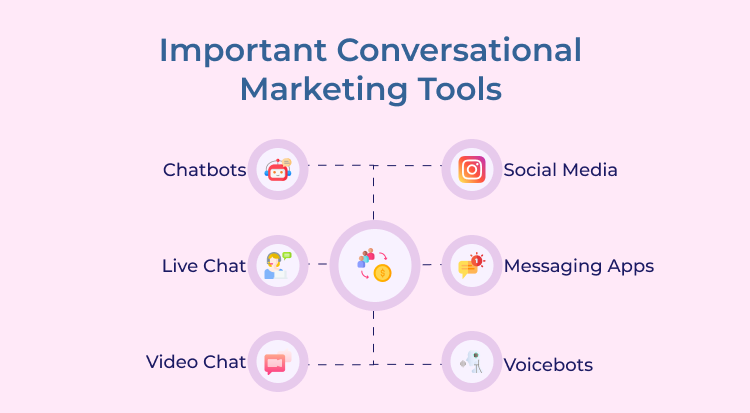
Chatbots are the most common form of conversational marketing tools you see everyday. They’re automated AI-powered tools that communicate with customers through text or voice. Chatbots provide assistance to customers in a personalized manner, saving time and resources for businesses.
Live chat allows businesses to connect with customers while providing instant assistance. Live chat is usually available on a website or app. Customers can type their queries and an agent will respond immediately. Live chat is an effective way to provide personalized customer service, and it also helps businesses build stronger relationships with their customers.
Video chat is an excellent tool for businesses that want to provide a more personal touch to their customer service. The tool allows customers to have real-time conversations with their representatives. Video chat is beneficial for customers who need help with complex issues or those who prefer a face-to-face interaction.
Social media platforms such as Facebook and Twitter are great conversational marketing tools for businesses. Customers can interact with businesses through social media, ask questions and give feedback. It is essential for businesses to be active on social media platforms and provide timely responses to customer queries.
Messaging apps such as WhatsApp and Facebook Messenger have become more popular for business-to-customer communication. Businesses respond to customer queries instantly using messaging apps and it also serves as a platform for businesses to send targeted promotions to customers.
Voicebots are similar to chatbots, but they use voice recognition technology to communicate with customers. Voicebots can be integrated with smart speakers such as Amazon Echo or Google Home to provide instant responses to customer queries. They can also be used for simple transactions such as changing a booking or placing an order.
While the concept of conversational marketing may seem abstract, there are plenty of real-life examples that showcase its effectiveness.
Amtrak, the national railway service in the United States, has embraced conversational marketing through their “Julie” chatbot. Julie allows customers to ask questions, receive immediate responses and make train reservations through Facebook Messenger. The chatbot even sends real-time updates about delays or changes in the schedule, making it a valuable tool for Amtrak passengers.
Domino’s Pizza embraced conversational marketing by introducing their chatbot named “Dom” on various messaging platforms. Customers can order pizza by simply engaging in a conversation with the chatbot, which simulates a human-like interaction. Dom asks questions to customize the order and provides real-time updates on the delivery status. By integrating conversational marketing, Domino’s Pizza simplifies the ordering process and creates a delightful customer experience.
1-800-Flowers, an online florist, uses conversational marketing to simplify the ordering process and enhance customer satisfaction. They have integrated their ordering system with popular messaging platforms, such as Facebook Messenger, Amazon Alexa and Google Assistant. Customers can now interact with the chatbot, seeking advice for gift ideas, tracking deliveries, and making purchases seamlessly within the conversation.
Conversational marketing might not be the ultimate tool but adding it to your business will enhance customer experience and achieve better results. By providing instant and personalized interactions, businesses deliver exceptional customer experiences that build loyalty.
What I find is, leveraging conversational marketing helps brands meet the growing expectations of customers. Implementing chatbots, live chat and continuous optimization are key steps to ensure exceptional CX. Remember, customers crave personalized and instant interactions – it’s up to businesses to fulfill these expectations as well as build meaningful connections with their audience.

Why is conversational marketing important?
Conversational marketing is important because it allows businesses to build more meaningful relationships with their customers. By engaging in real-time conversations with personalized experiences, businesses provide the information as well as support that customers need, leading to higher customer satisfaction and increased conversions. Conversational marketing also helps businesses gather valuable insights about their audience and their preferences.
How do you do Conversational Marketing?
Conversational marketing can be implemented through various channels such as live chat, chatbots, social media messaging and even voice assistants. To get started, you need to identify the platforms your target audience is most active on and choose the best tools to enable conversations. It is important to have well-trained staff or chatbots that can effectively manage conversations and provide relevant responses to customer queries or concerns.
How do you measure the effectiveness of conversational marketing ?
Measuring the effectiveness of conversational marketing can be done through several key metrics. These include response time, customer satisfaction ratings, conversion rates and the number of meaningful interactions. Monitoring these metrics allows businesses to assess the performance of their conversational marketing efforts and identify areas for improvement.
How do you scale Conversational Marketing?
Scaling conversational marketing requires the use of automation tools such as chatbots or AI-powered assistants. These tools can handle a large volume of conversations simultaneously, ensuring that customers receive quick and accurate responses. Businesses can leverage customer data to personalize conversations and provide tailored experiences at scale. It is important to regularly analyze and optimize conversational marketing strategies to ensure scalability.
 https://omni24.io/wp-content/uploads/2026/08/AI-Customer-Service-Agents.png
1256
2400
Webvision Solution
https://omni24.io/wp-content/uploads/2023/04/Omni-Logo-1.svg
Webvision Solution2026-09-21 04:48:512026-09-21 04:48:51How to Build an AI Customer Service Agents: 8 Key Steps
https://omni24.io/wp-content/uploads/2026/08/AI-Customer-Service-Agents.png
1256
2400
Webvision Solution
https://omni24.io/wp-content/uploads/2023/04/Omni-Logo-1.svg
Webvision Solution2026-09-21 04:48:512026-09-21 04:48:51How to Build an AI Customer Service Agents: 8 Key Steps https://omni24.io/wp-content/uploads/2026/08/Omnichannel-Conversational-AI.png
1256
2400
Tushar Joshi
https://omni24.io/wp-content/uploads/2023/04/Omni-Logo-1.svg
Tushar Joshi2026-09-16 03:51:072026-09-16 03:51:07How to Build Omnichannel Conversational AI Strategy
https://omni24.io/wp-content/uploads/2026/08/Omnichannel-Conversational-AI.png
1256
2400
Tushar Joshi
https://omni24.io/wp-content/uploads/2023/04/Omni-Logo-1.svg
Tushar Joshi2026-09-16 03:51:072026-09-16 03:51:07How to Build Omnichannel Conversational AI Strategy https://omni24.io/wp-content/uploads/2026/08/Customer-Service-Teams.png
1256
2400
Tushar Joshi
https://omni24.io/wp-content/uploads/2023/04/Omni-Logo-1.svg
Tushar Joshi2026-09-15 04:01:522026-09-15 04:02:16How to Build Customer Service Teams: 6 Key Steps
https://omni24.io/wp-content/uploads/2026/08/Customer-Service-Teams.png
1256
2400
Tushar Joshi
https://omni24.io/wp-content/uploads/2023/04/Omni-Logo-1.svg
Tushar Joshi2026-09-15 04:01:522026-09-15 04:02:16How to Build Customer Service Teams: 6 Key Steps
Whether it’s about acquire, engage or support – Omni24 covers all your customer engagement needs in one complete platform.

Copyright ©2026 Veemo All rights reserved.
CA, Los Angeles, Hall Ave, 19011