How to Develop a Knowledge Management Strategy: 7 Key Steps
A knowledge management strategy preserves expertise, boosts efficiency, drives innovation and creates a competitive edge.

A knowledge management strategy preserves expertise, boosts efficiency, drives innovation and creates a competitive edge.
Staying ahead in the fast-paced world is all about how efficiently we can tap into our collective wisdom. Modern businesses are better equipped to provide instant solutions by leveraging a well-crafted knowledge management strategy.
39% of organizations report better execution in terms of faster decisions, improved time-to-market with a unified KM strategy.
Having a knowledge management strategy in action can act as the secret sauce that transforms scattered information into a powerhouse of insights.
Explore best practices for creating a knowledge management strategy that works effectively for your business. Get ready to transform information overload into a streamlined superpower.
The definition of a knowledge management strategy is that it is a comprehensive plan that outlines how an organization will create, capture, organize, share and leverage its collective knowledge. It includes the processes or tools designed to maximize the value of an organization’s intellectual assets.
A well-planned KM strategy aims to improve decision-making, encourage innovation, enhance productivity and maintain a competitive advantage by ensuring that the right information is available at the right time. It involves identifying critical knowledge areas and creating a culture that encourages continuous learning and knowledge sharing across all levels of the organization.
Key objectives:
A successful knowledge management strategy hinges on core components that encourage effective information sharing, collaboration and organizational learning to drive innovation.
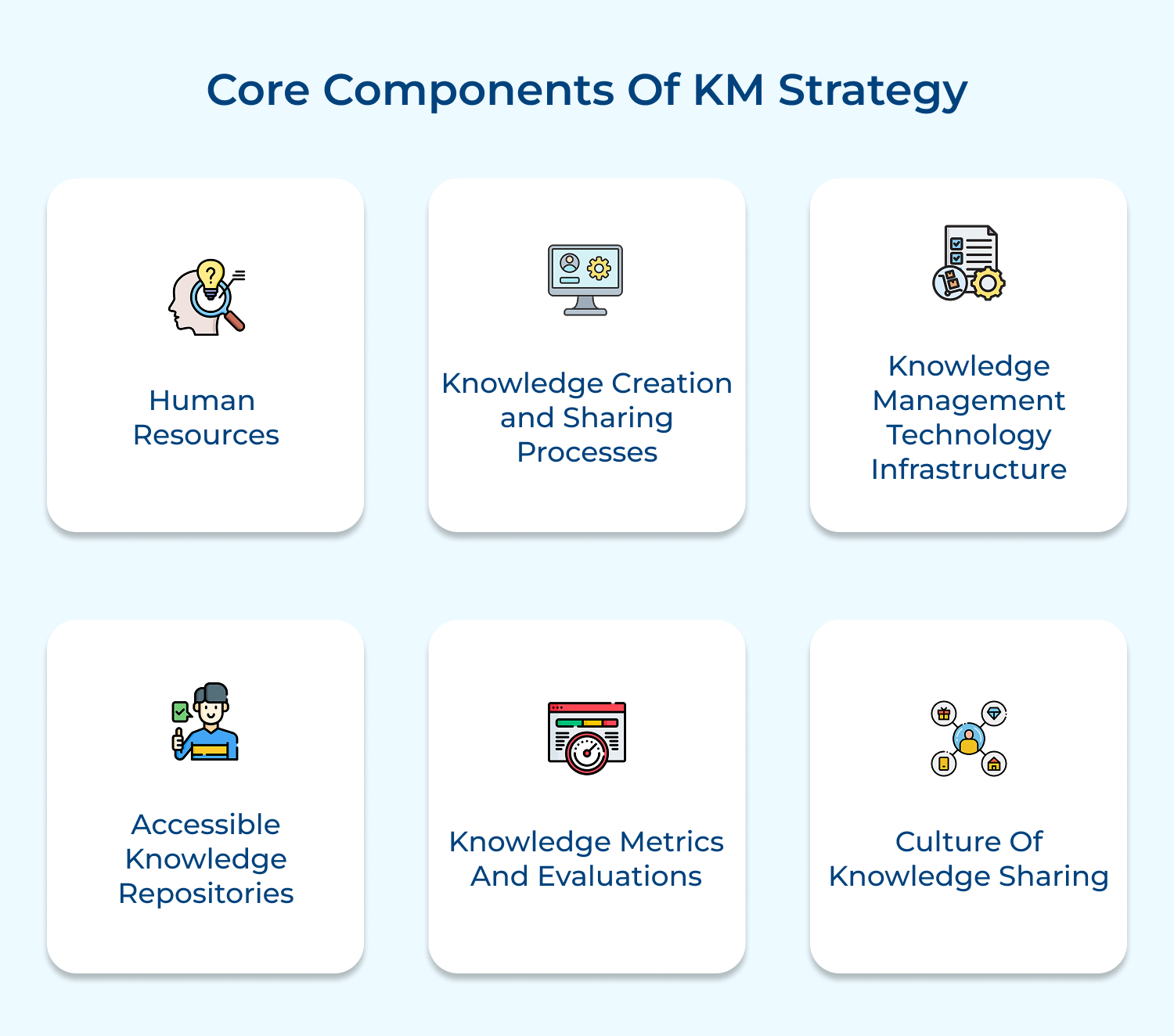
Human resources are vital for a successful knowledge management strategy. Recruiting skilled professionals who are adept at managing and sharing knowledge ensures an effective implementation.
Training and development programs further enhance employees’ capabilities, empowering them to contribute valuable insights. Also, engage with knowledge management practices effectively.
Pro tips:
Knowledge creation and sharing processes involve structured methods for generating new insights and disseminating them across the organization.
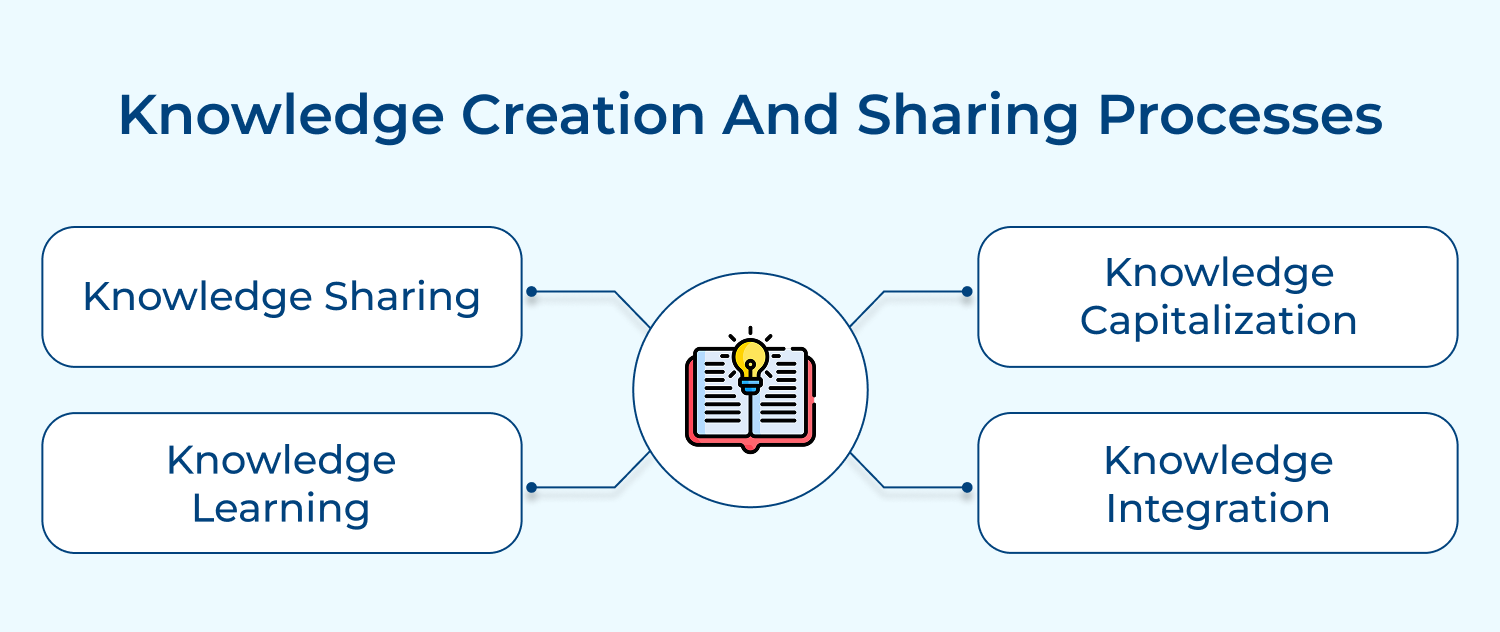
Implementing clear processes for capturing, documenting and sharing knowledge ensures that valuable information is systematically developed and readily available, encouraging innovation and informed decision-making.
Tips:
Knowledge management technology infrastructure includes the software and systems that support knowledge-related activities. The infrastructure should offer reliable, scalable solutions for storing, retrieving and managing knowledge.
Effective technology infrastructure facilitates seamless access to information, enhances collaboration and integrates with other organizational systems to support knowledge management efforts.
Best practices:
Accessible knowledge repositories are centralized systems that store and organize information for easy retrieval. These repositories should feature intuitive interfaces, advanced search capabilities and user-friendly navigation.
By ensuring that knowledge is readily available, organizations can improve efficiency, support decision-making and ensure that employees have quick access to relevant resources.
Pro tips:
Knowledge metrics and evaluations measure the effectiveness and impact of knowledge management activities. Key performance indicators such as usage statistics, employee feedback and business outcomes help assess the success of knowledge initiatives.
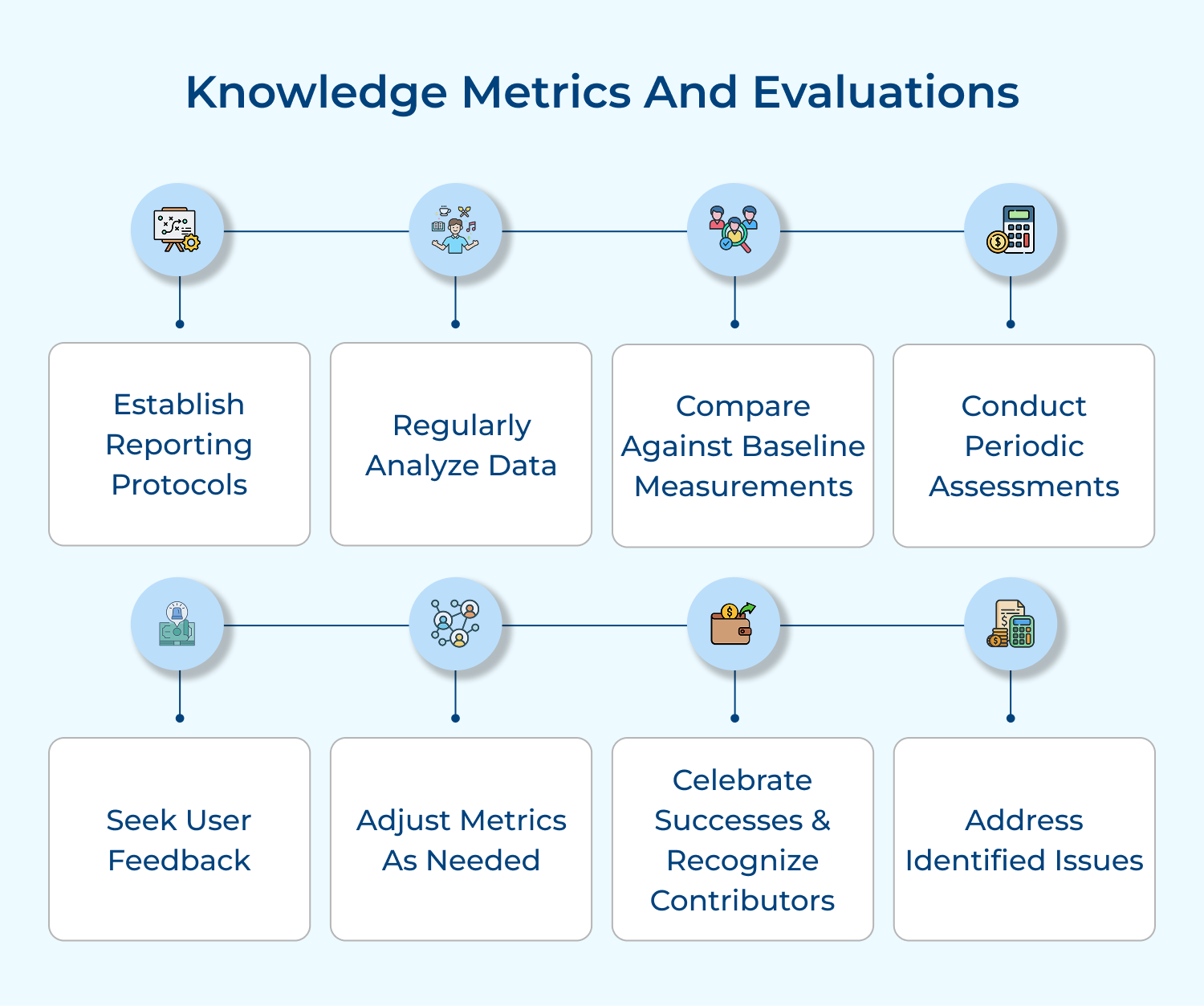
Regular evaluation ensures that strategies remain aligned with goals and facilitates continuous improvement by identifying areas for enhancement.
Pro Tips:
A culture of knowledge sharing promotes an environment where employees actively exchange information and collaborate.
Encouraging openness, trust and recognition helps break down silos and encourages a collaborative atmosphere. By embedding knowledge sharing into organizational values, organizations enhance collective learning, innovation and overall performance.
Best practices:
Knowledge management strategies come in various forms, each tailored to address specific organizational needs and goals. Here’s an overview of key types:
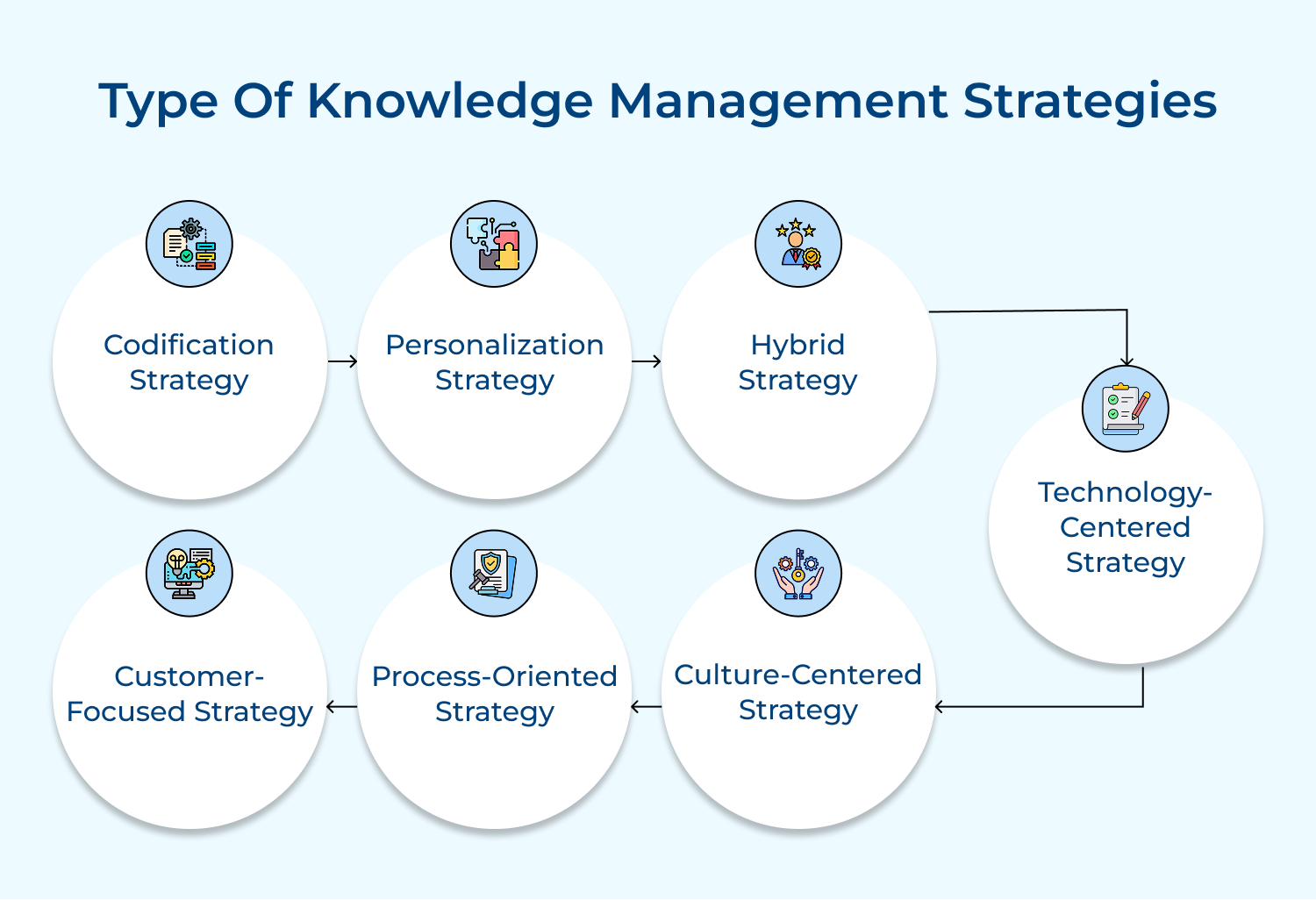
1. Codification strategy: The approach focuses on systematically capturing, storing and organizing explicit knowledge in a central repository. It involves creating detailed documentation, best practices guides and databases that employees can easily access.
Codification is particularly effective for organizations dealing with routine processes. It enables quick retrieval of knowledge, reduces duplication of efforts and ensures consistency in practices across the organization.
2. Personalization strategy: The strategy emphasizes person-to-person knowledge sharing, focusing on tacit knowledge transfer through direct interaction. It encourages networking, mentoring and collaborative problem-solving.
Personalization is ideal for companies dealing with unique, complex problems that require creative solutions. It encourages innovation and builds strong interpersonal relationships, but can be time-consuming and challenging to scale.
3. Hybrid strategy: The hybrid approach combines elements of both codification and personalization strategies. Organizations using a hybrid strategy implement systems to capture and store critical information while encouraging a culture of personal interaction and knowledge sharing.
The balanced approach allows for flexibility, catering to different types of knowledge and diverse organizational needs. It’s particularly effective for large, complex organizations with varied knowledge requirements across different departments or projects.
4. Technology-centered strategy: The strategy revolves around leveraging advanced technological solutions to manage knowledge. It involves implementing sophisticated knowledge management systems, artificial intelligence, data analytics and collaborative platforms.
The focus is on using technology to automate knowledge capture, improve access and enhance knowledge sharing. While this approach can significantly boost productivity and enable data-driven decision-making, it requires substantial investment in IT infrastructure and ongoing technical support.
5. Culture-centered strategy: The culture-centric approach prioritizes building an organizational culture that values and encourages knowledge sharing. It focuses on creating an environment where employees are motivated to share their expertise, learn from others and contribute to the collective knowledge base.
The strategy often involves implementing reward systems for knowledge sharing, encouraging open communication and promoting a learning mindset. While it can lead to sustainable knowledge management practices, it requires long-term commitment.
6. Process-oriented strategy: The strategy integrates knowledge management into core business processes. It involves mapping out key organizational processes and identifying critical knowledge points within these workflows.
The approach can lead to significant improvements in efficiency and decision-making quality. It requires a deep understanding of business processes and may necessitate process reengineering.
7. Customer-focused strategy: The customer-focused approach centers on capturing, managing and leveraging customer-related knowledge. It involves systematically collecting customer feedback, preferences and behavior patterns and using this information to improve products, services and customer experiences.
The strategy often employs CRM systems, customer analytics and feedback mechanisms. It can lead to enhanced customer satisfaction and loyalty but requires robust data management and analytics capabilities.
A solid knowledge management strategy is vital for organizations to enhance collaboration and drive innovation. Here are steps to develop an effective knowledge management strategy.
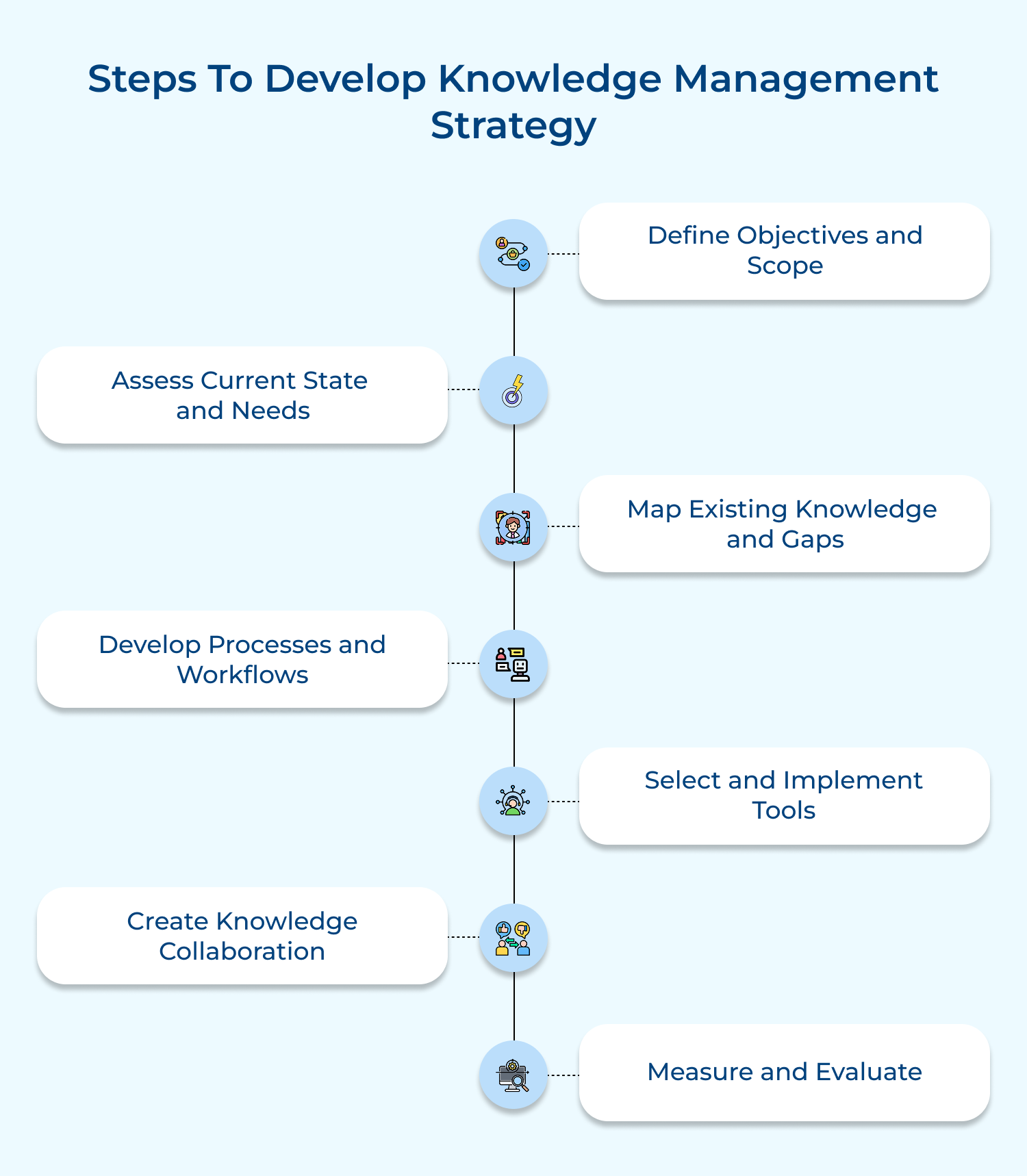
Clearly articulate the goals of knowledge management strategy and determine its boundaries.
It involves identifying what types of knowledge are crucial for the organization, which departments or teams will be involved and what outcomes are expected to be achieved. A well-defined scope helps focus efforts and resources on the most important areas.
Tips to follow:
Evaluate the organization’s existing knowledge management practices, tools and resources.
Identify strengths, weaknesses and areas for improvement. Conduct a thorough needs analysis to understand what knowledge is critical for different roles and departments and what challenges employees face in accessing or sharing information.
Tips to follow:
Create a comprehensive inventory of the organization’s knowledge assets, including tacit and explicit knowledge.
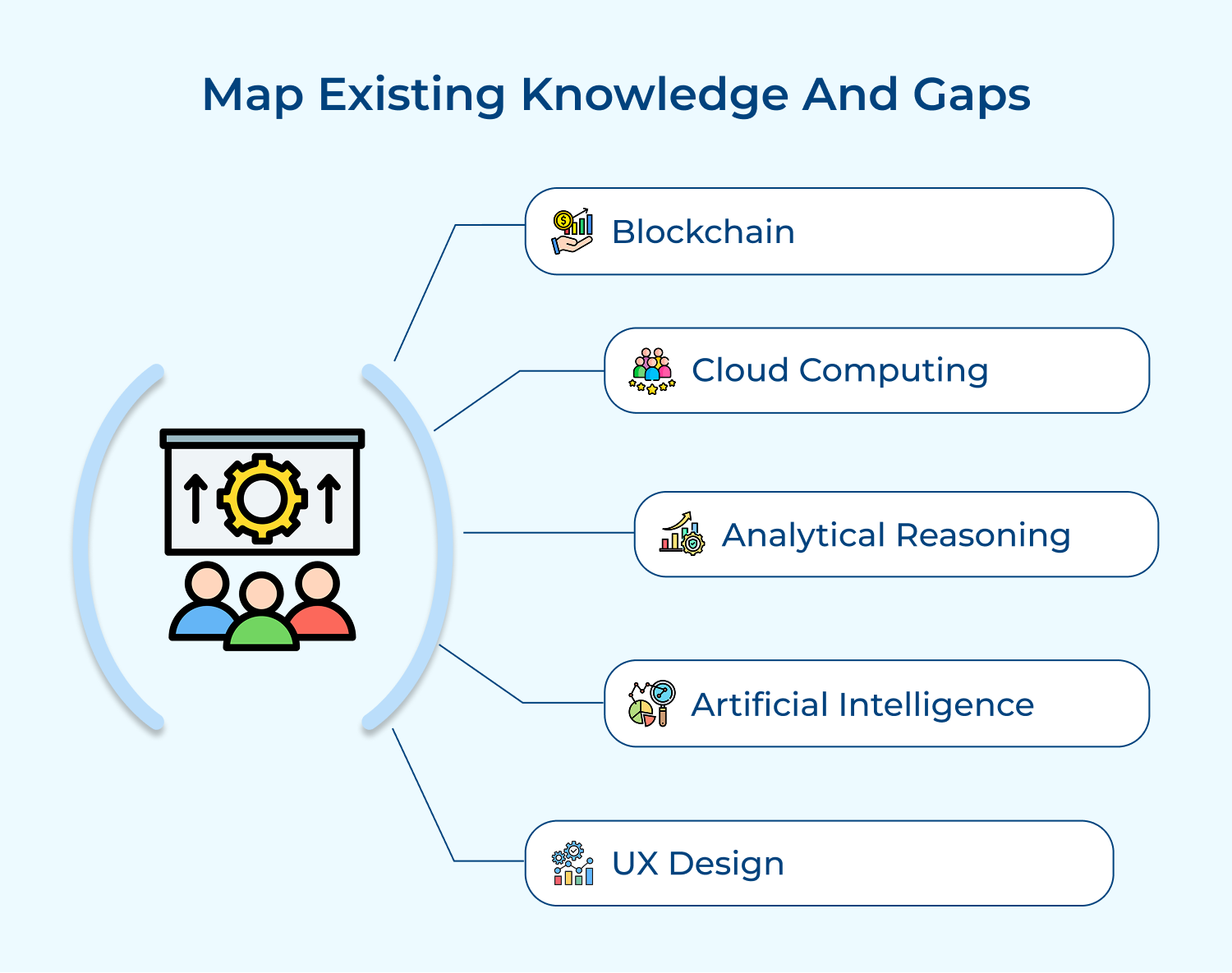
Identify where critical knowledge resides, who possesses it and how it’s currently shared. Pinpoint knowledge gaps that need to be addressed to support business objectives and improve overall performance.
Tips to follow:
Design efficient processes for capturing, organizing, storing and sharing knowledge throughout the organization.
Establish clear workflows for knowledge creation, validation and dissemination. Ensure these processes are integrated into existing work practices to promote adoption and minimize disruption to daily operations.
Tips to follow:
Choose appropriate technology solutions to support knowledge management strategy. It may include document management systems, collaboration platforms, intranets or specialized knowledge management software.
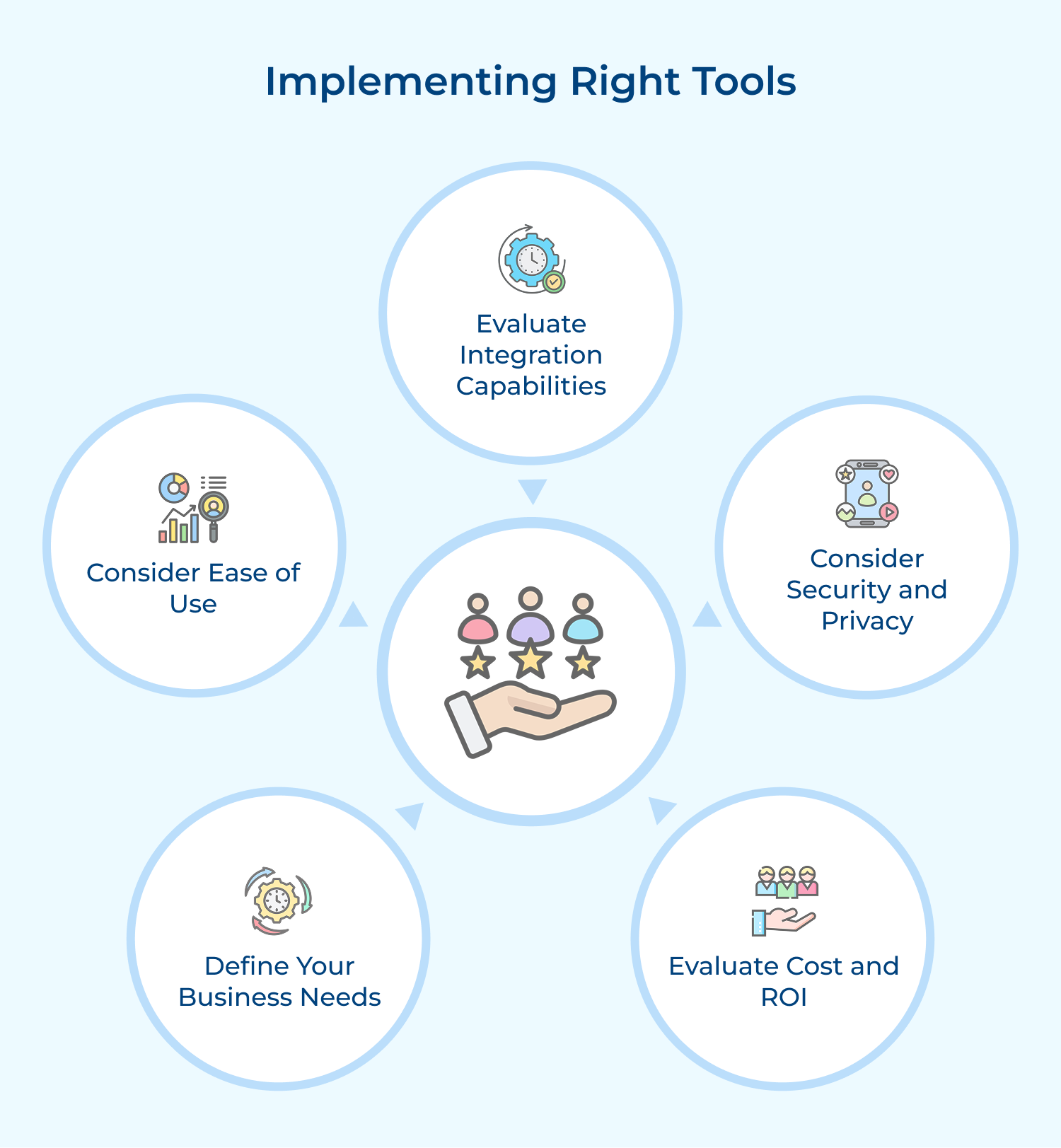
Ensure the selected tools are user-friendly, integrate well with existing systems and meet the specific needs of the organization.
Tips to follow:
Always create an environment that encourages and rewards knowledge sharing and collaboration.
It involves addressing cultural barriers, incentivizing knowledge contributions and demonstrating the value of knowledge sharing at all levels of the organization. Leadership support and role modeling are crucial for driving this cultural shift.
Tips to follow:
Establish key performance indicators (KPIs) to track the progress and impact of the knowledge management strategy. Regularly assess the effectiveness of initiatives, tools and processes.
Use these insights to make data-driven improvements and demonstrate the value of knowledge management to stakeholders.
Tips to follow:
Implementing a knowledge management strategy offers numerous advantages for organizational growth. Here are the key benefits of developing a comprehensive KM approach:
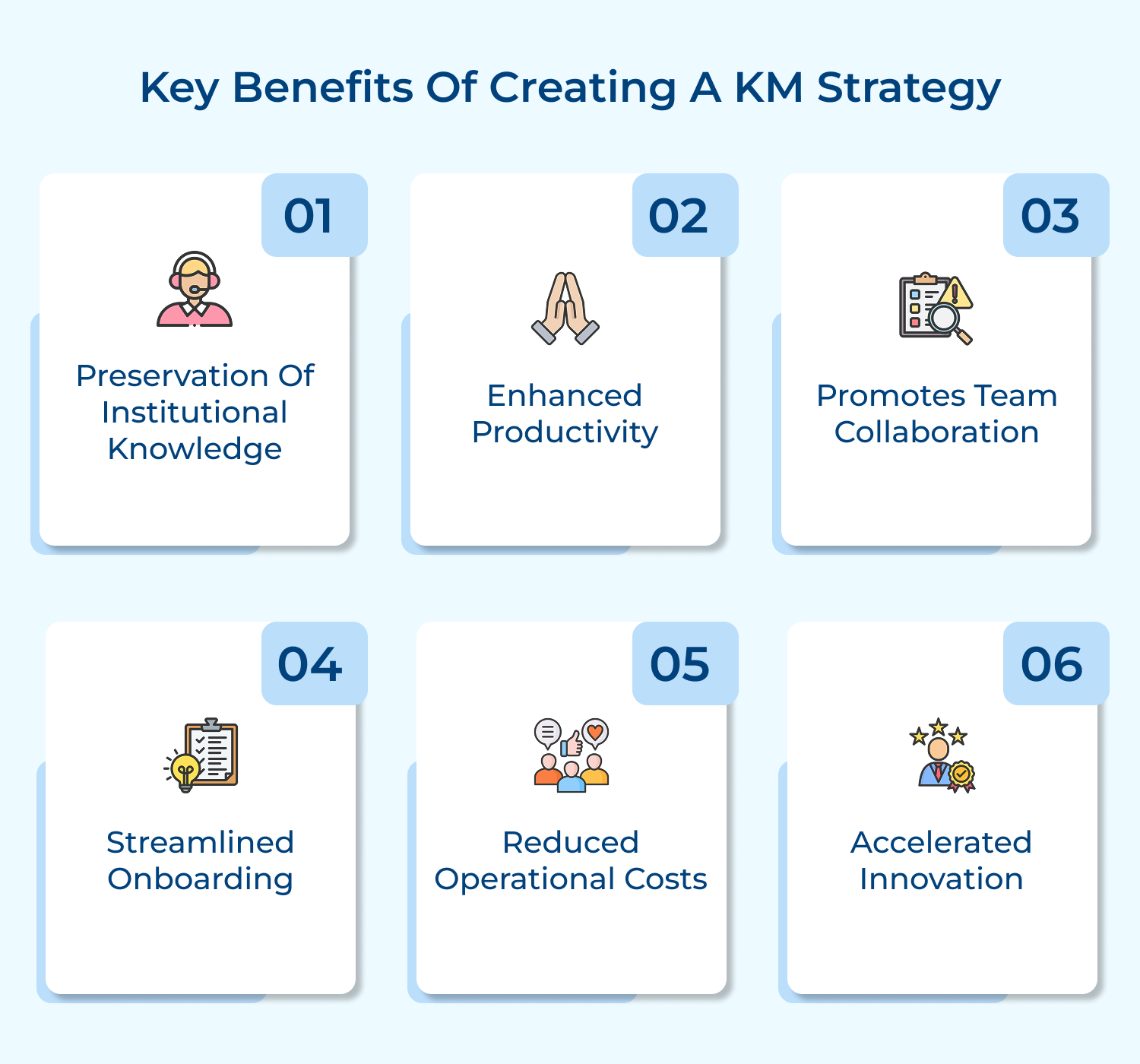
Applying best practices to knowledge management strategies enhances their effectiveness and aligns them with organizational objectives, ensuring that knowledge assets are utilized optimally.
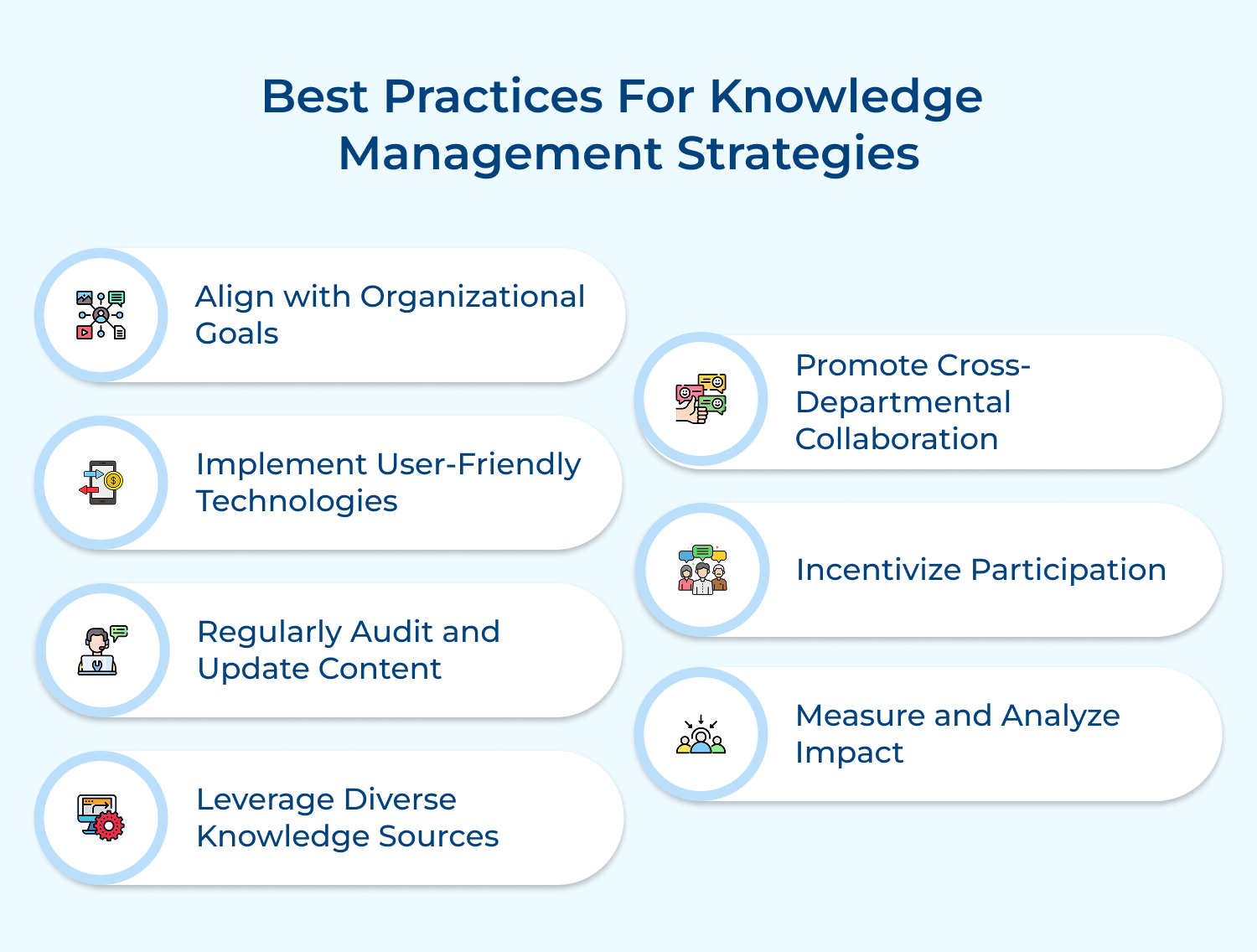
1. Align with organizational goals: Aligning knowledge management with organizational goals ensures that knowledge initiatives directly support strategic objectives. This alignment integrates knowledge assets into key business processes, making them relevant and actionable. By focusing on strategic priorities, organizations can optimize knowledge management efforts to drive growth, efficiency and competitive advantage.
2. Implement user-friendly technologies: User-friendly technologies simplify access and interaction with knowledge management systems. Intuitive interfaces and easy-to-navigate tools encourage employees to engage with and utilize knowledge resources effectively. By reducing technical barriers, organizations can ensure higher adoption rates and better utilization of knowledge assets, enhancing overall productivity and information sharing.
3. Regularly audit and update content: Regular audits and updates of knowledge content maintain its accuracy and relevance. Periodically reviewing and refreshing information ensures that it reflects current practices and insights. The practice helps prevent the dissemination of outdated or incorrect knowledge, ensuring that employees have access to reliable and up-to-date resources for informed decision-making.
4. Leverage diverse knowledge sources: Leveraging diverse knowledge sources enriches the organization’s knowledge base by incorporating various perspectives and expertise. It includes integrating internal insights from different departments and external information from industry experts. A diverse knowledge base enhances problem-solving, drives innovation and addresses complex challenges by offering a broader range of solutions.
5. Promote cross-departmental collaboration: Promoting cross-departmental collaboration encourages knowledge sharing across different organizational areas. Encouraging joint projects and interactions between departments breaks down information silos and enhances the flow of insights. The collaborative approach improves problem-solving, leverages diverse expertise and creates a more cohesive organization with shared knowledge and objectives.
6. Incentivize participation: Incentivizing participation in knowledge management activities motivates employees to actively contribute to knowledge-sharing initiatives. Offering rewards, recognition and other incentives encourages consistent involvement and enhances the overall effectiveness of knowledge management efforts.
7. Measure and analyze impact: Analyzing the impact of knowledge management strategies provides insights into their effectiveness. Key metrics, such as user engagement, content utilization and business outcomes, help evaluate performance and identify areas for improvement. Regular analysis ensures that knowledge management initiatives remain aligned with organizational goals.
Knowledge management strategies are essential for organizations to harness, share and optimize information effectively. Here are key examples to consider.
1. NASA’s Lessons Learned Information System (LLIS)
NASA developed the LLIS to capture and share knowledge gained from past missions and projects. The comprehensive database allows engineers and scientists to access valuable insights, avoiding past mistakes and building on successes.
The LLIS includes detailed reports, best practices and recommendations from various space missions. The system has been crucial in maintaining NASA’s expertise, improving safety and enhancing the efficiency of space exploration endeavors.
2. World Bank’s Communities of Practice
The World Bank established numerous Communities of Practice (CoPs) to connect experts across different countries and sectors. These virtual and physical networks enable knowledge sharing on topics like poverty reduction and sustainable development.
Members collaborate, share experiences and develop best practices. The CoPs have become a cornerstone of the World Bank’s knowledge management strategy, facilitating cross-cultural learning and improving the effectiveness of development projects worldwide.
3. Toyota’s Quality Circles
Toyota implemented Quality Circles as part of its renowned Production System. These are small groups of employees who meet regularly to discuss work-related problems and propose solutions.
The grassroots approach to knowledge management encourages continuous improvement and innovation at all levels of the organization. By tapping into the collective wisdom of its workforce, Toyota has maintained its position as a leader in manufacturing quality and efficiency.
4. Siemens’ ShareNet
Siemens developed ShareNet, a global knowledge sharing platform connecting sales and marketing professionals across the company. The system allows employees to share successful sales strategies, customer insights and market trends.
By leveraging this collective knowledge, Siemens has improved its ability to win contracts and serve customers globally. ShareNet has become a vital tool for encouraging collaboration and disseminating best practices across the organization’s diverse and geographically dispersed workforce.
5. McKinsey & Company’s Knowledge Management System
McKinsey, a global management consulting firm, implemented a comprehensive knowledge management system to capture and disseminate insights from client engagements.
The system includes a vast database of case studies, industry analyses and best practices accessible to consultants worldwide. It ensures that McKinsey’s teams can quickly leverage the firm’s collective expertise to deliver high-quality solutions to clients.
Knowledge management strategies are the bedrock of organizational success in an information-driven world. By harnessing collective wisdom, encouraging a culture of continuous learning and leveraging cutting-edge technologies, businesses can unlock unprecedented potential for innovation and growth. The journey towards effective knowledge management is ongoing, requiring dedication, adaptability and a commitment to collaboration.
As markets evolve and challenges arise, organizations with robust knowledge management practices stand ready to weather storms and seize opportunities. In the end, it’s not just about managing information – it’s about cultivating a dynamic ecosystem where insights flourish, expertise is shared and knowledge becomes the catalyst for transformative change.

Why is a knowledge management strategy important?
A knowledge management strategy is crucial because it helps organizations capture, organize and leverage their collective wisdom. It prevents knowledge loss, enhances decision-making, boosts productivity and encourages innovation. By systematically managing information, companies can improve problem-solving, reduce redundancy and maintain a competitive edge in rapidly evolving markets.
How to successfully develop a knowledge management strategy?
To develop a successful knowledge management strategy, start by assessing current knowledge assets and gaps. Define clear objectives aligned with business goals. Involve key stakeholders and create a culture that values knowledge sharing. Choose appropriate tools and technologies to support strategy. Implement processes for capturing, organizing and disseminating knowledge. Establish metrics to measure success and continuously refine the approach.
How do you draw up a knowledge management strategy for business?
Drawing up a knowledge management strategy involves several steps. Begin by identifying business needs and objectives. Map out existing knowledge resources and processes. Determine key knowledge areas to focus on. Design systems for knowledge capture, storage and sharing. Plan for technology integration and staff training. Create policies to encourage knowledge sharing. Develop a timeline for implementation and establish methods for measuring and evaluating the strategy’s effectiveness.
Why do you need a good knowledge management strategy?
A good knowledge management strategy is essential for maximizing organizational efficiency and innovation. It helps prevent knowledge silos, reduces time wasted on reinventing solutions and ensures critical information is preserved when employees leave. It empowers staff with the right information at the right time, leading to better decision-making and problem-solving. It drives business growth by turning collective knowledge into a strategic asset.
 https://omni24.io/wp-content/uploads/2026/08/AI-Customer-Service-Agents.png
1256
2400
Webvision Solution
https://omni24.io/wp-content/uploads/2023/04/Omni-Logo-1.svg
Webvision Solution2026-09-21 04:48:512026-09-21 04:48:51How to Build an AI Customer Service Agents: 8 Key Steps
https://omni24.io/wp-content/uploads/2026/08/AI-Customer-Service-Agents.png
1256
2400
Webvision Solution
https://omni24.io/wp-content/uploads/2023/04/Omni-Logo-1.svg
Webvision Solution2026-09-21 04:48:512026-09-21 04:48:51How to Build an AI Customer Service Agents: 8 Key Steps https://omni24.io/wp-content/uploads/2026/08/Omnichannel-Conversational-AI.png
1256
2400
Tushar Joshi
https://omni24.io/wp-content/uploads/2023/04/Omni-Logo-1.svg
Tushar Joshi2026-09-16 03:51:072026-09-16 03:51:07How to Build Omnichannel Conversational AI Strategy
https://omni24.io/wp-content/uploads/2026/08/Omnichannel-Conversational-AI.png
1256
2400
Tushar Joshi
https://omni24.io/wp-content/uploads/2023/04/Omni-Logo-1.svg
Tushar Joshi2026-09-16 03:51:072026-09-16 03:51:07How to Build Omnichannel Conversational AI Strategy https://omni24.io/wp-content/uploads/2026/08/Customer-Service-Teams.png
1256
2400
Tushar Joshi
https://omni24.io/wp-content/uploads/2023/04/Omni-Logo-1.svg
Tushar Joshi2026-09-15 04:01:522026-09-15 04:02:16How to Build Customer Service Teams: 6 Key Steps
https://omni24.io/wp-content/uploads/2026/08/Customer-Service-Teams.png
1256
2400
Tushar Joshi
https://omni24.io/wp-content/uploads/2023/04/Omni-Logo-1.svg
Tushar Joshi2026-09-15 04:01:522026-09-15 04:02:16How to Build Customer Service Teams: 6 Key Steps
Whether it’s about acquire, engage or support – Omni24 covers all your customer engagement needs in one complete platform.

Copyright ©2026 Veemo All rights reserved.
CA, Los Angeles, Hall Ave, 19011